
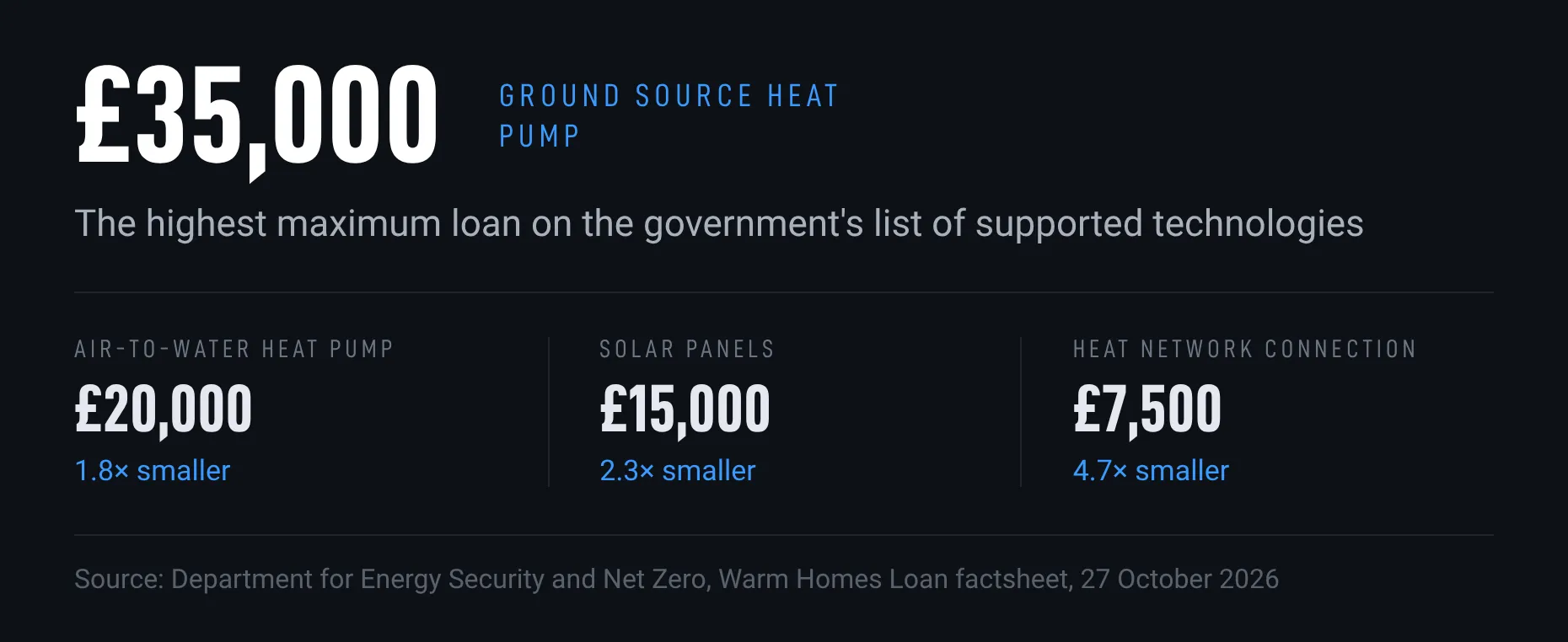
Warm Homes Loan limits top out at £35,000 for a ground source heat pump
The government has set loan ceilings by technology across the UK. Your customer pays the money back, and some lenders will only fund work done by their own partner installers.

Under the Warm Homes Loan, your customer can borrow up to £35,000 for a ground source heat pump, £20,000 for an air-to-water one and £15,000 for solar panels or a battery. The Department for Energy Security and Net Zero published the limits on 27 October 2026. To fit the financed work you need MCS certification, except on heat network connections, and some lenders will only fund jobs done by their own partner installers.
The scheme covers homes in England, Scotland, Wales and Northern Ireland. It adds a borrowing option to the home energy grants and schemes open to your customers: this is money they pay back, though at low or no interest, with no upfront cost and payments spread over many years. On a heat pump, your customer can put the loan alongside a Boiler Upgrade Scheme grant of up to £9,000, the government says. In Scotland, it points to Home Energy Scotland.
Warm Homes Loan ceilings are set by technology
| Technology | Maximum supported loan |
|---|---|
| Solar panels | Up to £15,000 |
| Electrical storage battery | Up to £15,000 |
| Air-to-water heat pump | Up to £20,000 |
| Air-to-air heat pump | Up to £10,000, when MCS certification is available |
| Ground source heat pump | Up to £35,000 |
| Biomass boiler | Up to £20,000 |
| Heat network connection | Up to £7,500 |
| “Micro-renewable system” | Up to £20,000 |
Source: Department for Energy Security and Net Zero factsheet, 27 October 2026.
The ceilings run from £7,500 for a heat network connection to £35,000 for a ground source heat pump, and each one is the largest loan the scheme supports for that technology. The government hasn’t said whether a household can stack two of them, what counts as a “micro-renewable system”, or how much of the rest of your quote sits inside the ceiling.
MCS gets you in, but the lender may pick the installer
Being on the MCS register gets you to the door. The government says MCS certification means recognised technical and consumer-protection standards will be met, the same ground the TrustMark consultation on quality schemes is looking at for registered businesses. Whether you get the job can depend on the lender: some only fund work done by their own partner installers, others let the customer pick any MCS-certified business.
Ten lenders are in the first round: Homeserve (partnering with E.On), Hometree Finance, Propensio, Secure Trust Bank, Selina Finance, South Manchester Credit Union, Sunsave, Tandem Bank, The Money Co-op and This Bank. The government expects more lenders and products to join as the scheme develops.
Your customer applies through a participating lender or installer. The lender runs affordability and credit checks and decides whether the household is eligible, so a quote under the ceiling can still be turned down.
Rates and terms vary from lender to lender
Some loans are interest-free and some can run for up to thirty years. The government describes an “up-to-5 per cent reduction in interest rates” compared with regular loans from banks or high street lenders, but sets no common final rate. It tells customers to look at the total they’ll pay back, monthly fees included, and how long they’ll be paying.
Air-to-air heat pumps are waiting on MCS certification before the £10,000 ceiling applies.
Once a loan is approved, the government tells customers to keep the paperwork. Three of those papers come from you: the quote, the invoice and, where it applies, the MCS certificate.

Trade resources for tradespeople, straight to your inbox.
Occasionally we will send you a newsletter. Free, unsubscribe in one click.
Keep reading

Molson administration: Bristol plant dealer's stock is being sold, Construction Enquirer reports
Construction Enquirer reports administrators now control five Molson companies and are selling off the remaining stock. If you've got plant on order or a deposit paid, the answer has to come from them.
Making Tax Digital deadline: sole traders and landlords send their second update by 7 November
If you're a sole trader or landlord already on Making Tax Digital for Income Tax, your second quarterly update goes to HMRC by Saturday. It's a summary of your income and expenses, and there's nothing to pay when you send it.

Planning permission delays: simple applications skip the committee queue from 31 October
Planning officers, not councillors, will now decide straightforward applications like extensions and loft conversions, MHCLG says. An AI tool for councils is being tested more widely too. A quicker answer isn't promised, and it can still be a no.