
Face to face banking will be protected by law: small businesses included, no start date yet
The government will legislate to protect essential in-person banking, and small businesses are named in the commitment. There's no start date yet, and no list of which services on your business account will count.

Face to face banking is going to get legal protection, and small businesses like yours are named in the government’s commitment. HM Treasury announced on 16 November 2026 that the government will legislate to protect access to essential in-person banking services. What it hasn’t said yet is when, or which business banking counts.
A bank counter you can still reach is part of running the business side of a trade. Lucy Rigby, Economic Secretary to the Treasury, said that “for people and businesses who rely on face-to-face services, being able to speak to someone in person really matters. We will act to protect the access they need.”
Unlike Making Tax Digital for sole traders or the new business rates multiplier and reliefs, this one doesn’t have a start date yet, so there’s nothing to put in the diary.
Which face to face banking services count is still open
The government has accepted the central recommendation of the independent Access to Banking Services Review, chaired by Richard Lloyd OBE. The Treasury’s summary lists two kinds of essential service: day to day banking, centred on opening and managing personal current accounts, and more complex services linked to unplanned life events or circumstances needing tailored support. Nothing in that list mentions a business account, so which of your business banking will be protected is still open. There’s no size test yet either, so nobody can tell you whether a business with a handful of staff or a few dozen is in.
The review was informed by more than 18,000 public responses, alongside evidence from businesses, charities, consumer groups and industry. It found that most people manage fine through remote services, but a minority will keep needing a counter for the foreseeable future. In the Treasury’s summary, declining access to in-person banking has caused “widespread, material and recurring harm”.

Your branch’s future still needs a separate answer
The government will work with the Financial Conduct Authority (FCA), industry, consumer groups and other stakeholders to design the new legal framework. Part of that job is deciding what “reasonable access” means for different essential services. The Treasury says the framework will be carefully targeted and proportionate, and able to respond as more people bank digitally.
HM Treasury cites FCA figures showing that 79.6% of the UK population lived within three miles of a branch of the larger banks and building societies offering personal current accounts in 2025, compared with 87% in 2022.
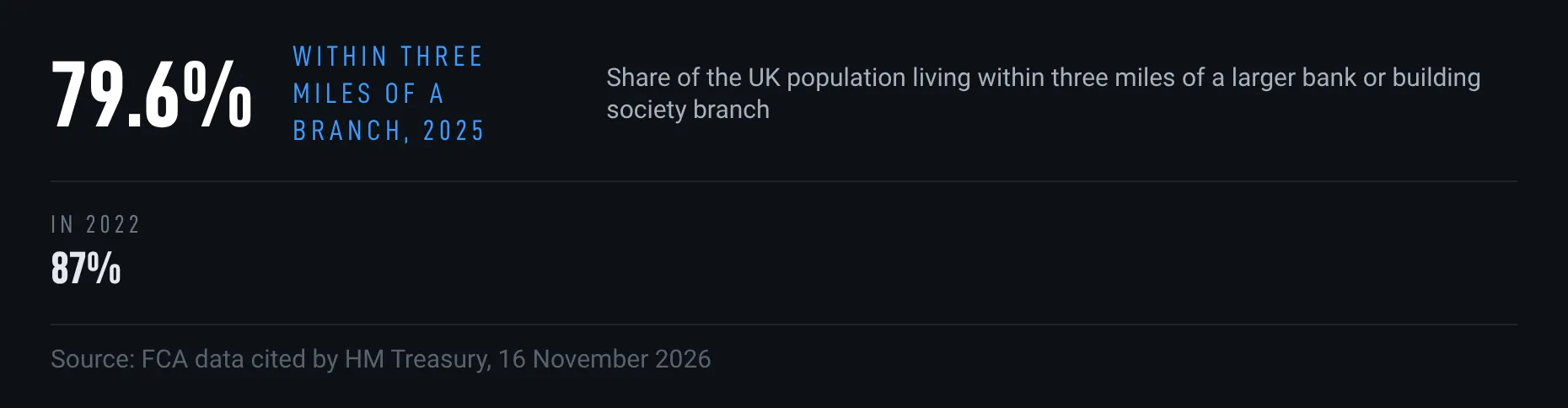
That three-mile figure measures coverage. It isn’t a standard the new law will set, and the announcement names no maximum distance, no opening hours and no branch it will keep open.
Nothing changes on your business account today, and there is nothing to apply for. The answers will come from the definition of “reasonable access” that the Treasury is now working out with the FCA and the banking industry. Until then, the branch on your high street has the same future it had last week.

Trade resources for tradespeople, straight to your inbox.
Occasionally we will send you a newsletter. Free, unsubscribe in one click.
Keep reading
Retrofit framework: NEPO's £500m deal has up to 12 places per specialist lot, Construction Enquirer reports
NEPO's four-year deal replaces its existing retrofit framework, Construction Enquirer reports. Bids close at noon on 18 January 2027, and Construction Enquirer says winners pay NEPO a 1% rebate on the work they get through it.
Self Assessment scam warning: HMRC logs 1,704 reports, and its refund advice doesn't agree
HMRC logged 1,704 Self Assessment scam reports in 12 months, around 900 of them from one fake refund email. Its own pages disagree on refund messages, so check on GOV.UK before you click.

Supply chain opportunities at Epic Campus for contractors turning over £2 million, The Construction Index says
The Construction Index reports that Epic Campus in Long Ashton, North Somerset, wants to hear from local contractors turning over £2 million, with their own workforce and commercial jobs to show for it, before tenders go out.