
Functional competence: CITB asks if your staff's specialist skills should count on paper
A roofer who fits solar panels could get that one skill recognised without a whole new qualification. CITB is asking employers and workers whether it would work, until 15 January 2027.

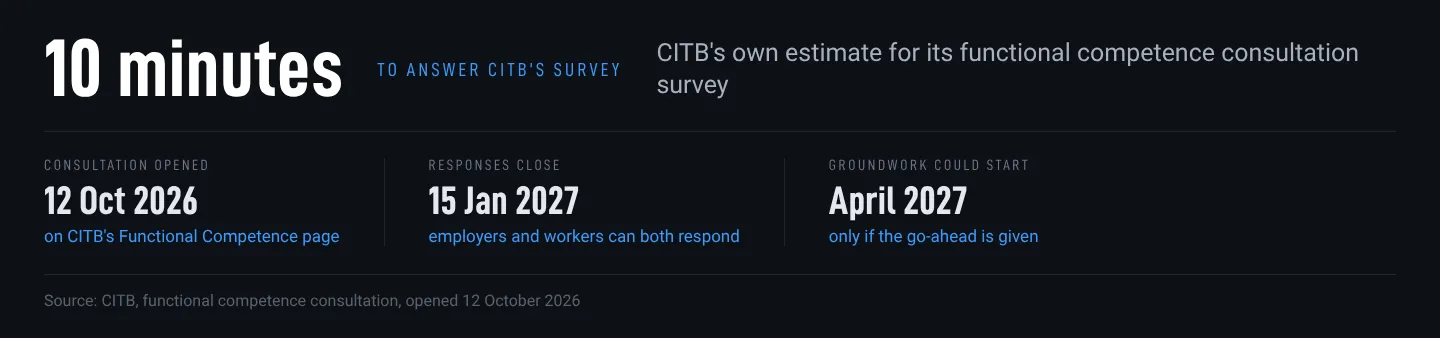
Most businesses have someone who does one job better than anyone, with nothing on paper to show for it. CITB opened a consultation on functional competence on 12 October 2026: a proposed route to recognising that one area of work without a whole new qualification. Responses close on 15 January 2027. It’s a proposal, and you can’t sign anyone up yet.
It isn’t only about hiring and apprentice training. CITB says new entrants and career changers could benefit, and so could people already on your books who move into a related trade or add specialist upskilling to their existing work. Keeping a specific skill up to date when methods change is another proposed use.
CITB links the proposal to changing building methods and technology, and to the greater focus on competence since the Building Safety Act.
Functional competence would recognise one skill, fully assessed
Take CITB’s own example: a roofer who also installs solar panels. Under the proposal, that defined area of work could be assessed and recognised on its own.
The recognition is meant to travel with the worker, from one employer to the next. You could rely on it when hiring. Your own staff could take it with them if they leave.
It would mean full competence within that scope, not partial competence. The work would be grouped into proper, assessable chunks that reflect real jobs, not single tasks.
Someone independent would assess the worker and quality assure the result, to the same standard as full occupational competence. Industry groups would agree the standards, using the relevant Competence Framework.

It would sit alongside NVQs and existing construction apprenticeships, and it wouldn’t automatically come with a skilled or occupational card. Deciding whether someone is right for a particular job, in its particular conditions, stays with you.
You have until 15 January 2027 to respond
CITB estimates its survey takes approximately 10 minutes. You’ll find the survey link on CITB’s Functional Competence consultation page.
Employers can respond, and so can the workers themselves. CITB also invites training providers, awarding bodies and card schemes. It wants to know whether the approach would be useful and practical, and what problems you can see coming.
Some things you would want to know before putting staff forward haven’t been decided. Which other jobs would count, beyond the roofing example, is still open, and the pages say nothing about whether it would ever be compulsory. They don’t set out the evidence a worker would need, who could assess them, or what it would cost, so there’s nothing yet to weigh against government funding for construction training.
After the consultation, CITB will take its findings to the relevant industry leadership forums, which will agree whether and how it goes ahead. If it gets the go-ahead, Competence Framework Working Groups would start working out the requirements trade by trade from April 2027. That’s when the groundwork would start. Nobody has said when the first worker could actually be recognised.
If you’ve got a worker with one specialist skill like that, yours is the case CITB is asking about.

Trade resources for tradespeople, straight to your inbox.
Occasionally we will send you a newsletter. Free, unsubscribe in one click.
Keep reading

Construction bursary scheme: Band of Builders launches BoB Bursary for tools, PPE and workwear
Help with tools, PPE and workwear for people starting out in the trade, Electrical Contracting News reports. Students at three colleges get it first. Amounts, eligibility rules and dates aren't out yet, and nothing says a business can apply for its apprentice.

Right to work subcontractors: the self-employed you bring in can now count as your hire
The Home Office guide now covers individual subcontractors you bring in for a customer's job, and can make you liable for labour another business supplies. What protects you depends on who holds which contract.

Working at height near power lines: painter sentenced after his stepson was electrocuted moving a ladder
Daniel Watton approved ladders throughout an exterior painting job. His trainee stepson died moving a fully extended ladder near an overhead power line, and HSE found the original plan unsafe too.