
Working at height near power lines: painter sentenced after his stepson was electrocuted moving a ladder
Daniel Watton approved ladders throughout an exterior painting job. His trainee stepson died moving a fully extended ladder near an overhead power line, and HSE found the original plan unsafe too.

A painter who approved ladders for the whole of an exterior job has been given a suspended prison sentence after his trainee stepson was electrocuted moving one of them. The Health and Safety Executive (HSE), which reported the sentence on 6 October 2026, found that the working at height plan he started with wasn’t safe either.
Connor Lambert, 24, was a trainee painter. On 29 July 2024 he and a colleague were moving a fully extended ladder at the gable end of a house in Farndon, near Chester. HSE found that the ladder either touched an overhead power line or came close enough for an electrical arc to form. Connor died. His colleague suffered burns to his hands, feet and stomach.
For anyone running the business side of a trade that sends people up ladders outside, the plan for an exterior job has to cover what’s overhead, and who is moving the ladder past it.
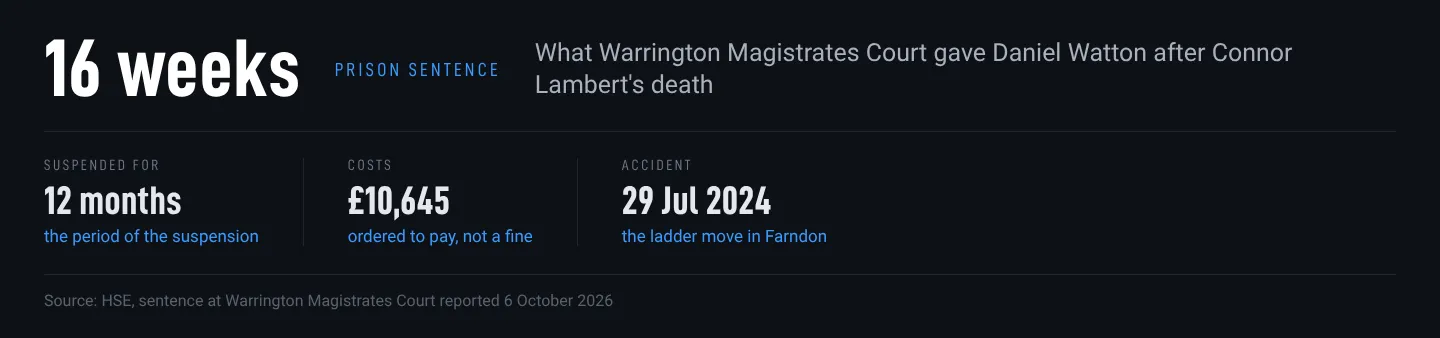
Daniel Watton, 50, Connor’s stepfather, is a sole trader trading as Inside Out Painters and Decorators Property Maintenance. He pleaded guilty to breaching Regulation 4(1) of the Work at Height Regulations 2005. On 6 October 2026, Warrington Magistrates Court gave him 16 weeks in prison, suspended for 12 months, and ordered him to pay £10,645 in costs. The rule he broke isn’t new.
The working at height plan was already unsafe
The original plan used a tower scaffold and ladders to paint the outside of the house. In practice the work moved away from that plan, and ladders were used throughout, with Watton’s approval. HSE judged both versions unsuitable and unsafe.
Investigators found that the work at height had not been properly planned, supervised or carried out safely. The selected equipment and methods were unsuitable for the task, and the risks of working near overhead power lines had not been adequately assessed or controlled.
HSE also found problems with the training and competence of the people doing the work. On this job, one of them was a trainee.
HSE has taken two other cases to court recently, a work at height fine over a stripped floor and a work at height fine for an unprotected stairwell. In both, the danger was the fall. Here nobody fell: the hazard was the overhead power line.

Near overhead power lines, the risk has to be removed or reduced
HSE’s line is that working at height you can’t avoid has to be properly planned, appropriately supervised and carried out safely, with suitable equipment and methods and people competent to do it.
Where you can’t keep away from overhead lines, HSE says the risk has to be eliminated or reduced: by getting the supply isolated, using appropriate equipment and keeping a safe distance.
HSE inspector Keeley Eves said the fact that Connor’s death “could and should have been prevented with proper planning and control measures” made it all the more stark.
The plan on paper had a tower scaffold in it. The job that actually ran used ladders throughout, one of them moved at the gable end near an overhead power line, and HSE found neither version safe.

Trade resources for tradespeople, straight to your inbox.
Occasionally we will send you a newsletter. Free, unsubscribe in one click.
Keep reading

Right to work subcontractors: the self-employed you bring in can now count as your hire
The Home Office guide now covers individual subcontractors you bring in for a customer's job, and can make you liable for labour another business supplies. What protects you depends on who holds which contract.

Fast track electrician courses: a few weeks in a classroom isn't enough, SELECT and SJIB warn
SELECT and the SJIB have renewed their warning about short courses sold as a quick way into the trade, Professional Electrician reports. If you're hiring, the certificate is only half of what you need to know.

Flexible working requests: Acas drafts new guidance on saying no
Acas is consulting until 17 December 2026 on a draft code for the legal changes expected in autumn 2027. Saying no will also need an explanation of why refusing is reasonable. Until then, keep using the current code.