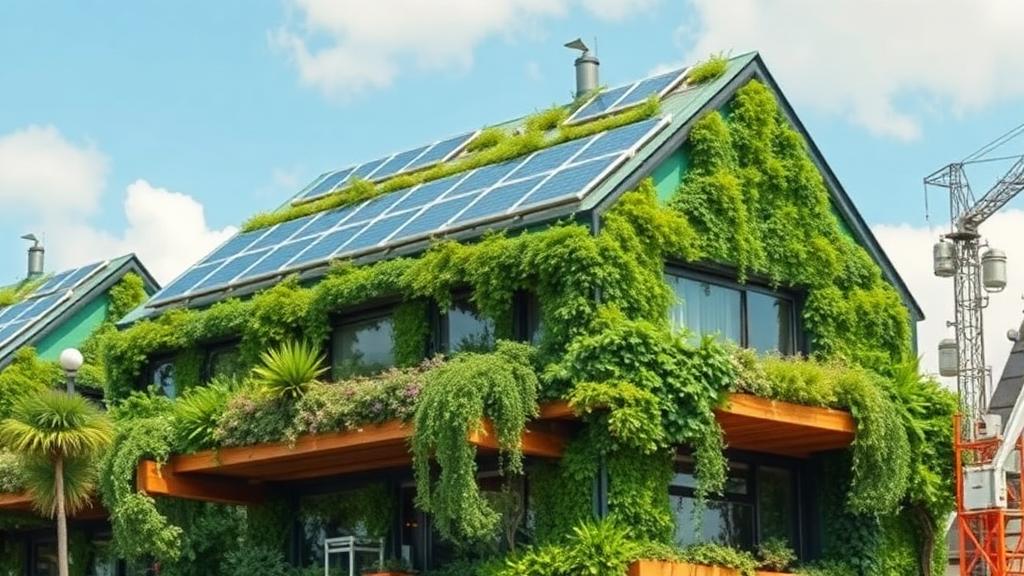
Sustainable Construction Training: Building Green Skills for the Future
How green skills training is transforming construction to meet net zero targets and deliver sustainable infrastructure.
Table of Contents
Jump to section
Sustainable Construction Training: Building Green Skills for the Future
The urgency of climate change, net zero targets, and tightening regulation is forcing a shift in how we build. In the UK, construction accounts for a significant share of carbon emissions and energy use. To deliver sustainable infrastructure and housing, we must also build a workforce steeped in green skills. That means training programmes that go beyond basic craft skills to teach low-carbon design, retrofitting, embodied carbon thinking, circular economy practices, and sustainability governance.
This article explores the state of sustainable construction training in the UK, key green skills in demand, methods to build effective curricula, challenges to overcome, and a roadmap to scale "green" capability across the industry.
Why Green Skills Matter in UK Construction
Construction and the built environment generate approximately 36% of final energy use and 39% of energy-related CO₂ emissions in the UK (including embodied and operational).
As the government ramps up net zero commitments, policies like the Future Homes Standard will drive demand for low-carbon technologies, better insulation, heat pumps, sustainable materials, and retrofit work. Reuters notes that the UK must reskill or mobilise ~251,500 construction workers over the next five years, especially in plumbing, HVAC, and electrical trades.
Furthermore, the "green skills gap" is widening. Contributors to UK Parliament's POST briefing note emphasise that sustainability and retrofit skills need to be built into the education system and workplace training.
A report by NOCN (with BACH) argues that we must "re-orientate to green across"—embedding green knowledge across all vocational pathways, not just a niche subset.
In short: if construction cannot retrain its workforce, many carbon ambitions and retrofit goals will stall.
What Are the Green Skills Construction Needs Most
In practice, "green skills" in construction means mixing technical, systemic, and behavioural competencies. Here are some of the highest-demand skills shaping curricula today:
Retrofitting & Energy Efficiency Techniques
Upgrading existing buildings to improve thermal performance, installing insulation, improving air tightness, integrating heat pumps and energy recovery systems.
Low-Carbon & Alternative Materials
Knowledge of low-carbon concrete, recycled / reclaimed materials, sustainably sourced timber, traditional materials (lime, hemp) and embodied carbon accounting.
Energy Modelling & Simulation
Use of tools such as SAP, SBEM, IES, passive design software for optimising building performance and forecasting energy demand.
Circular Construction, Waste Management & Lifecycle Thinking
Planning for reuse, deconstruction, waste hierarchies on site, cradle-to-cradle thinking, modular design for disassembly.
Sustainability Certification & Standards
Familiarity with BREEAM, LEED, PAS 2080, ESG reporting, carbon accounting.
Systems Thinking & Sustainable Governance
Understanding how all building systems interact (energy, water, materials, site ecology), stakeholder coordination, integrating sustainability from early design. POST notes that systems thinking is vital.
Behaviour Change, Client Engagement, and Soft Skills
Communicating sustainability goals with clients, managing trade adoption of new practices, embedding green habits on site.
Because green building is interdisciplinary, training programmes must be holistic rather than siloed.
Examples of UK Sustainable Construction Training in Action
Some colleges and institutions are already stepping up:
- MidKent College, Maidstone opened a Sustainable Construction "Skills Factory", funded by the Strategic Development Fund. It includes labs for energy efficiency, low-carbon building techniques, and renewable heating systems.
- Numerous FE colleges, via government Strategic Development Funds, are upgrading their facilities to support low carbon/retrofit curricula.
- Retrofit and low-carbon training modules are being embedded into apprenticeship frameworks or upskilling bootcamps.
These are early but promising signs that sustainable training is beginning to take root.
Designing High-Impact Sustainable Construction Programmes
To create a training programme that genuinely builds green skills, you should structure it thoughtfully across phases and modalities. Here's a blueprint:
Phase 1: Foundation & Awareness
- Introduce climate science, carbon budgets, net zero policy, regulatory drivers (e.g. Building Regulations Part L, Future Homes Standard).
- Basic environmental literacy: water, waste, biodiversity, materials.
- Case studies of successful sustainable buildings and retrofit projects.
Phase 2: Technical Core Modules
- Thermal modelling & simulation
- Fabric performance & insulation
- Ventilation, heat pumps & low-carbon heating systems
- Material specification & embodied carbon calculation
- Circular design & waste management planning
- Sustainability standards, certifications & compliance
Phase 3: Labs & Immersive Workshops
- Hands-on labs: mock building envelope assemblies, blower door testing, thermal imaging, material testing.
- VR/AR or simulation for retrofit scenarios and energy flow visualization.
- Project work: students design / retrofit a real or hypothetical building applying green rules.
Phase 4: Site Integration & Mentorship
- Place learners on projects with sustainability scopes (e.g. retrofit pilot, new low-energy build).
- Pair with mentors experienced in sustainable construction.
- Use digital monitoring, feedback loops, post-occupancy evaluation.
Phase 5: Certification, Assessment & Scaling
- Use rigorous assessments requiring evidence (models, site data, carbon reports).
- Badge competency levels (Green Level 1/2/3).
- Feed results into industry standards and continuous improvement.
Continuous Micro-learning & Refreshers
- Use micro-modules delivered via mobile (e.g. carbon tip of the week, new material brief).
- Safety/environmental hazard refreshers tied to site conditions.
- Analytics to target weak modules or knowledge gaps.
Infographic: Sustainable Training Impact Metrics
Sustainable Training Outcomes (Index, 0–100)
- Carbon Reduction Awareness: 95
- Retrofit Competency: 70
- Material Specification Skills: 80
- Whole-build Performance Design: 65
- Client Sustainability Literacy: 85
This illustration suggests that training should emphasise higher levels (system design, client engagement), not just technical modules.
Key Challenges & Strategies to Overcome
Challenge: Diffuse Responsibility & Traditional Mindsets
Many firms see sustainability as "bolt-on" rather than core. Changing culture is hard.
Strategy:
- Leadership buy-in; show ROI (energy cost savings, regulatory compliance, reputation).
- Embed sustainability KPIs into project contracts and design briefs.
Challenge: Cost & Resource Constraints
Green training requires labs, simulation tools, new equipment, teacher expertise.
Strategy:
- Partner with manufacturers, material suppliers, sustainability consultants for access.
- Use shared regional hubs and training collaboratives.
- Seek government funds (e.g. Strategic Development Fund) or green skills grants.
Challenge: Keeping Curriculum Current
Standards, materials, technologies evolve fast.
Strategy:
- Periodically review content with industry advisors.
- Use modular, updateable curricula.
- Establish a sustainability advisory network to feed evolving trends and innovations.
Challenge: Integrating Learning with Real Projects
Without live application, theory retention is weak.
Strategy:
- Use pilot retrofit or new build projects as labs for learners.
- Require sustainability deliverables (e.g., energy model, carbon report) as part of site tasks.
Challenge: Measuring Impact & Validation
How to certify that someone is "green competent"?
Strategy:
- Use mixed assessments: project deliverables + site performance metrics + certification exams.
- Link training outcomes with post-occupancy performance measures (energy, occupant comfort).
What Success Looks Like by 2030
If sustainable construction training becomes ingrained, we might see:
- A workforce where every site role has baseline green competence, not just specialists.
- Retrofit work becoming mainstream, closing the performance gap across the housing stock.
- Major programmes (housing, infrastructure) delivered under carbon budgets with fewer overruns due to sustainability risk.
- A vibrant green jobs ecosystem, with training pipelines that feed in new talent.
- Enhanced UK reputation in sustainable construction, exporting skills and standards abroad.
First Steps for Organisations
If you want to pioneer green training in your firm or region, here's where to begin:
- Conduct a green skills audit of your workforce and projects.
- Identify priority sustainability challenges in your region (e.g. retrofit demand, heat pump uptake).
- Partner with a local college or FE provider to develop pilot modules.
- Set up a lab or simulation environment (can be scaled) – thermal imaging, blower doors etc.
- Embed sustainability tasks in live projects with learners.
- Collect performance data (energy use, occupant comfort) to feed back into training.
- Promote green credentials internally and to clients.
- Scale modules gradually, improving iteratively.
Sustainable construction training is not a niche—it is becoming central to how the industry survives and thrives. For the UK to meet net zero goals while delivering the homes, offices, and infrastructure we need, we must develop a workforce fluent in low-carbon design, retrofit, materials logic, lifecycle thinking, and sustainability governance.
The transition is steep, but with deliberate investment, partnerships, and forward-thinking programs, the construction sector can move from carbon problem to climate solution—trained one learner at a time.