AI receptionist for tradesmen: what it costs and what your contract must cover
An AI receptionist for a small UK trades business can answer without booking. The price needs to cover a working connection to your diary; emergency cover needs someone who actually picks up.

Suppose your business phone rings at seven in the evening while you are getting tea on. A customer has water coming through the ceiling. Your on-call engineer needs the message, with the urgency intact.
We searched studies and reporting for UK trades emergency calls: no verified AI failures, nor independent proof of reliable handling. A slot tomorrow leaves that customer waiting tonight. The handover needs to reach someone who can accept the call-out. The leak is a suggested supplier demo, not a real call.
Your business remains responsible for the bot’s promises, as the AI for tradesmen guide explains. The contract needs to limit what the bot can promise about attendance.
An AI receptionist for tradesmen can answer without booking
“What will I pay for it to put the job into the software we already use?”
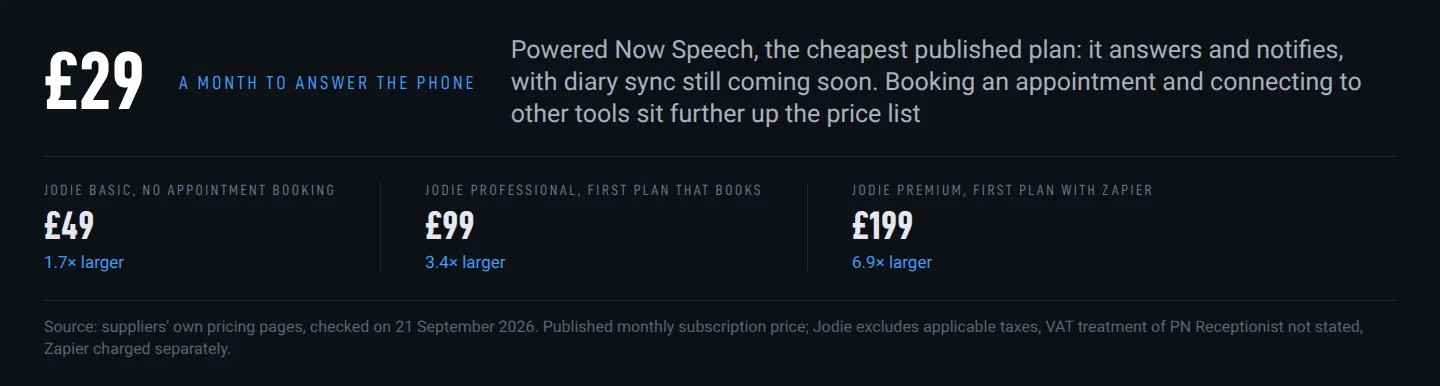
Published AI receptionist costs depend on what you need done. Job-management provider Powered Now sells Speech answering for £29/month. AI receptionist Jodie Professional costs £99/month with appointment booking. Jodie Premium costs £199/month with access to Zapier, a service carrying information between two pieces of software. Zapier Professional costs extra, in US dollars: from $19.99/month billed annually or $29.99/month billed monthly.
Prices are the suppliers’ published rates as at 21 September 2026. Jodie excludes applicable taxes. VAT treatment for PN Receptionist and Zapier needs confirming in the quotation.
Jodie Basic costs £49/month and does not book appointments. Its pricing table marks Zapier “Not included” on Professional and includes it only from Premium. So answering with a booking is £99/month. Getting that booking into other software means Premium at £199/month, plus the Zapier subscription on top, before tax and before anyone builds the connection.
For an AI receptionist for plumbers, the useful price ends with a job in the diary your office uses. Jodie lists customer-management software connections, plus Zapier. The written quote needs your job software named, with a price for building and maintaining that connection.
Job-management software ServiceM8 lists its Phone Agent under Connect Plus and Unlimited. Its UK pricing page gives only a starting price: “From £15/mo”. The support page describes tiers; the pricing page gives a starting figure. “Which plan buys the agent, at what price?” remains for the supplier to settle.
AI receptionist Sophiie advertises updates flowing both ways with ServiceM8. Its sales team needs to quote for that connection and demonstrate the job appearing in your system. A calendar invitation alone does not establish that your office has a usable job record.
Powered Now’s paid-for story leaves its customer unnamed. Independent studies measuring booking or revenue gains in UK trades businesses are still absent.
Powered Now’s £39/month Speech + Text plan adds SMS. Both PN Receptionist plans deliver a phone notification. For the connection to its own job software, the supplier’s wording is “Full Powered Now sync”, followed by “coming soon”.
Accent claims do not tell you how a noisy call will go
“Can we try it with a local accent and site noise behind the caller?”
The clearest reported AI receptionist failures in the UK come from healthcare.
The Guardian reported on 20 August 2026 that patients in Rotherham struggled with an AI receptionist. Kym Gleeson, manager of Healthwatch Rotherham, described difficulties understanding broad Yorkshire accents. The report concerns GP calls, not the products priced above.
The Interspeech 2025 paper Automatic Speech Recognition Biases in Newcastle English: an Error Analysis linked recognition errors to regional dialect features. The findings explain a mechanism of error. A failure percentage for your receptionist would require testing that product.
AI receptionist supplier Team Connect advertises regional British accent support. The supplier claim and the independent reports concern different systems under different conditions. Both belong in the discussion; neither settles how your callers will get on.
For construction noise, searches across trades forums and Trustpilot, plus wider reporting, produced no independent performance measurement or verified incident report involving a trades AI receptionist.
Voice-platform documentation describes noise-handling features. For site noise, the question becomes: “What measured results can you show for calls with tools running in the background?”
In the demonstration, your caller supplies the wording and background sound. Your caller corrects a postcode and pauses mid-description. Then comes an interruption while the bot is speaking.
Vapi, a voice-bot building platform, documents timing and interruption controls. Your supplier needs to explain which controls are available in the product you would buy.

With the ceiling-leak scenario, you need to see the saved urgency and hear how the bot recovers when words are missed. “Could you repeat the address?” and a working route to a person tell you more than a smooth greeting.
Your recordings need an exit route as well as a storage policy
“Can I take my number and recordings with me, and do you use my calls for training?”
Jodie’s sales page says you keep your existing number and forward calls to the service: “No porting, no new numbers.” Keeping the number and retrieving the recordings are separate arrangements.
Under ICO guidance, you normally decide how data is used; your supplier handles it for you. UK GDPR Article 28 requires a written contract providing for return or deletion of personal data at your choice when the service ends, unless the law requires retention.
AI receptionist Rosie’s terms say subscribers own call data. The same terms describe recordings and transcripts being used “for training purposes”. Its privacy policy refers AI training to the subscriber’s contract.
The ownership statement and the training permission coexist. “Does that training serve our account alone, or other customers too?” needs an explicit contractual answer.
The Lawful Business Practice Regulations 2000 permit business recording for purposes including establishing facts. The rules also require all reasonable efforts to inform people who may use the system that communications may be intercepted. Informing callers is only part of the test.
As with CCTV in the workplace and consent, recording needs a lawful basis and a justified retention period under UK GDPR.

Your agreement also needs a usable export format and a date for handing over records, alongside the cancellation notice period. For any business tools and technology contract, leaving should not mean losing the record of an unresolved complaint.
The public terms reviewed for Jodie and Powered Now leave the recording export format and access after cancellation unspecified.
Emergency cover needs a person at the end of it
“If it treats an emergency as routine, who answers when I ring you?”
AI answering providers NextPhone and Trillet advertise calling duty staff and assessing urgency respectively. For the ceiling-leak caller, the demonstration needs to include wording outside the supplier’s usual script.
The reviewed public terms say nothing specific about what happens when a trades emergency is misclassified. Then comes the contractual question: “If you classify that as routine, who takes over and how quickly?” The answer needs a named support contact and a written response commitment.
A separate scenario covers an unanswered transfer or the whole service failing: what does the customer hear, and where does the call go? Your on-call rota needs to match the people the system actually contacts.
Automation provider Down To Earth AI advertises services working above 99.9% of the time, on its sales page. The reviewed providers publish no contractual uptime guarantee with financial compensation. An explicit route for incoming calls during an AI outage is missing from every public contract reviewed. The follow-up is: “Which contract clause guarantees that, and what do you owe us if it fails?”
The liability clauses show why the written answer matters. AI receptionist providers Beeslee and VoiceAIWrapper limit payouts to your previous twelve months’ fees; Densu uses three months. All exclude indirect losses.

Trillet’s terms make you cover claims that come from your own data, your scripts and settings, or from breaking its terms or the law. The caps above limit suppliers’ payouts. The obligations run in different directions and cover different risks.
If that ceiling leak is booked for tomorrow, the customer may ring back to say nobody came. Your duty engineer needs the original message and authority to take over. You need a supplier contact who answers at that hour. Otherwise, your engineer is dealing with the leak while you are still trying to establish what the caller was promised.

Trade resources for tradespeople, straight to your inbox.
Occasionally we will send you a newsletter. Free, unsubscribe in one click.
Keep reading

Smart helmet for construction workers: why a camera mount isn't enough
A construction safety helmet with camera needs more than a mount that fits. A separate camera comes with separate paperwork, and some helmets sold as smart only store wearer information on a contactless chip.
AI for tradesmen: a UK owner's guide, trade by trade
AI can turn a house scan into a heat pump design and help code sewer footage. Further down the trades, the offering gets thin. The price often tells you less than the allowance beside it.

Safety glasses with camera: why your phone usually wins
You can buy glasses with a built-in camera. Whether they can replace your existing PPE is a separate question, and some manufacturers' own pages leave it open.