
Building safety levy: building notices are excluded, but check the street before you pick one
MHCLG has restated the exclusion three weeks before the levy starts. If you build new homes, a private street outside can already mean full plans instead of a notice, and the letter says nothing about who pays.

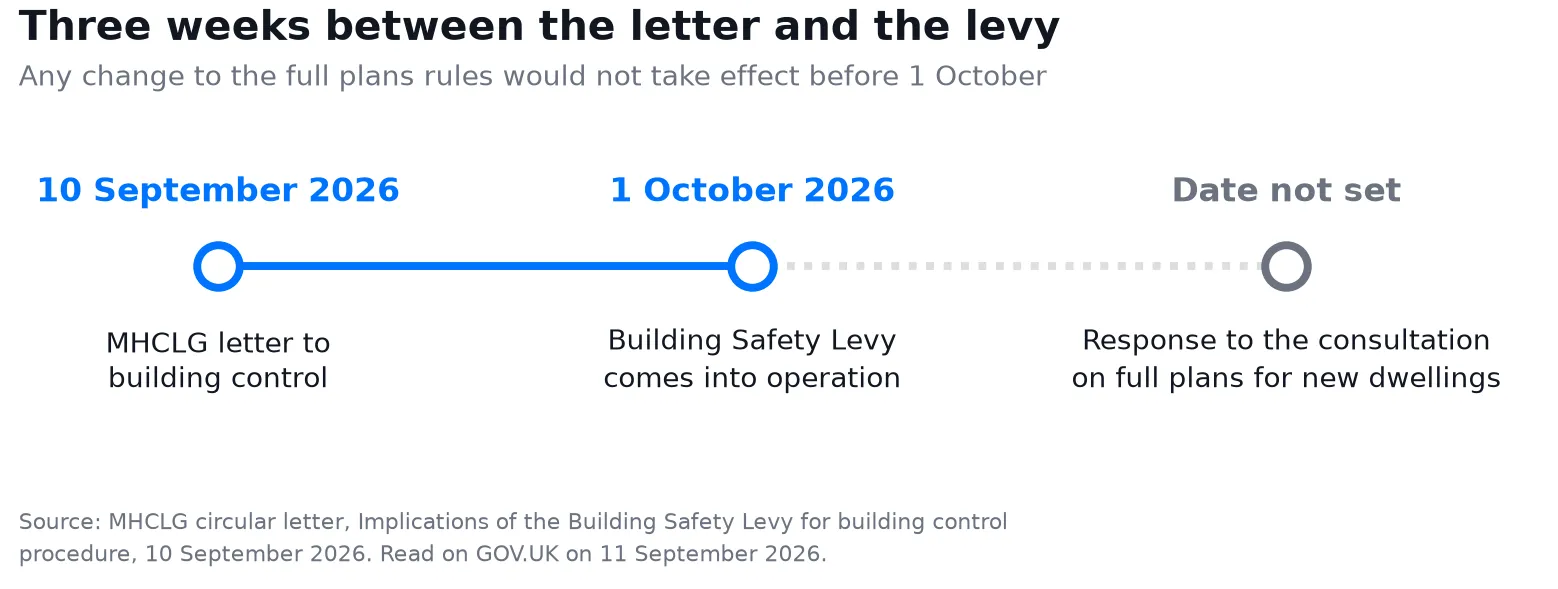
Building notices are outside the building safety levy, which comes into operation in England on 1 October 2026. That is the good news. The catch is that not every new housing job is allowed a building notice, and the street outside decides.
The reminder comes from the Ministry of Housing, Communities and Local Government (MHCLG), in a letter to councils and Registered Building Control Approvers dated 10 September 2026 and signed by Keeran Jugdoyal, Deputy Director, New Build Standards and Performance. A second MHCLG letter the same day covers building control fees and cost recovery.
What the letter does not tell you
It does not say who pays the levy, how much, which developments are liable, or whether getting a notice in before 1 October keeps a job outside it. Needing full plans does not answer any of that. What each route gives you, and what a building notice does not, is in our guide to building control for the trades. Check the levy position for the job separately, alongside the grants and schemes that touch the job, before you price it.
The building safety levy exclusion leaves the full plans rules where they were
The exclusion covers building notices given to local authorities under regulation 12 of the Building Regulations 2010. What it does not do is widen who can use one. MHCLG reminds building control that you must apply for building control approval with full plans in three existing cases:
- building work on a building the Regulatory Reform (Fire Safety) Order 2005 applies to, now or once the work is finished
- building work that includes erecting a building fronting onto a private street
- building work where paragraph H4 of Schedule 1, building over sewers, imposes a requirement
The second one is the one MHCLG dwells on. It says many new dwellings will, at the point of application, front onto a private street as the Highways Act defines it. For a building notice on new homes, the 1:1250 plan that goes with it has to show the width and position of any street, and the council is told to use that plan to decide whether the notice is invalid and a full plans application under regulation 14 is needed instead.
MHCLG also expects a surge of initial notices and applications during September and says it will put strain on local authorities. If yours is going in this month, it will have company.
An initial notice is not a building notice
If you go through a Registered Building Control Approver you serve an initial notice, and the letter says nothing about the levy and initial notices either way. Do not carry the exclusion across in your head. What it does say is that, where the Advance Payments Code applies, an initial notice for a building fronting onto a private street counts as a full plans application for the purpose of telling the street works authority. That is a duty on the council, not on you.
The rest is still on the table. MHCLG’s consultation proposes full plans for every new home that uses the local authority route, and a plans certificate before the final certificate for new homes and Fire Safety Order buildings that use a Registered Building Control Approver. The government’s response, with the timing, has no date. MHCLG says any change would not take effect before 1 October 2026, which is a floor, not a start date.
Before you settle the route with your client, look at the street on the 1:1250 plan and ask whether it is private. On many new housing jobs, that is the check that decides whether a building notice is on the table at all.

Trade resources for tradespeople, straight to your inbox.
Occasionally we will send you a newsletter. Free, unsubscribe in one click.
Keep reading
Boiler Upgrade Scheme: The April 2026 Overhaul That Changes Everything for Heating Engineers
On 28 April 2026 the UK government scrapped the EPC requirement, extended the scheme to 2030, and made air-to-air heat pumps eligible at £2,500. Here is what every heating engineer needs to know.

UK's First Dedicated Heat Pump Apprenticeship Launches: The Low-Carbon Heating Technician
A 36-month Level 3 apprenticeship dedicated to heat pump and low-carbon heating installation, with a £22,000 funding band per apprentice. The first proper structured route into the renewables workforce.

Government Announces 13,000 New Construction Apprenticeships in £20bn Education Estates Strategy
During National Apprenticeship Week 2026, the government unveiled 13,000 apprenticeships and T-level placements across construction, backed by a £20bn School Rebuilding Programme. The biggest skills push in a decade.