
Building control for the trades
Registered installers can certify their own work. You still have an extension to manage, inspections to arrange and a declaration to sign. These are England's rules.

You’re at the customer’s kitchen table on the extension’s last day. The original quote is beside your job file: structural opening, replacement boiler, new kitchen circuits. They ask: “Are you sorting building control as well?”
Building control checks compliance with the Building Regulations, through councils or private approvers. That means more than booking today’s inspection. You need the right route for each part, the notices, the certificates and your declaration. The decisions started back when you priced the work.
The quote needs a building control route for each part
Check the original scope against the file. The Building Regulations 2010 distinguish work needing an application, work covered by registered installers and work requiring compliance without notification. Planning permission is separate, as GOV.UK explains.
Regulation 12, Schedule 3 (self-certifying work and schemes) and Schedule 4 (work exempt from notification) give you these starting points. Electrical schemes include NICEIC and NAPIT. A special location means defined bath or shower zones, or a room containing a pool or sauna heater.
| Work in the quote | Route |
|---|---|
| Extension outside the exemptions | Building control |
| Opening in a loadbearing wall | Building control |
| Replacement gas boiler | Gas Safe notification |
| New circuit or replacement consumer unit | Registered scheme, registered third party appointed beforehand, or building control |
| Existing circuit alteration outside a special location | No notification, but electrical compliance still applies |
| Replacement windows in an existing dwelling | Appropriate scheme, such as FENSA, or building control |
| Bathroom installation without shared or underground drainage | Appropriate scheme registration or building control |
| Replacement sanitary fittings meeting Schedule 4 conditions | No notification |
The structural opening affects Part A, the structural requirements, under regulation 3. No competent person scheme, a register permitting installer self-certification, covers it in Schedule 3.

These are England’s routes. Welsh Government guidance sets out Wales’s separate regime; mygov.scot explains Scotland’s building warrants, and Northern Ireland’s Department of Finance directs applications to district councils.
A competent person scheme covers its registered work
At the boiler, check who’s sending the notification. Schedule 3 ties self-certification to the installer’s registered scope. GOV.UK describes Gas Safe as technically separate from a competent person scheme, although its installers have corresponding building regulations responsibilities.
Your Gas Safe business notifies the boiler through the register. Approved Document J, the combustion appliance guidance, generally requires notification beyond repairs and maintenance. Registered Gas Engineer’s February 2026 fee announcement lists £3.84 plus VAT online for 2026/27, but its VAT-inclusive and VAT-exclusive figures conflict. The Gas Safe certificate covers the boiler, not the extension or structural opening.
The kitchen’s new circuits are notifiable. Regulation 12(6A) also covers consumer unit replacements and existing circuit additions or alterations in special locations. Approved Document P, the electrical safety guidance, says other electrical work still needs appropriate inspection, testing and certification.
Outside a scheme, Approved Document P required advance notification to building control or a registered third-party certifier, who inspects another installer’s work, appointed before starting. Today’s electrical installation certificate cannot arrange either retrospectively.
The council can check drawings before you build
Before the inspector arrives, check which route your extension followed. A building notice means notifying the council and starting after two working days, without plans checked in advance. Full plans means submitting drawings and getting a decision before building. Either can lead to a completion certificate.
Regulation 12 requires full plans where the Fire Safety Order, covering non-domestic premises and flats’ common parts, applies or will apply; for new buildings fronting private streets; and for work subject to Part H4’s sewer provisions.
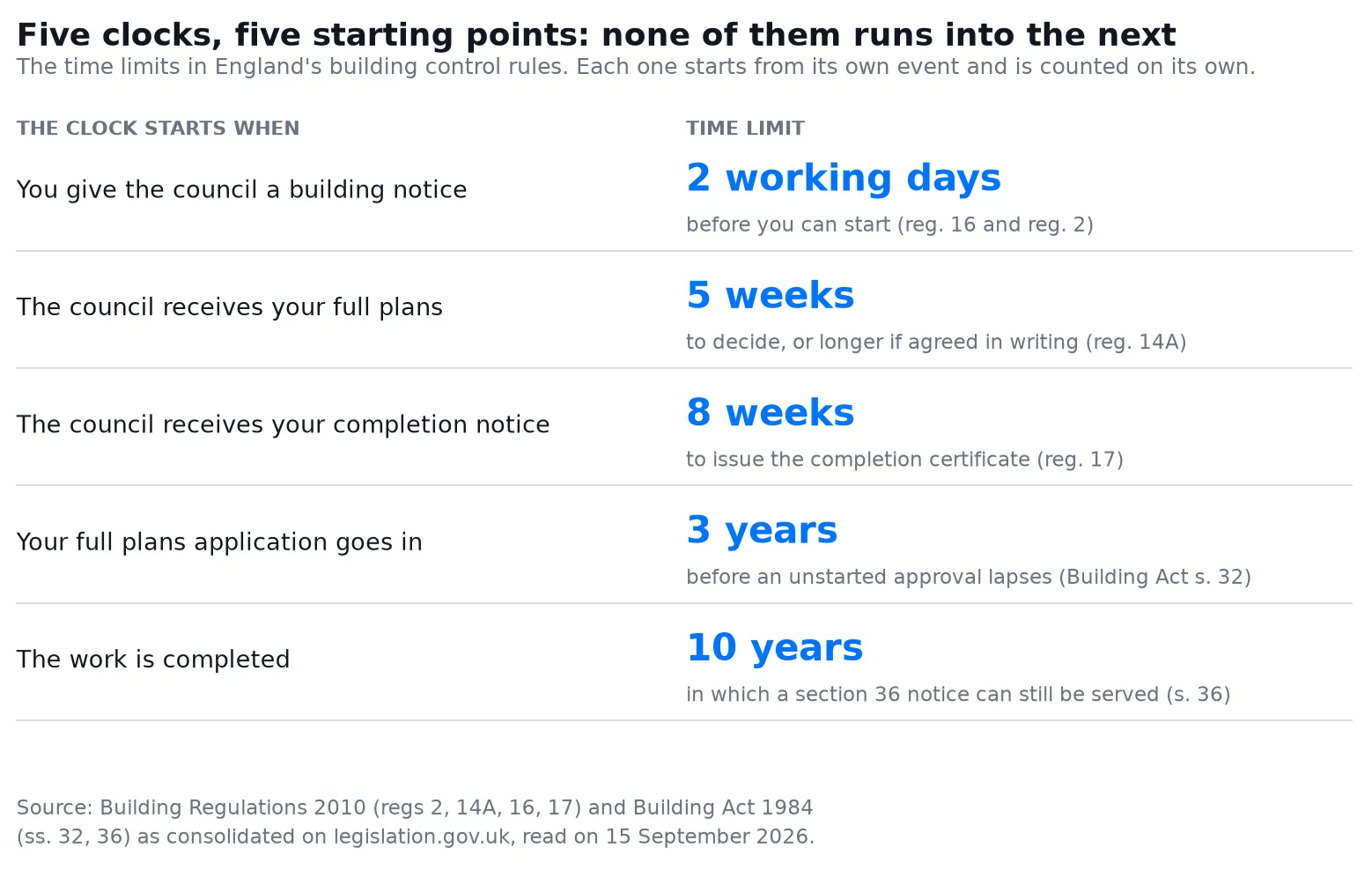
Regulation 14A sets five weeks for a full plans decision, or longer by written agreement. GOV.UK says “2 months with your consent”; the regulation sets no ceiling. The wording conflicts, and silence counts as neither approval nor rejection. Chase an overdue decision in writing.
Following approved plans and imposed requirements protects this ordinary extension against a section 36 notice, an order to remove or alter work, under the Building Act 1984.
Alternatively, hire a Registered Building Control Approver, or RBCA, a private building control business. Its initial notice tells the council it is taking the job and is submitted jointly with you. GOV.UK requires approvers to register with the Building Safety Regulator. Check the register before engaging one.
Not for this extension: for new homes, the building safety levy starts on 1 October 2026; its regulations exclude building notices. For existing flats, BSI dates the revised PAS 9980 2026 external wall code to 30 September, its project listing to 22 September, while Specification Online reported publication on 15 September. Those dates conflict.
The council’s price belongs to this job
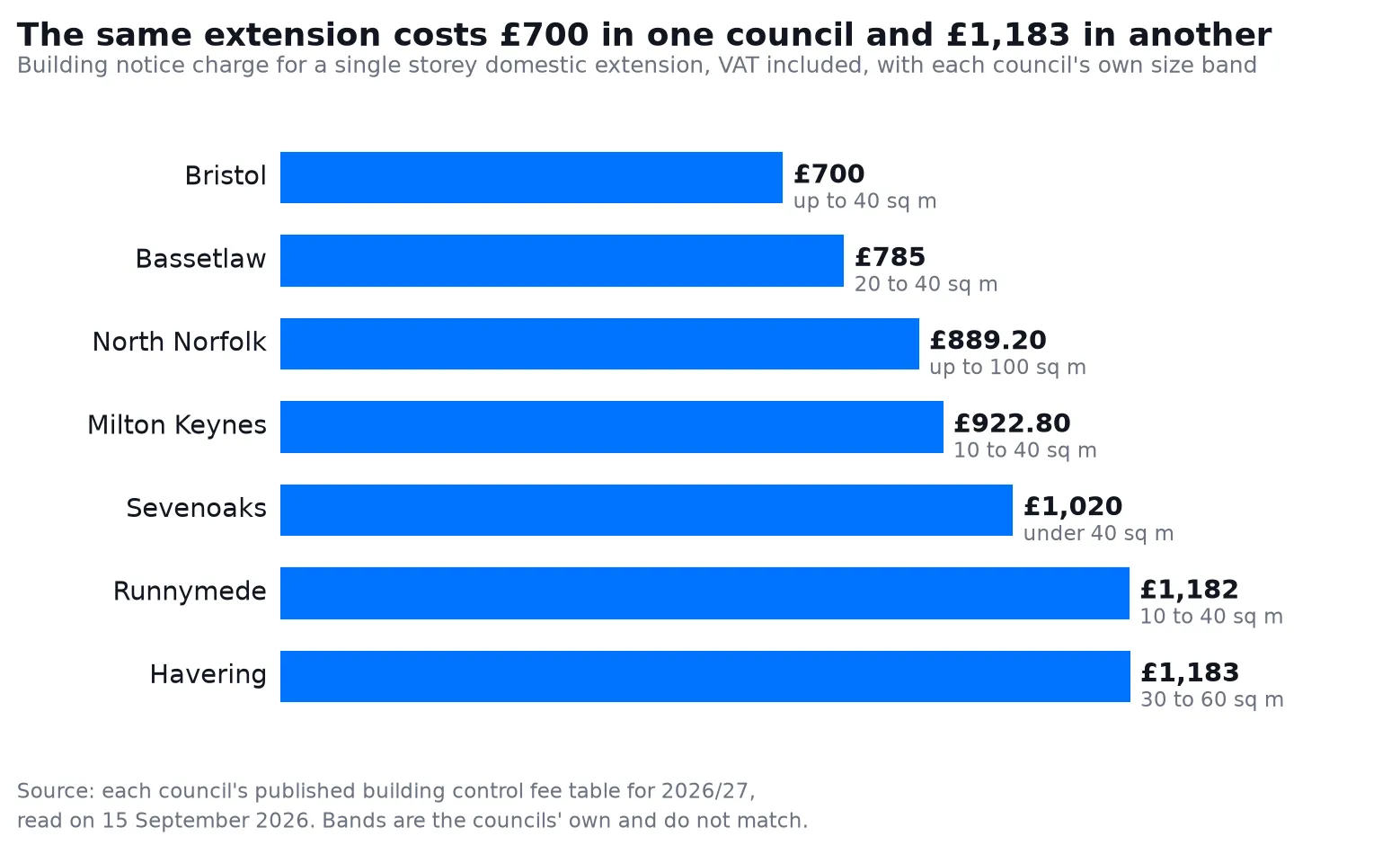
Over lunch, you check the building control fees against the allowance in the quote. Councils set their charges under the Building (Local Authority Charges) Regulations 2010, aiming to match chargeable income and costs across financial years.
The tables checked on 15 September 2026 put Bristol’s building notice for an extension up to 40 square metres at £700 including VAT. Runnymede’s single storey band from 10 to 40 square metres costs £1,182 including VAT.
Check electrical extras too. Coventry’s April 2026 table charges £770 including VAT for domestic electrical work by a non-certified installer; the council employs an electrician to oversee it.
Private approvers negotiate fees directly, according to GOV.UK. Get the complete quotation rather than assuming that route costs less. MHCLG’s letter of 10 September 2026 on building control fees reform proposes letting councils charge for a wider range of functions, subject to Parliamentary approval.
The crew still needs you to run the job
After lunch, the boiler engineer and electrician have their own checks. You still need someone coordinating their work with the extension.
Regulation 11D(6) treats a sole contractor as principal contractor, responsible for coordinating the build. “Principal” does not require a bigger van. Where several contractors are expected, construction and design appointments must be made in writing before construction begins.
On domestic projects, regulation 11C transfers compliance management and checks of others’ competence to the sole contractor, or the principal contractor on multi-contractor jobs. On the latter only, the client may agree in writing that the principal designer, who controls design work, takes those duties.
The customer keeps their duties to provide information and cooperate.
If you’re only the plumbing subcontractor, coordination stays with the principal contractor; regulation 11L still requires compliant work and reporting concerns.
You must be satisfied the customer knows their duties before starting, and provide workers with appropriate supervision, instructions and information under regulation 11L. The Local Government and Social Care Ombudsman’s building control guidance makes clear that the inspector is not your site manager.
If the customer would rather not involve building control, that does not move the duty. Regulation 12 is addressed to the person who intends to carry out the work. Section 35 of the Building Act 1984 makes contravening the regulations an offence, and Planning Portal says action “will usually be taken against the person carrying out the work (builder, installer or main contractor)”. The Federation of Master Builders’ (FMB) guidance on its 2025 contract templates says most domestic clients do not realise they have duties at all.
Assigning those checks is part of running the business: put a name against each one rather than leaving the crew to assume someone else has it covered.
At the drains, check the earlier inspection record
Outside, check the drainage inspection record and photographs taken before backfilling. Your file should already contain the earlier notices.
Regulations 16 and 2 required notice, then two full working days after the notification day before starting. A second notice follows within five working days of legal “commencement”.
For this rear extension, commencement under regulation 46A meant completing foundations, any basement and the ground floor structure. For other work, its 15 per cent test means completing the client’s specified share.
Full plans approval lapses without legal commencement within three years from the end of the application day, under Building Act section 32.
England’s regulation 16 leaves intermediate inspection stages to the council’s written, risk-based requirements. Hart District Council’s guidance includes foundations, drainage, structural work and insulation before covering. Check those requirements against the inspection record.

Building Control Solutions, serving West Berkshire and Wokingham, says it may inspect some intermediate stages virtually, case by case, but lists foundations and completion as on-site visits. Check that your inspector accepted the photographs for this stage.
Missing notices can mean opening the work again
If today’s file reveals missed notifications, deal with that before promising sign off. Regulation 16 permits the council to require work to be cut into, laid open or pulled down for inspection.
For eligible unauthorised work, the owner applies to the council for regularisation, retrospective approval, under regulation 18. It can require opening up, tests and samples, assessing the rules applicable when the work was done.
Regularisation has no VAT; each council sets its surcharge. Runnymede’s 2026 table charges £1,595 for it, against £1,182 for the extension application; Bristol lists £700 for both routes.
Separately, a section 36 notice requires the owner to remove or alter non-compliant work. Its window became ten years on 1 October 2023 under the Building Safety Act.
Basildon Borough Council reported missing notices, missed inspections and unsafe structural work on Steve Figg’s job. At Chelmsford Magistrates’ Court on 23 April 2026, he received a 12-month prison sentence suspended for two years, £85,000 compensation and a two-year prohibition on acting as principal contractor or carrying out building works.
A missing certificate can also surface years later, when the customer sells. HomeOwners Alliance quotes £20 to £300 for building regulations indemnity insurance; it responds to council enforcement, it does not repair anything, and approaching the council about the missing approval invalidates the cover. Nobody publishes a figure for how many sales trip over a missing certificate.
Building control sign off needs your declaration
Back inside, collect the boiler and circuit paperwork. The commissioning record and electrical installation certificate are separate from their building regulations compliance certificates.
For scheme work, regulation 20(3) requires notification to the authority and a certificate copy for the occupier within 30 days of completion. GOV.UK’s scheme page says eight weeks. Those published timings conflict. Work to the regulation’s shorter deadline.
For the extension, send the completion notice within five working days under regulation 16(4). It includes the client’s signed statement and declarations from the relevant contractors and designers. Your declaration confirms you fulfilled your principal contractor duties.
If a contractor or designer declaration cannot be included, regulation 16(4B) requires written reasons. The council’s eight-week certificate period starts on receipt of the compliant notice, under regulation 17, and depends on it being satisfied about compliance.
Your building regs completion certificate is “evidence (but not conclusive evidence)” under regulation 17. It isn’t a guarantee; keep your own records. On the private route, Building Act section 51 requires the RBCA to give the council a final certificate when satisfied with completion.
Tomorrow morning, check your electrician’s scheme and the council’s fees and inspection stages, then put each work item’s route in your next quote.
That evening the completion notice for the extension has gone. The tools are back in the van. The job file stays open until the certificate comes.

Trade resources for tradespeople, straight to your inbox.
Occasionally we will send you a newsletter. Free, unsubscribe in one click.
Keep reading
AI for tradesmen: a UK owner's guide, trade by trade
AI can turn a house scan into a heat pump design and help code sewer footage. Further down the trades, the offering gets thin. The price often tells you less than the allowance beside it.

CIS explained for UK trades
Paying subcontractors puts the CIS deduction, return and paper trail on your business. That applies to your subcontractor payments even on a job in someone's kitchen, and even when another contractor is making deductions from your own invoices.

Safety glasses with camera: why your phone usually wins
You can buy glasses with a built-in camera. Whether they can replace your existing PPE is a separate question, and some manufacturers' own pages leave it open.