
Jobs guarantee scheme goes nationwide: six months of funded wages, employer details not yet set out
From the end of November, DWP will pay the minimum wage for up to 25 hours a week, for six months, for an eligible 18 to 24 year old on Universal Credit. Who counts as an eligible employer, and what else is paid, isn't spelled out in the announcement.
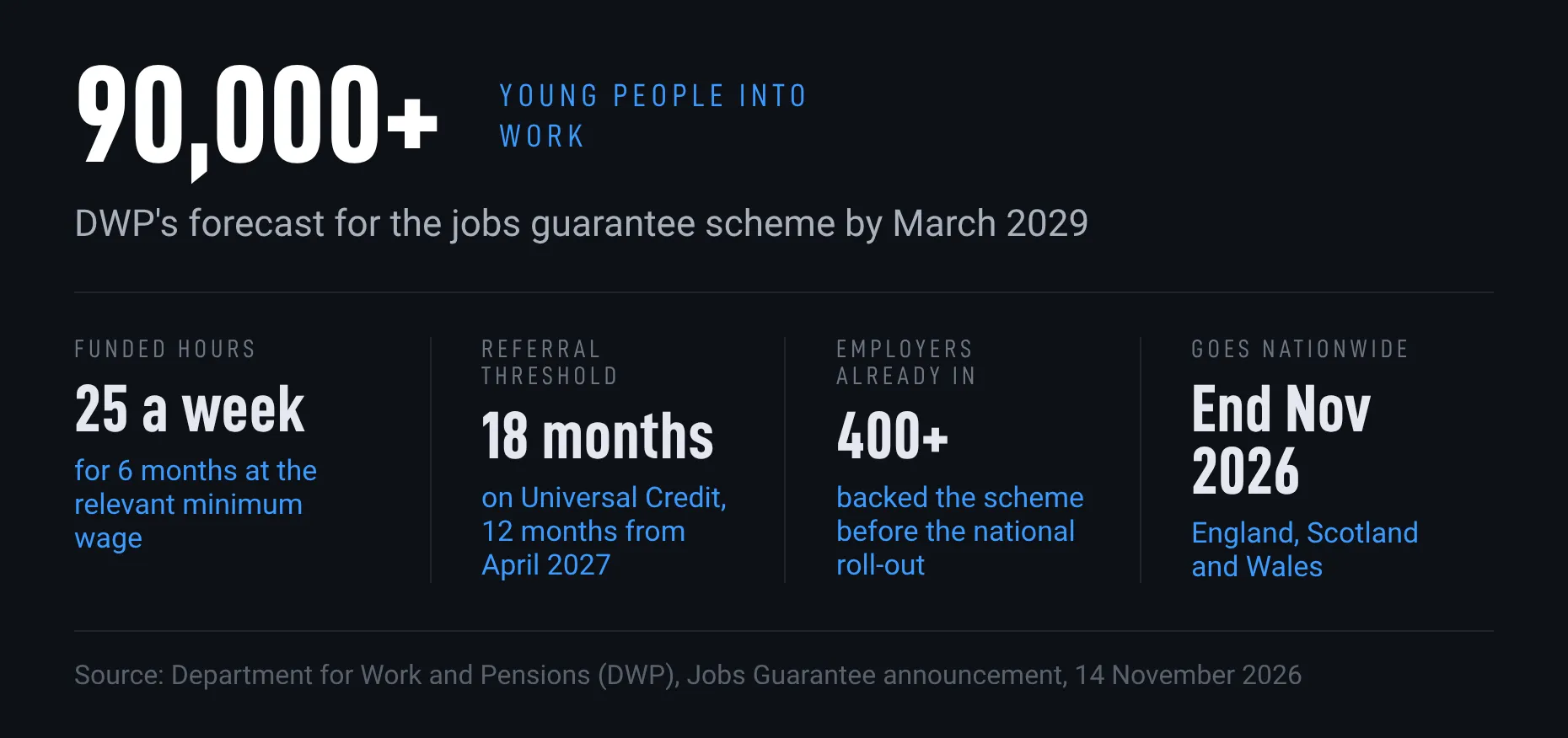
From the end of November, the jobs guarantee scheme covers eligible 18 to 24 year olds on Universal Credit who are looking for work, anywhere in England, Scotland and Wales. The Department for Work and Pensions (DWP) announced the extension on 14 November 2026. The government funds up to 25 hours of paid work a week for 6 months, at the relevant minimum wage. Employers who want to offer a role get in touch through DWP’s Contact Employer Services.
It isn’t a trial any more. The scheme started in six areas with some of the highest youth unemployment, and DWP says more than 400 employers have already backed it.
What the jobs guarantee pays for, and what to ask
These are paid jobs with support, not apprenticeships, so they sit apart from your other hiring and apprentices options. If you want a recruit working towards a trade qualification, the apprenticeship hiring payment for young apprentices is the scheme built for that.
DWP calls the jobs “fully-funded”. What it sets out is the wage: the hours, the six months and the minimum wage rate. Employer National Insurance, pension contributions, kit and training aren’t mentioned in the release, and nor is whose payroll the recruit sits on or what’s expected of you when the six months end. Ask about each before you count on a free pair of hands. Enterprise Nation’s chief operating officer, Polly Dhaliwal, says in a testimonial in the release that the scheme also covers “the onboarding costs”, but DWP’s own funding description there doesn’t mention them.
If you keep someone on afterwards, you’re doing the same sum as anyone asking is it worth taking on an apprentice: what they cost against what they bring in once they’re up to speed.
The £3,000 employer hiring payment in the same release belongs to another stage of support, for young people still out of work after six months. Keep it out of your jobs guarantee sums: DWP doesn’t say the two can be combined.
Jobs guarantee referrals come through a local partner
You don’t pick a young person off the street. Their work coach refers them to a local delivery partner, which matches them with a role suited to their skills. They get tailored support before they start and while they’re in the job.

Right now a young person is referred after 18 months on Universal Credit and out of work. From April 2027 that drops to 12 months, so more young people will reach the scheme, and sooner. One paragraph of DWP’s release gives the 12 months without a date; its detailed notes put the change in April 2027. Also from April 2027, eligible young people on the health element of Universal Credit can take part voluntarily.
DWP expects the scheme to help more than 90,000 young people into work by March 2029. That’s a forecast for the whole programme, not a count of jobs already filled.
Employer Services takes your first enquiry
DWP’s Contact Employer Services form has a “Jobs Guarantee (18 to 24 year olds)” option. It asks whether you’re recruiting nationally, in several locations or in one, with towns or cities and postcodes if you know them.
Fill it in and Employer Services gets back to you. Which employers qualify and how the money reaches you aren’t in the announcement, so that reply is where those answers should come from.

Trade resources for tradespeople, straight to your inbox.
Occasionally we will send you a newsletter. Free, unsubscribe in one click.
Keep reading

Construction college funding: a funded place for every young person, but no new employer payment
Colleges have been promised backing to take extra learners. Construction Management reports that CIOB wants stronger teaching capacity behind it, and funding for small employers too.

Construction training scheme for NEETs offers free courses, but how you hire is still unclear
Free courses and a shareable skills record could help you find entry-level candidates. Construction Management describes the offer, but leaves the locations and employer sign-up route unanswered.

Construction bursary scheme: Band of Builders launches BoB Bursary for tools, PPE and workwear
Help with tools, PPE and workwear for people starting out in the trade, Electrical Contracting News reports. Students at three colleges get it first. Amounts, eligibility rules and dates aren't out yet, and nothing says a business can apply for its apprentice.