
Is it worth taking on an apprentice? Yes, if they stay past qualifying
An apprentice can repay the investment, but the available British model puts recovery after qualification. What they produce matters, and so does the time your engineer spends teaching them.
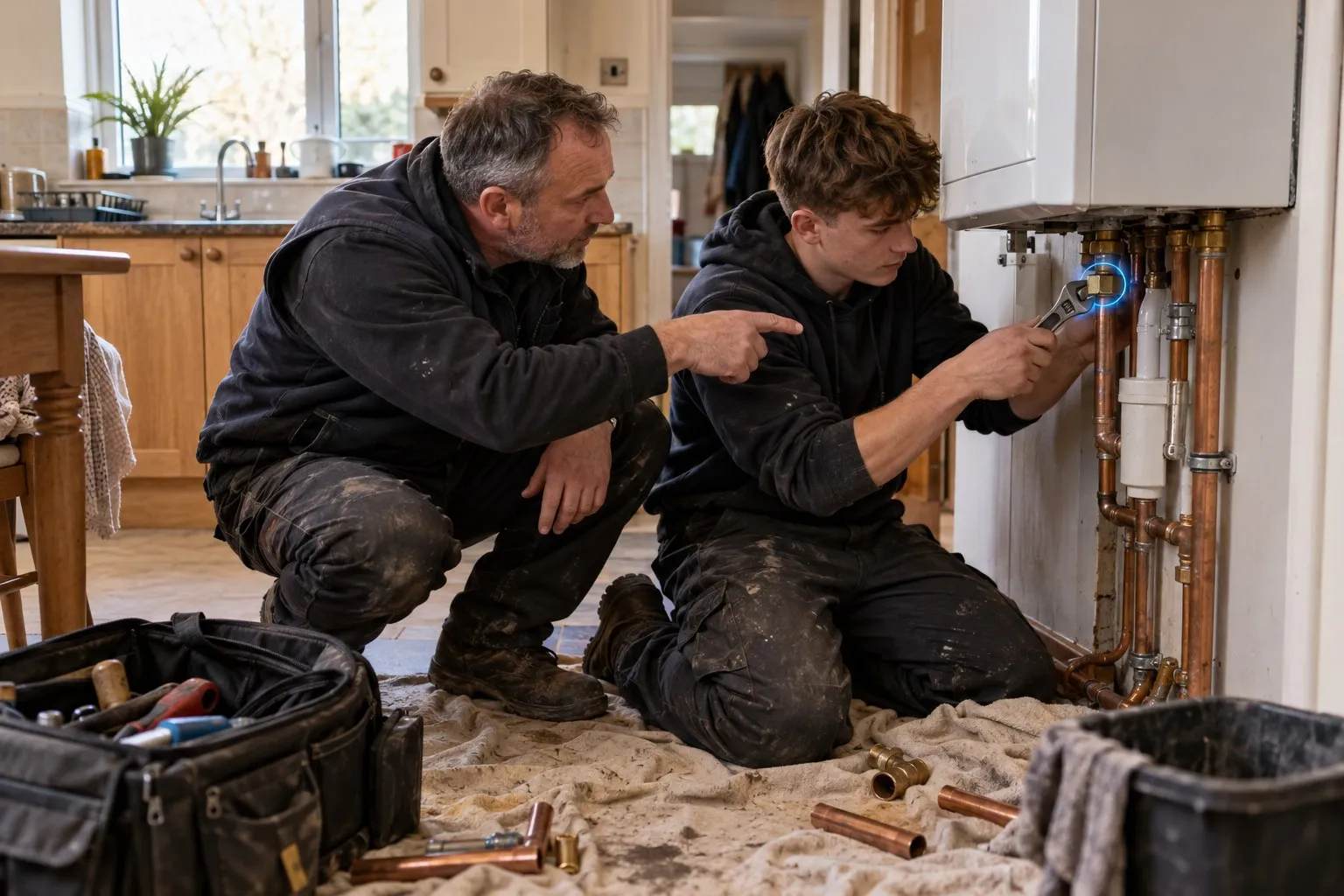
People ask will AI replace electricians, yet the adverts say the opposite. Randstad, the recruitment company, counted more than 50 million job adverts worldwide and found demand for heating, ventilation and air conditioning engineers up 67% since late 2022. In the UK, every respondent to Turner & Townsend’s construction market report, published in July 2026, said they were short of qualified mechanical, electrical and plumbing workers. So the advice every owner hears is the same: train your own.
Is it worth taking on an apprentice? Yes, if they stay long enough. The only British study that measures it year by year puts the payback after they qualify, not during the training.
Taking on an apprentice puts the biggest cost in year one
Your engineer’s time explaining a pipework job belongs in the budget too.
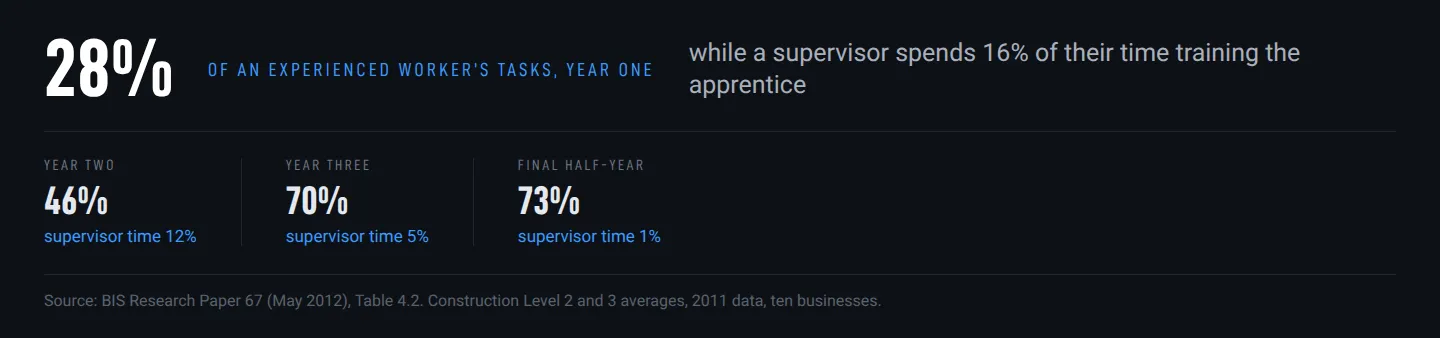
The government’s Department for Business, Innovation and Skills (BIS) commissioned Research Paper 67. Published in May 2012 using 2011 data, its construction chapter covered ten businesses with 11 to 200 staff, including heating and plumbing employers and an electrical business. The 2011 prices have not been converted to today’s money: use the shares, not the pounds.
First-year apprentices could undertake 28% of an experienced worker’s tasks. Supervisors spent 16% of their time training. After subtracting the value of the apprentice’s work, the employer’s first-year cost was £10,962. BIS valued that work using the experienced worker’s wage; customer charges were not measured.
Your starting costs today follow different rules:
- Pay: GOV.UK sets the apprentice minimum at £8.00 an hour from April 2026. It applies to under-19s and apprentices aged 19 or over during their first apprenticeship year.
- Employer National Insurance: HM Revenue & Customs sets a 0% rate for apprentices under 25 on earnings up to £50,270 annually. You need a recognised apprenticeship and written agreement.
- Training fees in England: for starts from August 2026, the state funds training and assessment for 16-to-24-year-olds with non-levy employers, up to its funding limit. Non-levy means you do not pay the apprenticeship payroll charge: your annual wage bill, including connected businesses, is below £3 million. With someone aged 25 or over, you contribute 5%. You pay any amount above the cap.
- Payments: England’s rules pay you £1,000 for 16-to-18-year-olds, on top of any hiring payment. Non-levy employers can also receive the £2,000 apprenticeship hiring payment for eligible new starters aged 16 to 24 from 1 October 2026. Your college or training organisation passes on both in halves at 90 and 365 days, while employment and training continue. No hiring payment arrives before January 2027.
Off-the-job training happens during paid working hours. For new starters, each apprenticeship has its own minimum training hours. The official Skills England register lists 857 hours across the plumbing and heating programme and 1,066 for installation electricians. Our plumbing calculation: roughly 28 paid training days a year over four years, assuming 7.5-hour days. The gas apprenticeship requires 509 hours.
Early departure is another first-year risk. The Department for Education (DfE) surveyed 506 apprentices who left without finishing, across all sectors, in 2023. Of them, 65% left within the first year; the average time before leaving was nine months. Reasons were spread widely: a better job offer led, at 16%. Not getting on with the employer accounted for 11%; insufficient time to learn, 10%.
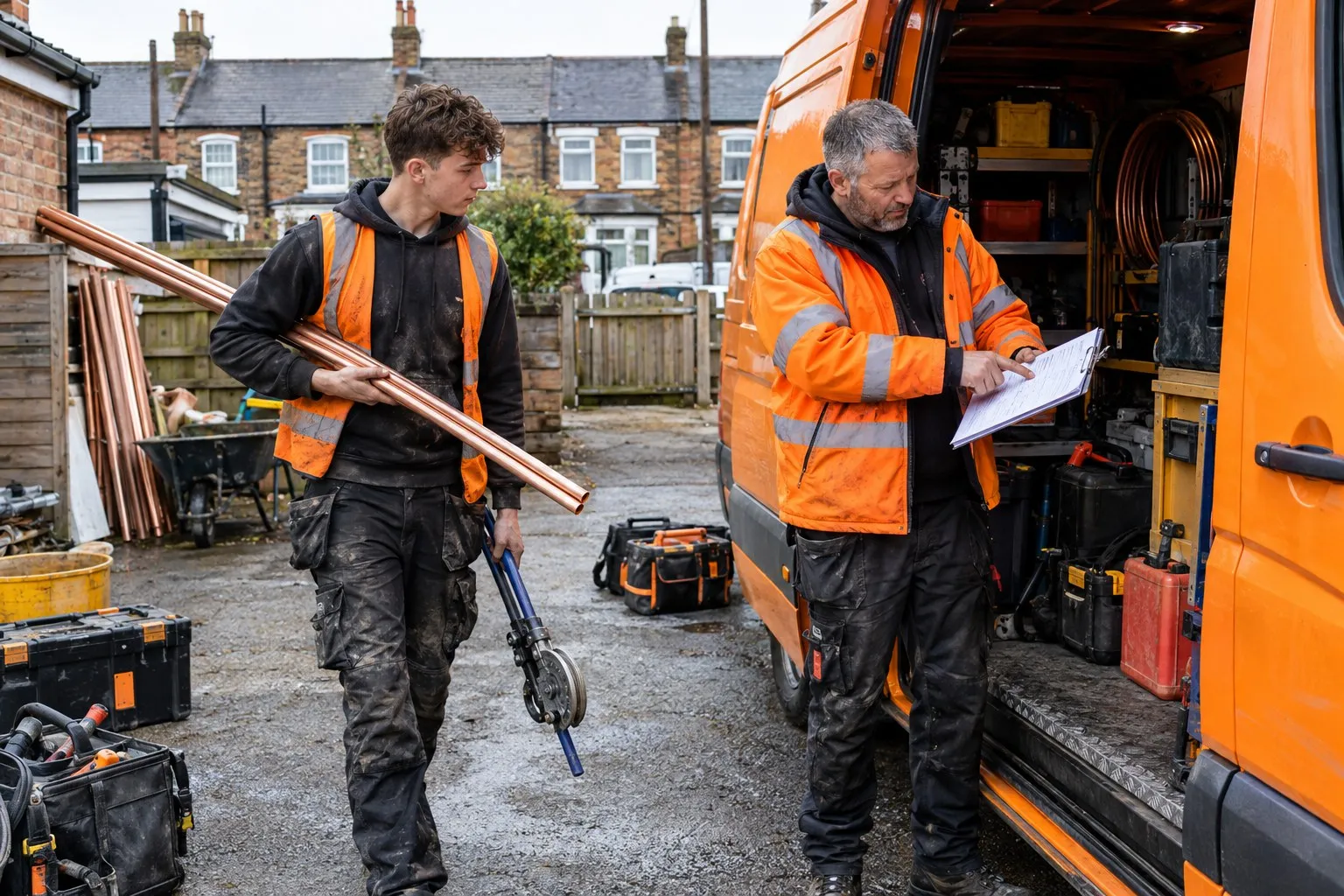
A bigger contribution comes with a higher wage in year two
At 46% of an experienced worker’s tasks, the BIS apprentice was contributing more. Second-year net cost fell to £7,847, while supervisor training time fell to 12%.
Your wage bill can rise here. Under GOV.UK’s rules, a second-year apprentice who is still 18 stays on £8.00; once they are 19, the age-related minimum applies. Current hourly rates are £10.85 for ages 18 to 20 and £12.71 from age 21.
Longer programmes carry departure risk beyond the first year. In the DfE survey, 51% of those who left programmes planned to last at least two years left after their first year. The finding covers 109 of those surveyed, across sectors, without a separate trades breakdown.
By year three, you’re still covering a shortfall
The person teaching gets more of their time back. BIS measured supervisor training time at 5%, with apprentice productivity reaching 70% of experienced-worker tasks. Net cost had fallen to £2,134 at 2011 prices.
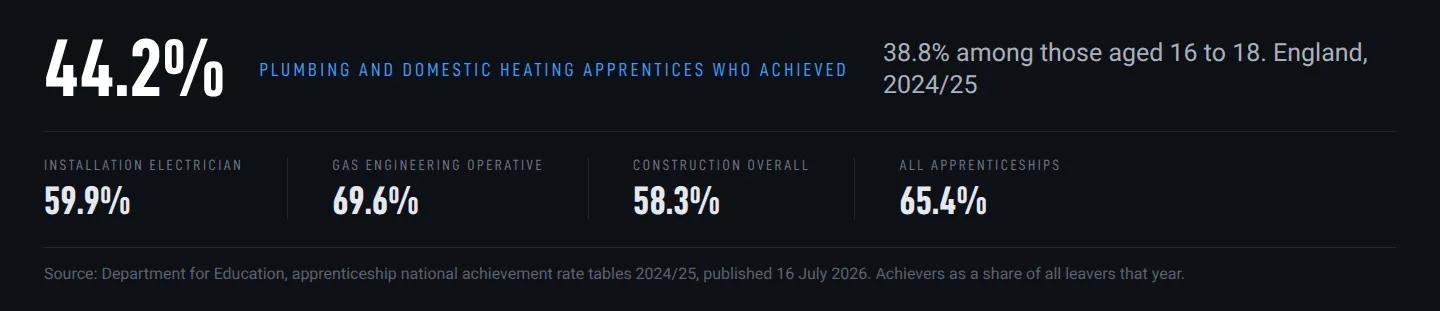
Some apprentices leave before they reach qualification. DfE’s English achievement tables, published on 16 July 2026, give plumbing and domestic heating a 44.2% achievement rate for 2024/25. Among apprentices aged 16 to 18, it was 38.8%.
The rates show how many got the qualification, out of everyone who finished or left early that year. They describe that year’s leavers, not the prospects of your particular recruit.
In construction, 94.3% of those who finished their training passed. The bigger loss was people leaving before the end.
The payback on an apprentice depends on who stays
Qualification arrives on different timetables. Skills England lists plumbing and heating at four years plus a typical six-month assessment period. Installation electrician is 54 months; gas engineering operative is 18 months.
BIS assumed an apprenticeship lasting three and a half years. Counted from the day they start, the study’s model puts recovery at around five and three-quarter years: three and a half years of training plus two years and three months afterwards, our sum, not a figure BIS publishes. The estimate cannot predict today’s plumbing payback. In its final half-year, costs were £13,165 and the apprentice’s work was valued at £10,176, leaving £2,989 to cover.
One employer in the study described a “golden period” of around a year before qualification, when apprentices needed little supervision but were still below a qualified worker’s wage. Across the whole model, the employer covered £23,932 at 2011 prices, or £26,074 after allowing for apprentices who left without finishing.

The UK construction skills shortage gives you a reason to train someone, and a reason to think about keeping them. DfE’s all-sector 2023 employer survey found that 61% of employers kept everyone who finished their apprenticeship. Where a completer had left, 83% of those employers said the decision was the apprentice’s.
Whether getting an apprentice is worth it depends partly on what you can offer afterwards. Your hiring and apprenticeship plans therefore extend beyond qualification, while the investment is still being recovered.
Productive work makes an apprentice worth it for employers
Germany measures this better than Britain does. In a 2017/18 survey by BIBB, Germany’s federal vocational training institute, businesses that trained on the job had a net cost of €4,951 per apprentice a year, against €13,372 where apprentices also spent time in a separate training workshop. BIBB puts part of that gap down to the workshop and its trainers, and part to apprentices having less chance to do productive work.
For your jobs, the useful measures are work completed to the required standard and how much of your engineer’s own work stops while they teach. On pipework, that could mean a familiar task completed correctly with fewer repeated explanations.
Safety requirements set the boundary. The gas engineering operative assessment plan places competence assessment and Gas Safe registration at the end; an apprentice cannot do gas work independently before those requirements are met.
For electrical work, Regulation 16 of the Electricity at Work Regulations requires the technical knowledge or experience needed to prevent danger, or supervision appropriate to the work.
Step-by-step guidance could take on some repeated explanations during supervised work. No published independent study measures whether it gets installation-trade apprentices competent sooner. Manufacturer case studies cannot establish that result.
Moving the first-year line is the part worth testing
TrainAR is built for the first-year training burden: a qualified engineer records a job wearing smart glasses, and the apprentice follows step-by-step guidance on their supervised jobs and asks questions without putting down the tools. The aim is more productive work earlier, with less demand on the engineer’s time. Whether it moves your apprentice past the 28% of year one is something to measure on your own jobs, by your engineer’s teaching time and the tasks done right first time; nobody’s word is enough, including ours.

Trade resources for tradespeople, straight to your inbox.
Occasionally we will send you a newsletter. Free, unsubscribe in one click.
Keep reading
Building control inspection stages on an extension, and who decides them
Your council's written notice sets the stage notifications for your job. A private building control body has its own list of stages. Photographs can provide evidence where the body accepts them, but sending them is not approval.
NICEIC or NAPIT: first-year cost, renewal and per-job charges
NICEIC's £834 covers application and 12 months' certification. NAPIT's £786 covers application and initial assessment, with no published annual fee or confirmation that it is included. Both include VAT. The prices are not like for like.
Building regs for boiler replacement: what goes on your Gas Safe notification
You notify the boiler and its controls through Gas Safe. A new chimney liner or electrical circuit takes another route. An unvented cylinder depends on the scope of your registration.