
Missing building regs certificate: where to look and who applies
Your former client's buyer wants the certificate. A paid archive search can end empty. The owner applies for regularisation, with a fee to pay and a separate question over who ultimately bears the cost.
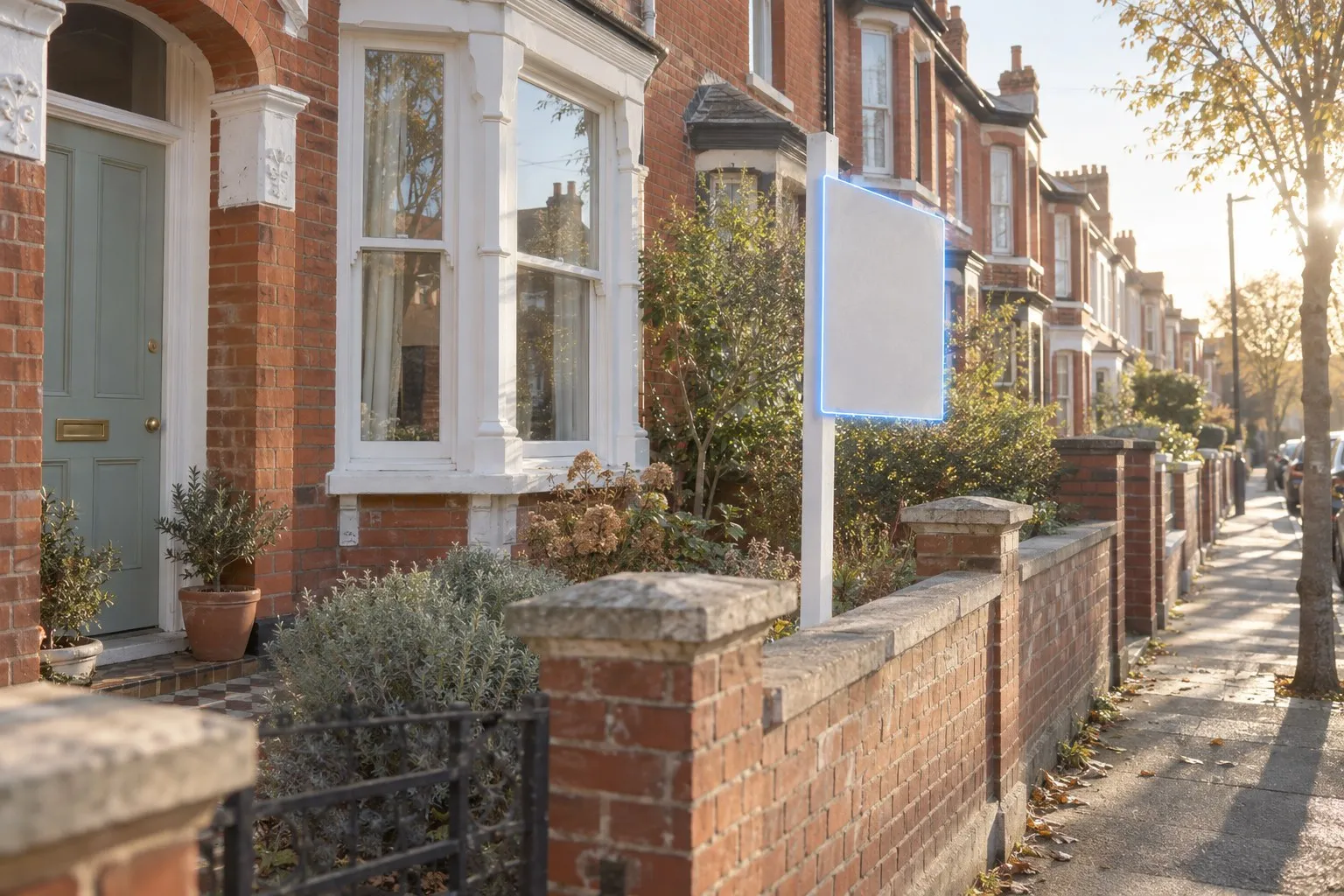
The buyer’s solicitor’s request reaches you through a former client, years after the job: “supply copies of the planning permissions, building regulations approvals, completion certificates or competent person certificates for the work if you have them”. It comes from the TA6, the property information form the seller fills in, at question 5.2(c) of its 6th edition (2025).
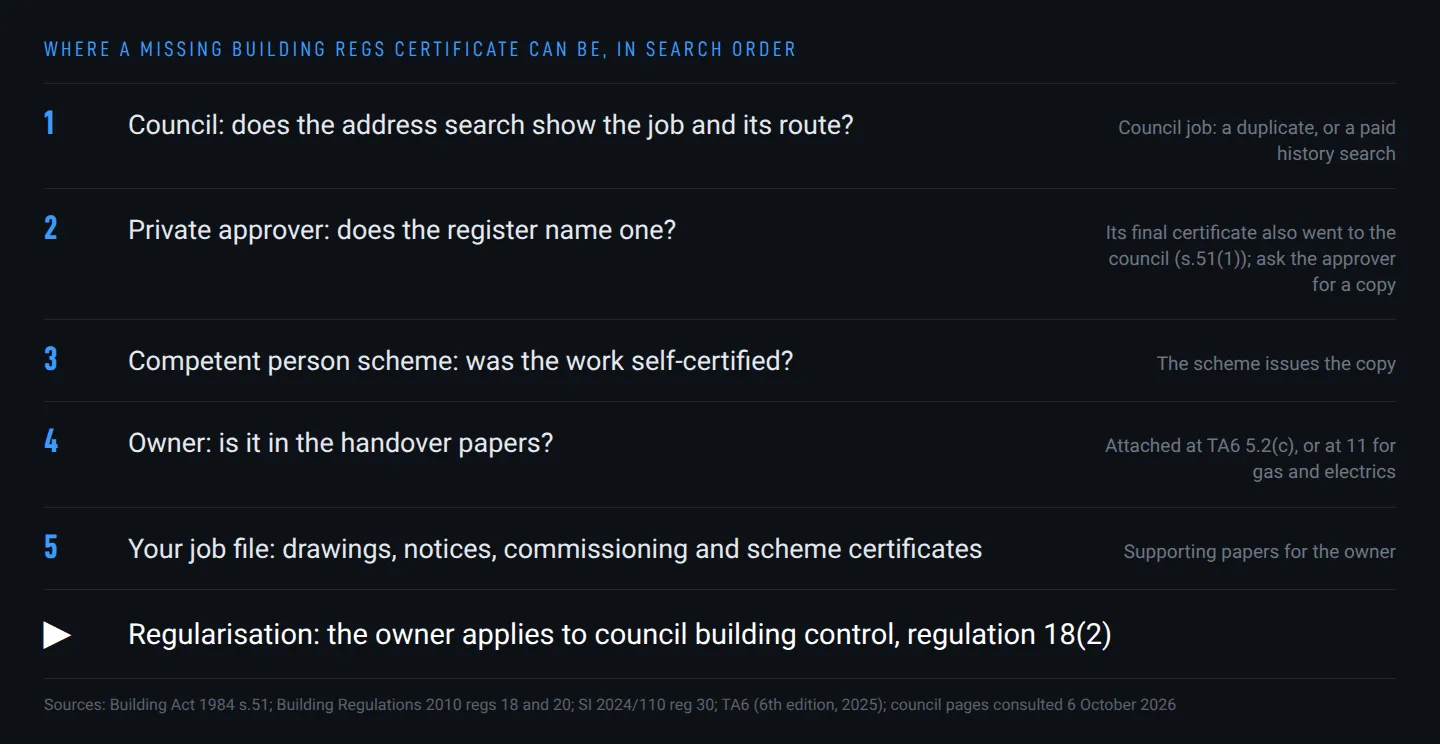
For a missing building regs certificate, your own file comes first: was a council notice submitted? If so, the owner can request the certificate there. For unauthorised work, the owner’s route is regularisation. Council applications and installer self-certification have different paperwork, covered in building control for the trades.
England is the ground here; Wales, Scotland and Northern Ireland run separate building control systems.
The council’s records, searched by address
Camden and North Northamptonshire offer address searches online. North Northamptonshire’s register identifies private approver work by references ending IN, INX, INW or INDEX. Enquiries go to the seller or private approver, formerly called an approved inspector. Scheme notifications begin with the scheme’s code.
Councils also keep a register of private approvers’ notices and certificates, indexed by address. In England, SI 2024/110 regulation 30 describes it under Building Act 1984 section 56.
Older files depend on council practice. Charnwood calls 15 years a legal minimum; Bromsgrove cites government guidance. Ashford keeps basic records after full files go, including whether a certificate was issued. Nottingham began issuing completion certificates at the end of 1995.
Cheshire East only exceptionally issues a certificate if completion is notified more than five years after the work finished. If the council no longer holds the file, the next places to ask are the private approver or the scheme.
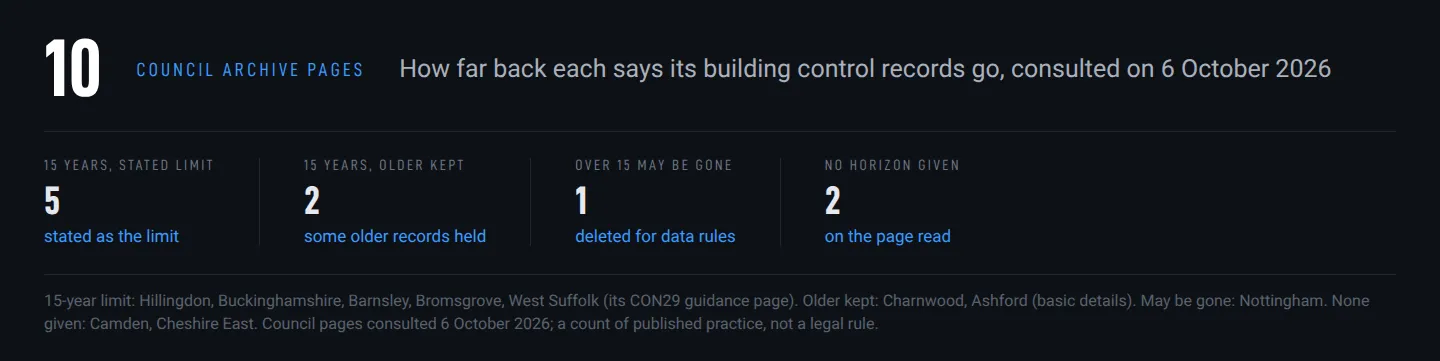
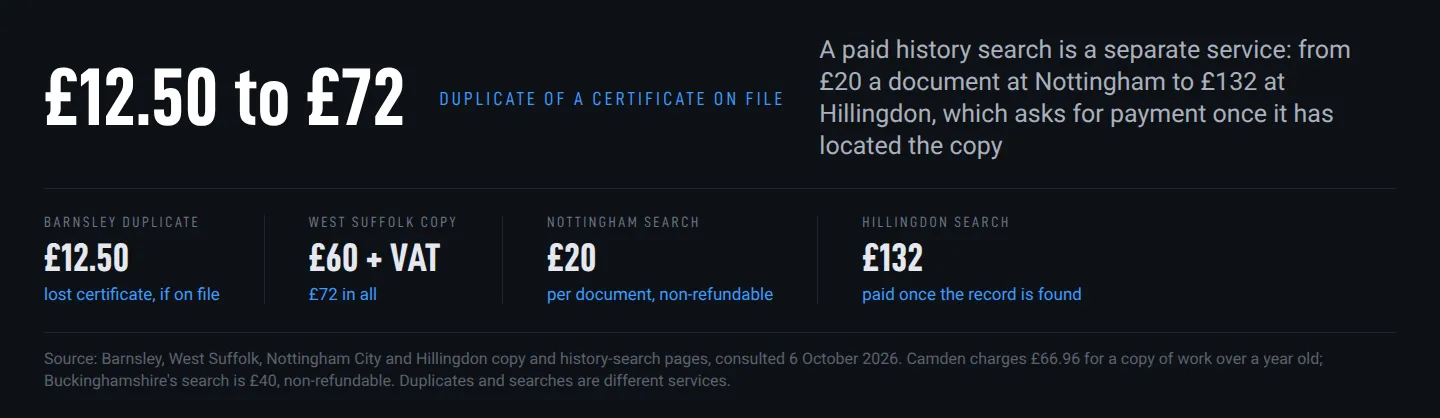
A duplicate copies an existing certificate. Your council’s search fee may buy no document. On council pages consulted on 6 October 2026, Barnsley charges £12.50 for a duplicate; West Suffolk charges £60 plus VAT (£72 in all). Camden charges £66.96 in 2026 for work over a year old, free under a year. Searches run from Nottingham’s £20 per document to Hillingdon’s £132. Nottingham and Buckinghamshire (£40) retain fees after an empty search. Hillingdon takes payment only after locating the copy.
Buckinghamshire sends copies to owners or their solicitors; Bromsgrove names owners or appointed agents; North Northamptonshire accepts someone acting for the owner. Your request goes through your former client or with their authority.
If a private approver signed the job off
Building Act section 51(1) requires the private approver’s final certificate to reach the council. Camden and Nottingham still send copy requests to the private approver named in the register. So ask the council first and, if it has no copy, the private approver.
GOV.UK’s cancellations and transfers guidance covers unfinished work and names no home for a closed private approver’s files. Since April 2024, regulation 30 requires the signatory’s name and address, plus the acceptance date. Older entries followed previous rules.
Scheme certificates stay with the scheme
Nottingham and North Northamptonshire direct you to the scheme for its certificates. Competent person schemes let registered installers certify specified work themselves. Building Regulations 2010 regulation 20(3) requires the installer, which may have been you or your subcontractor, to give the occupier a copy and send the authority either notice or the certificate. Under regulation 20(3A), the authority must keep those records retrievable.
Gas Safe Register issues the boiler compliance certificate; North Northamptonshire lists GASAFE among its scheme codes. NICEIC’s help pages say duplicate Building Regulations Certificates of Compliance can be bought online.
In Wokingham 23 011 721, decided on 28 February 2024, a registered engineer uninstalled and reinstalled a wood burner fitted by someone else before notifying the council. The Ombudsman accepted the council’s position that the engineer’s certificate could not replace regularisation. The owner still paid the fee, with a partial refund.
The owner’s handover papers and the sale forms
Among your former client’s handover papers may sit the missing building regs certificate. TA6 question 5.2(c) offers “Attached / To follow / Not available”. Gas and electrical work go under question 11: 11.2 for electrical certificates, and 11.4(d) for heating compliance certificates, whose options are “Attached / To follow / None”.
For scheme certificates under CON29 (2016) question 1.1(l), the Law Society’s guidance notes, updated in September 2019, suggest councils with incomplete records add: “The local authority may not always be aware of such works and enquiries should also be made of the seller.” For the rest of question 1.1, including completion certificates at 1.1(k), they suggest councils state the period their electronic records cover.
The Federation of Master Builders’ client guide puts receiving certificates and warranty documents before final payment, a useful reminder for your next handover.
Your own job file and the missing building regs certificate
Your drawings and correspondence can explain what was submitted. The completion notice tells the council work is finished. Its reply and commissioning or scheme certificates can help trace the missing document.
Oxford makes validation of a regularisation application conditional on a technical package including plans with sections and elevations, specifications, mechanical and electrical information, engineers’ reports and calculations, and any commissioning certificates, including scheme certificates. It is one council’s list, and your job file is where most of those documents may still be.
Retrospective building regs: regularisation, who applies and what it costs
For regularisation, the owner applies under regulation 18(2). GOV.UK says retrospective building regs approval is available only through council building control. An empty search does not prove the work was unauthorised; your old notice shows what was submitted.
The council can require covered work to be opened for inspection; your job file is what you can contribute. Stratford says it has discretion over whether to process an application. Oxford’s wait of up to eight weeks is for an initial response, not a certificate.
Salford warns that unproven compliance means no certificate and no refund. Hillingdon’s note 14 states: “There is no entitlement to a refund of any regularisation charge paid, particularly if the Council cannot determine what work is required to comply with the relevant requirements.”
When a sale goes ahead without the certificate, the seller’s side may use building regulations indemnity insurance instead, a policy that responds to council enforcement.
What a regularisation certificate costs
The regularisation certificate cost often starts with the building notice charge, the fee for a notice given before work starts, but the formula varies by council. Tower Hamlets charges the building notice rate plus 25 per cent. Hillingdon’s regularisation fee has included a 30% penalty charge since 1 April 2022, already built into its 2026/27 table, and is exempt from VAT. Redbridge adds 50% to the base cost excluding VAT, from 1 April 2026. Chorley and South Ribble assess individually, quoting “typically … a minimum of 150% greater than the gross building notice charge”.
Hillingdon’s 2026/27 table sets the regularisation charge for removing a chimney breast, or for a simple structural opening in a wall such as a through lounge, at £440 each, VAT exempt.
For extensions up to 10 m², four of the seven tables specify single-storey; three use a general extension band. Colchester lists £565 excluding VAT; Windsor and Maidenhead lists £1,121.25 including VAT. Those are published figures, not VAT-adjusted comparisons. The seven tables publish a regularisation figure for that band and could be read on 6 October 2026.
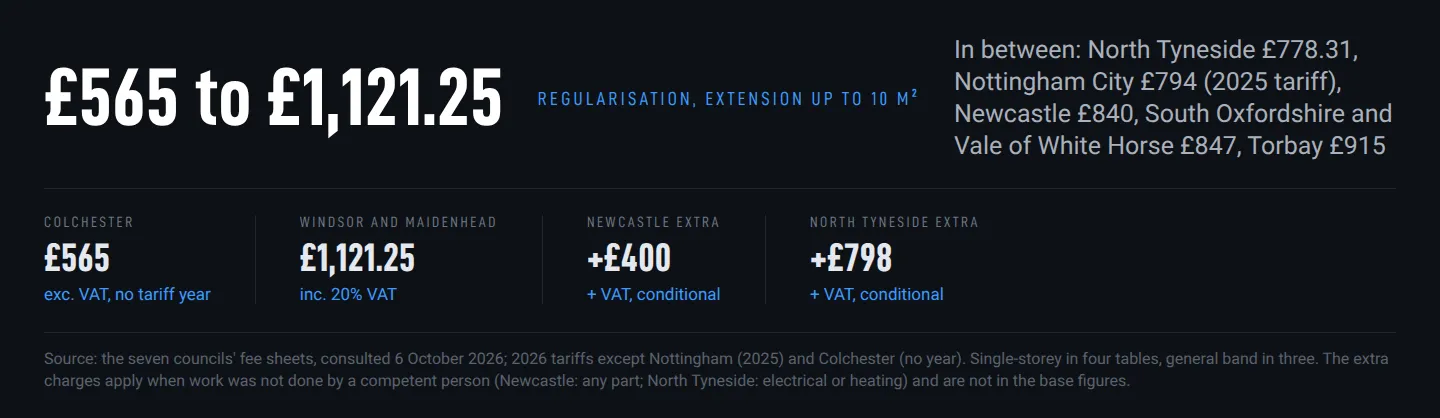
Newcastle adds £400 + VAT where any part of the work was not done by a competent person scheme installer or registered certifier; North Tyneside adds £798 + VAT where electrical or heating work was not done by a qualified or competent person.
Newcastle and North Tyneside require payment on submission. North Tyneside’s guidance says the owner of the building or of the work pays the regularisation charge.
Keeping the job contract is part of running the business; who bears the cost between you and your former client depends on its terms and the case.
For older jobs, there is a cut-off. Regularisation under regulation 18(1) is unavailable for unauthorised work carried out before 11 November 1985.

Trade resources for tradespeople, straight to your inbox.
Occasionally we will send you a newsletter. Free, unsubscribe in one click.
Keep reading

Are smart glasses allowed at work? The gap in the privacy regulator's guidance
The privacy regulator's guidance names body cameras, not glasses. Your decisions start before purchase and get harder when an employee brings their own pair.

Contractor or subcontractor under CIS? The registration you may be missing
Being paid under CIS does not register you to pay your own subcontractors. Your role follows each contract. If you already employ staff, adding the contractor side changes your existing PAYE scheme.

CCTV in the workplace UK: what you have to do before you switch it on
The maximum fine gets quoted in every article about cameras at work, and it is not going to happen to you. Staff complaints, an order to stop recording and an unpaid ICO fee are the nearer concerns.