
Will AI replace plumbers? The headline isn't a forecast for your job
The biggest job-loss headlines count different things. The original papers tell you more about plumbing than the headlines do, but none gives you a reliable forecast for your own job.
“Goldman Sachs Predicts 300 Million Jobs Will Be Lost Or Degraded By Artificial Intelligence.”
Forbes ran that headline in March 2023. If you earn your living on the tools, it sounds like somebody has counted the jobs that are going.
The report measured potentially automatable work, not jobs lost. Products in the AI for tradesmen guide perform individual tasks.
Will AI replace plumbers? Today’s tools do only parts of the job
Frey and Osborne’s 2013 Oxford study gave “Plumbers, Pipefitters, and Steamfitters” a 35% probability of computerisation. It scored a combined US occupation. It did not forecast that 35% of plumbers would lose their jobs, or establish what happens to your job in Britain.
AI products offer plumbers diagnostic guidance. Specialist robots cut inside pipes. As of September 2026, no reviewed source verifies a commercial robot completing domestic plumbing repairs in customers’ homes. Laboratory manipulation tasks and demonstrations do not establish that capability. Current capabilities cover particular tasks. The employment studies cannot give you a reliable forecast for your own job.
The Forbes headline came from Joseph Briggs and Devesh Kodnani’s Goldman Sachs report, published on 26 March 2023. Its wording is “the equivalent of 300mn full-time jobs” exposed to automation.
“Equivalent” and “expose” are doing important work. Goldman Sachs combined potentially automatable tasks into full-time job equivalents, then extrapolated globally. Counting that amount of work is different from counting people whose entire occupation disappears.
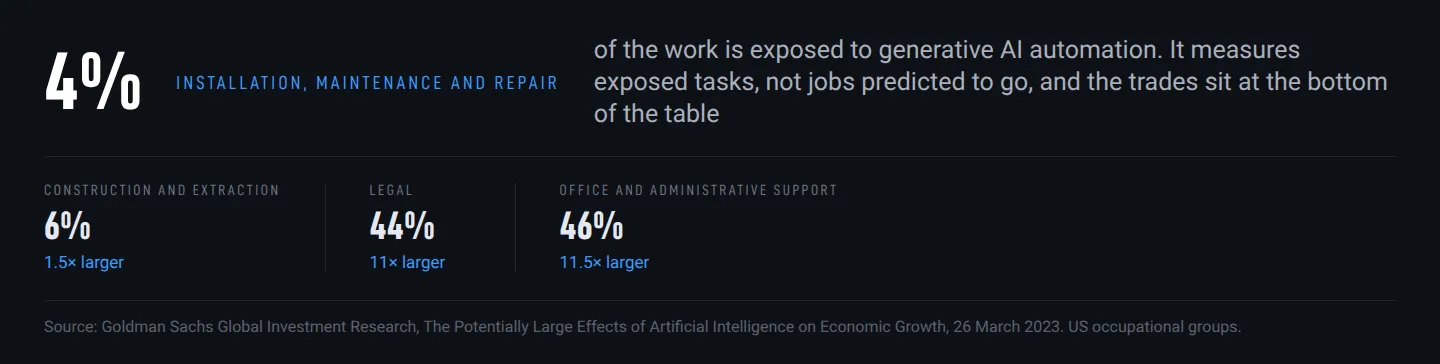
Its US occupational comparison puts construction exposure at 6%. Installation, maintenance and repair stands at 4%. These are broad categories assessed for exposure to generative AI.
The report does not mention plumbers by name. Those broad categories cannot give you a personal probability of redundancy.
The largest estimates sit elsewhere in the same report: office and administrative support at 46%, and legal work at 44%.
Nor does the construction figure mean that the remaining work is protected indefinitely. Goldman Sachs was assessing exposure to generative AI under its model, not every possible development in robotics.
Oxford’s plumbing score came from a model of occupations
A separate estimate puts 47% of US jobs at risk. It comes from Carl Benedikt Frey and Michael Osborne’s September 2013 Oxford paper, The Future of Employment.
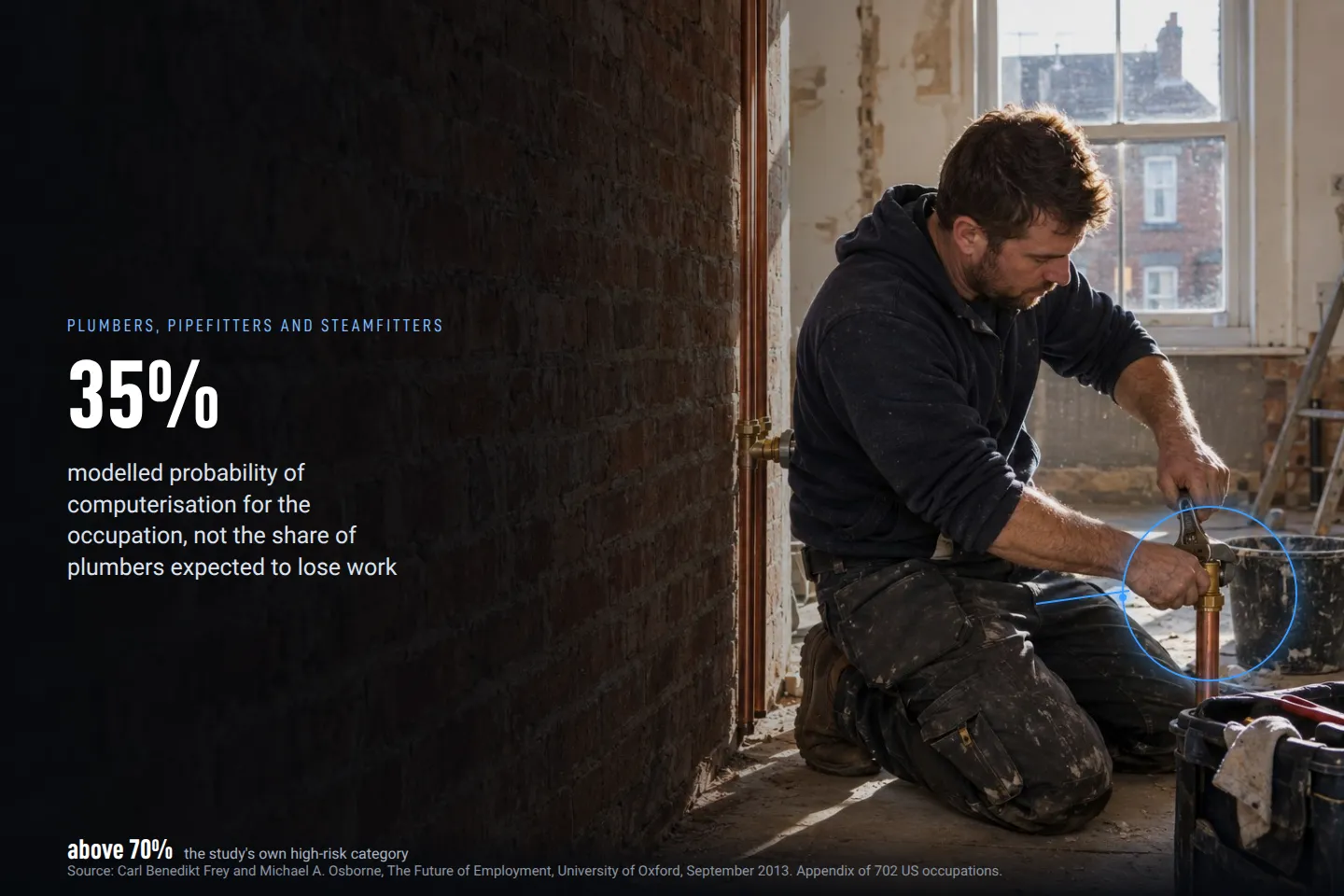
The researchers modelled the probability of computerisation for 702 US occupations. Experts first labelled 70 occupations; the model inferred scores across the wider set.
The 47% was the share of US employment in occupations above the study’s high-risk threshold. Plumbing has a separate entry in the appendix.
“Plumbers, Pipefitters, and Steamfitters” received a modelled probability of 35%. Reading that as “35% of plumbers will lose their jobs” changes the unit being measured. The score belongs to an occupation.
The paper’s high-risk category begins above 70%. Plumbing was also among the occupations the experts had labelled as not fully automatable under the study’s assumptions.
The study is American. A British plumber today gets no verdict from it either way.
The British estimates depend on different assumptions
Another 35% appears in the ONS’s March 2019 paper, The probability of automation in England: 2011 and 2017.
While reviewing earlier studies, the ONS says transferring Frey and Osborne’s methodology to UK data “generates an estimate of 35% of jobs”. The matching number is a coincidence: the ONS passage concerns employment across the country. Oxford’s plumbing score concerns a particular American occupation.
The ONS paper itself contains no plumbing-specific figure. You cannot use its national findings as an official forecast for your trade.
PwC’s March 2017 UK Economic Outlook gives a more specific sector estimate: 23.7% of UK construction jobs potentially at high risk of automation by the early 2030s.
Could AI replace plumbers? PwC’s construction estimate makes the physical obstacle explicit. The report says its forecast would require major advances in mobile robotics to prove reliable.
PwC also anticipates a potentially long intermediate stage for robots working outside controlled factory or warehouse conditions. Mobile robotics is an assumption built into the forecast, with construction covering many occupations.
The percentage and that condition belong together. Quoting only the percentage turns a conditional estimate into something much more definite.
An official-sounding citation cannot tell you which plumbing jobs will go
Some newer scores look much more personal.
Xtell, a freemium labour-market platform with paid tiers, gave UK plumbers a 12% displacement-risk score when checked in September 2026. Its sources include a “UK Government AI Occupational Assessment”. The platform does not publish a reproducible calculation.
The reference sounds official. The source is unclear.
The closest matching government document is the Department for Education’s November 2023 report, The impact of AI on UK jobs and training. That report does not contain a 12% replacement probability for plumbers. No source consulted confirms whether Xtell intended to cite that document.
The DfE measures relative occupational exposure. Its findings place workers with lower-level building and construction qualifications among those least exposed to AI.
More recent government wording is cautious in another direction. The Department for Science, Innovation and Technology and the Department for Culture, Media and Sport’s January 2026 AI Skills for Life and Work report says skilled-trades jobs “may decline”. The warning is qualitative and applies to a broad occupational group.
A ranking, a proprietary score and a broad warning answer different questions. None gives you a dependable personal redundancy probability.
The hands-on work has its own evidence
A better-grounded number describes what people in the occupation actually do.
The US Department of Labor’s O*NET database reports that 86% of respondents in its combined plumbing occupation use their hands to handle or control objects continuously or almost continuously.
The percentage counts respondents selecting that answer. Reading it as the share of every plumber’s working day would make the same mistake as turning an occupational risk score into a headcount.
The measurement is American.
For the British description of your work, Skills England’s Plumbing and Domestic Heating Technician apprenticeship standard requires installation and commissioning. Maintenance, fault diagnosis and repair sit alongside planning and customer handover.
The standard describes competence without allocating percentages of the working day. Physical installation and testing are written into the duties themselves.
The British standard establishes that manipulating and testing an installation are required parts of the job. The American responses show how prominent hand use is in that surveyed occupation. Neither source measures immunity from automation.
Will robots replace plumbers? Work can move before robots master it
A blanket claim that machines cannot touch plumbing would be wrong.
The authors behind the 47% estimate returned to the question in 2024.
In Generative AI and the Future of Work: A Reappraisal, Frey and Osborne still describe jobs centred on “complex perception and manipulation” as relatively safe from automation. Their qualification matters: work can also be reorganised into more repeatable tasks. Construction prefabrication is one of their examples.
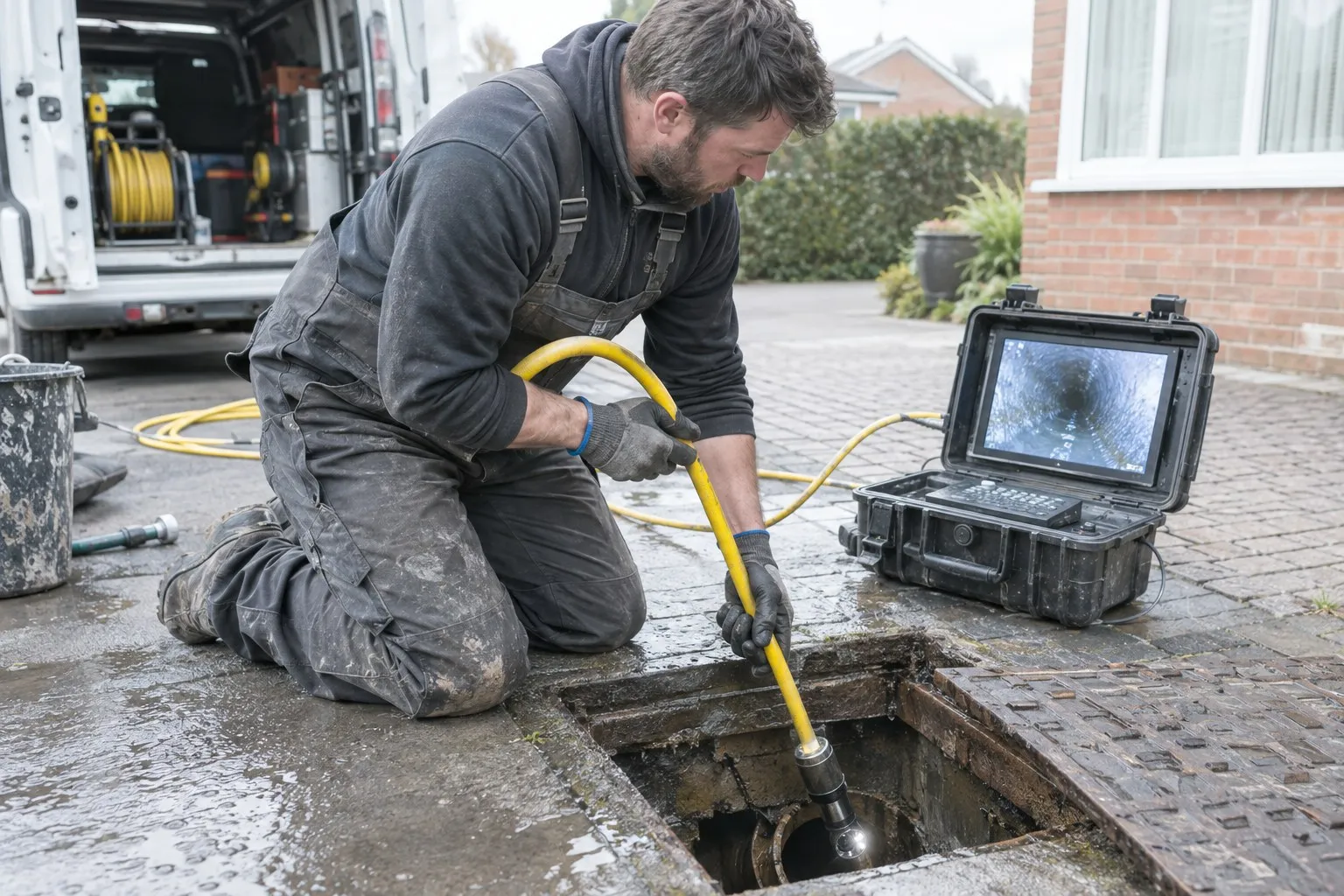
The products near your trade show why the task matters. Picote Solutions markets cutting heads mounted on robotic platforms for pipe rehabilitation. Gas App UK describes Boiler Bot as providing diagnostic guidance and technical information.
Picote sells a cutting head. Gas App UK sells a diagnostic chatbot. Neither company has published a single case of its product completing a domestic repair on its own.
A claim that tools and technology replace an occupation has to account for the work left between those operations. A cutting head operates inside a pipe. A diagnostic chatbot supplies an answer for someone to act on.
CCL Wetrooms describes bathroom pods arriving as completed units with plumbing already installed. Prefabrication changes where installation happens. The route identified in Oxford’s later paper does not depend on a robot copying every movement you make in a customer’s house.
Another supplier, Offsite Solutions, claims over 100,000 bathroom pods delivered on its website, checked in September 2026. The figure counts units supplied, not robots repairing leaks or plumbers displaced.
At an existing leaking connection, the “complex perception and manipulation” in that reassessment means working out how to reach the joint and making the repair. Today’s evidence does not show AI can replace you as a plumber. Prefabrication can move work off site, so that is no guarantee for your job.

Trade resources for tradespeople, straight to your inbox.
Occasionally we will send you a newsletter. Free, unsubscribe in one click.
Keep reading
Will AI replace electricians? The tools take on tasks, not responsibility
Machines drill planned holes. Apps record test readings. Automating those tasks does not mean taking over the completed installation or your responsibility for it.
Are smart glasses allowed at work? The gap in the privacy regulator's guidance
The privacy regulator's guidance names body cameras, not glasses. Your decisions start before purchase and get harder when an employee brings their own pair.

CCTV in the workplace UK: what you have to do before you switch it on
The maximum fine gets quoted in every article about cameras at work, and it is not going to happen to you. Staff complaints, an order to stop recording and an unpaid ICO fee are the nearer concerns.