
Will AI replace electricians? The tools take on tasks, not responsibility
Machines drill planned holes. Apps record test readings. Automating those tasks does not mean taking over the completed installation or your responsibility for it.
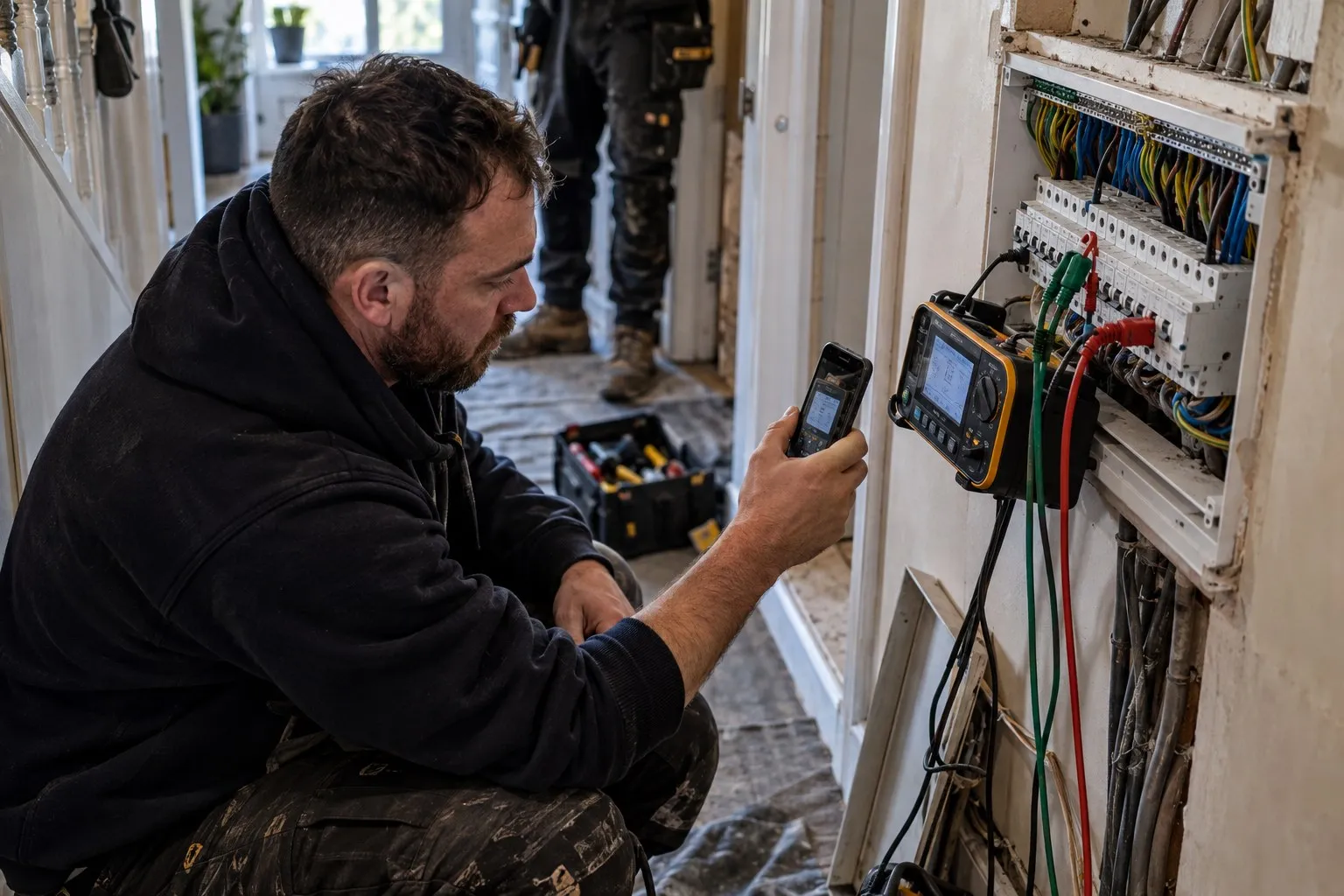
On the IET’s model Electrical Installation Certificate (EIC) for BS 7671:2018+A4:2026, you certify that you exercised reasonable skill and care, and that the work you were responsible for is in accordance with BS 7671 to the best of your knowledge and belief, except for stated departures. Design and construction have separate declarations, as does inspection and testing. The form names the responsible signatories and limits their liability to the work described.
Will AI replace electricians? Today’s products automate particular tasks within those wider duties.
Will AI replace electricians? The starting point is Regulation 16
Regulation 16 of the Electricity at Work Regulations 1989 requires knowledge or experience where necessary to prevent danger or, where appropriate, injury. You must possess it or receive supervision appropriate to the nature of the work. The duty names a person.
For notifiable domestic electrical work in England, Approved Document P describes three certification routes: self-certification by a registered competent person, certification by a registered third-party certifier or certification by a building control body.
The 2013 document references older Wiring Regulations. It permits updated standards as guidance if they continue to address the relevant Building Regulations requirements.
Across the AI for tradesmen market, management software handles scheduling and invoicing. Countfire sells drawing-symbol counting to the electrical estimator, a separate occupation from your installation work.
Asked about another trade, the same question tends to arrive as an employment forecast: will AI replace plumbers takes those figures back to the reports they came from. Regulation 16 asks something narrower, and it asks it of you.
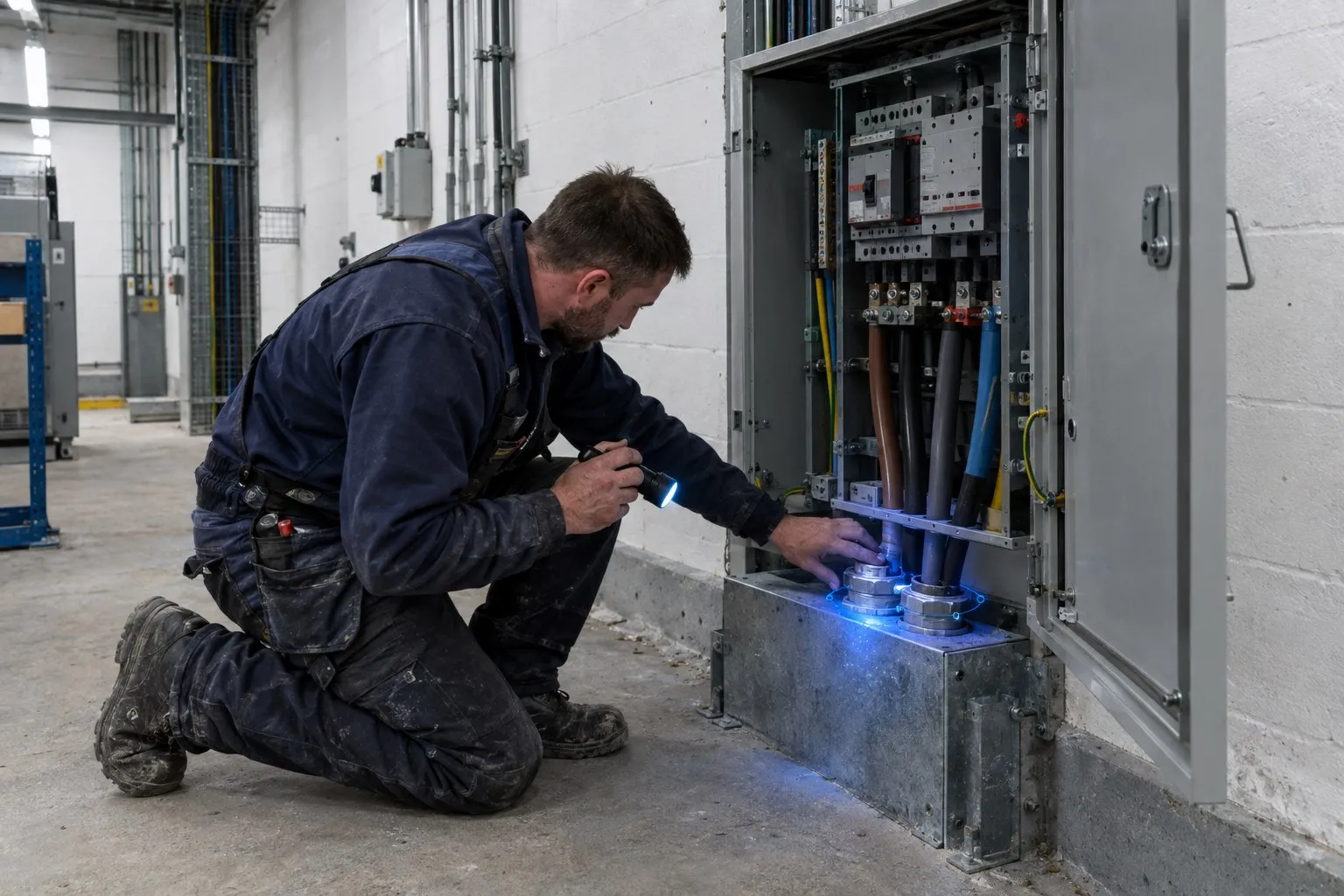
The products take slices of an electrician’s written duties
You obtain the results and record them. Skills England separates those skills in its installation and maintenance electrician standard, ST0152 v1.2.
| Written duty or skill | Supplier’s published function | Where that leaves you |
|---|---|---|
| Duty 8: install cables within building fabric, maintaining fire compartments | Hilti Jaibot marks and drills planned fixing holes | It prepares fixing points. Hilti’s description ends at the drilled hole; the cable and the fire compartment are still your work. |
| Skill S9: inspect and test using test equipment | iCertifi Test Vision photographs an instrument display and transfers readings | Your inspection and physical test produce the result the app records. |
| Duty 13 and skill S14: complete documentation and record results | Tradecert extracts circuit information from board photographs and suggests certificate wording | It assists with the record. Its conditions require competent-person review before use. |
| Skill S10: apply diagnostic techniques to identify and resolve faults | ElectriciansMate guides troubleshooting from the system details and symptoms you enter | You perform the tests and the repair. The supplier’s workflow depends on your observations. |
Sources: Skills England and suppliers’ descriptions, reviewed on 21 September 2026. Published functions, not hands-on findings.
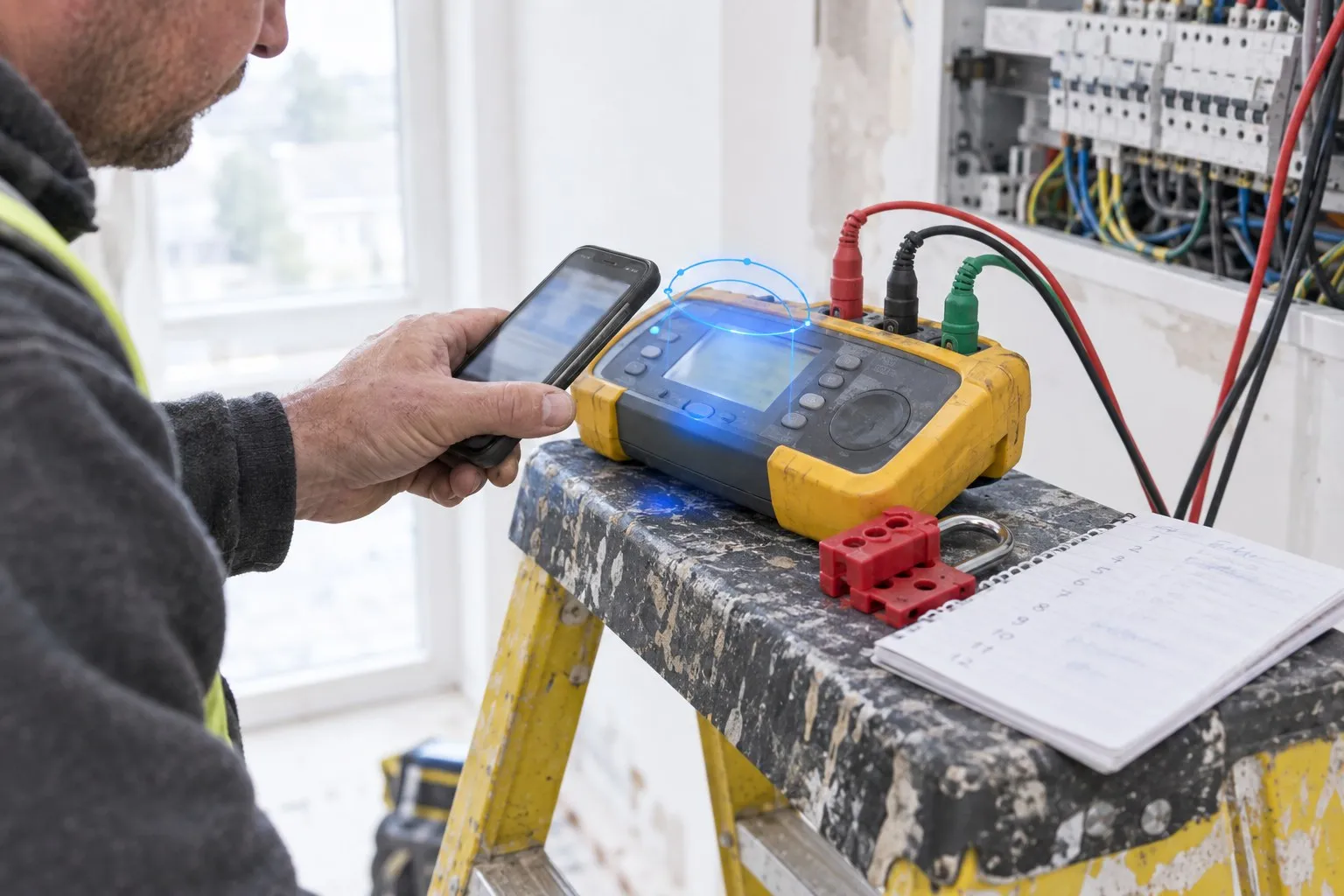
National Electrotechnical Training (NET) runs the AM2 practical competence assessment. Its May 2025 candidate checklist requires you to verify that the results obtained conform to the values required by BS 7671 and IET Guidance Note 3. Accurate transcription covers the recording half. You verify the result against the standard before the photograph.
The IET’s model test schedule prohibits an incorrect-polarity mark when issued with an EIC. You need an acceptable result.
The assessment requires you to demonstrate the work
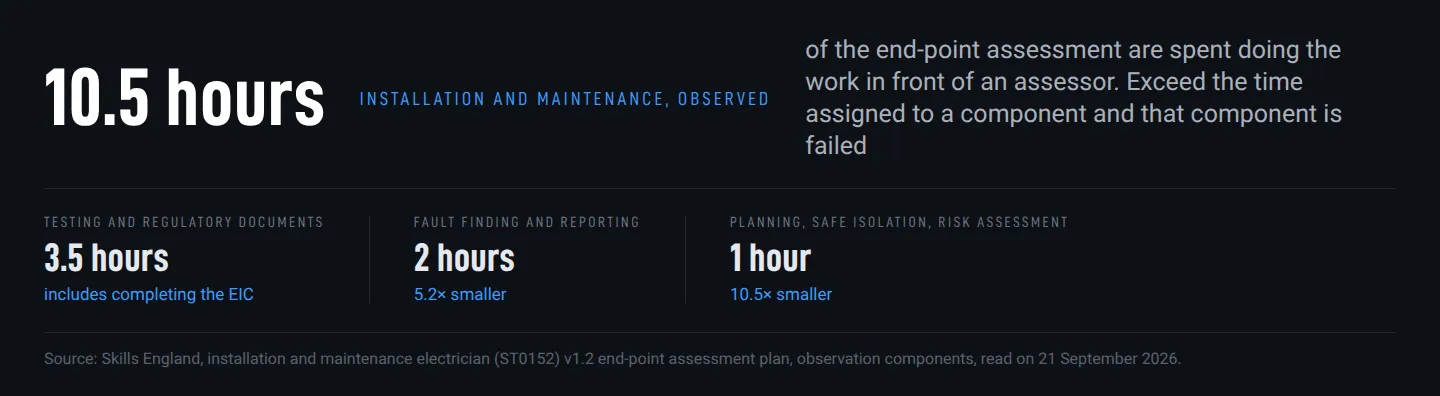
In the practical assessment, you do the work in front of an assessor. NET distinguishes the NVQ-route AM2 from the apprenticeship AM2S.
NET’s AM2 checklist starts with visual inspection. Its tests include protective-conductor and ring continuity, insulation resistance, polarity, earth fault-loop impedance, prospective fault current, phase sequence and rotation checks, and functional testing.
Skills England puts your EIC in the same timed assessment component as the physical tests.
Unsafe practice stops the testing or fault-finding component with a fail. Exceeding the assigned time fails the installation, testing or fault-finding component concerned.
Official documents disagree: Skills England specifies pass/fail; City & Guilds’ July 2026 handbook describes pass/merit/distinction; NET publishes different timings. Each requires practical demonstration.
Could AI replace electricians? The contracts leave judgement with you
Tradecert and ElectriciansMate put verification back on you in their terms.
Under its terms, Tradecert requires independent verification of every safety-critical value before issuing a document where the work is subject to a statutory safety regime.
ElectriciansMate’s terms say the app does not replace professional judgement or training, and that you assume full responsibility for work done with it. The company publishes user testimonials, but no diagnostic accuracy measure.
iCertifi’s Board Vision accuracy claim covers recognising equipment in photographs. The company supplies no measurement method. Even if you accept the claim, inspecting your installation is a separate skill under ST0152. The AM2 assesses it separately, beginning with visual inspection.
Elec-Mate’s page describes specialists trained on “BS 7671:2018+A4:2026 (Amendment 3:2024)”. The wording names different amendments within the same training claim. The page does not explain which version informs your answers.
Machines already take work at the fixing point
On a concrete soffit, Hilti’s semi-autonomous Jaibot drills holes from a digital plan, with an operator and total station.
Engineering News-Record’s 2020 reporting describes the operator repositioning it and deciding whether to skip a hole. Dalkia’s May 2024 account of its own UK trial concerns anchor-hole drilling for bracket fixing points.
Installing anchors and hanging containment follow the drilling.

Construction Management reported HP SitePrint’s commercial availability in the UK and Ireland in July 2023. It prints lines and information from digital drawings onto floors. Among site tools and technology, it is an example of automation executing a prepared plan.
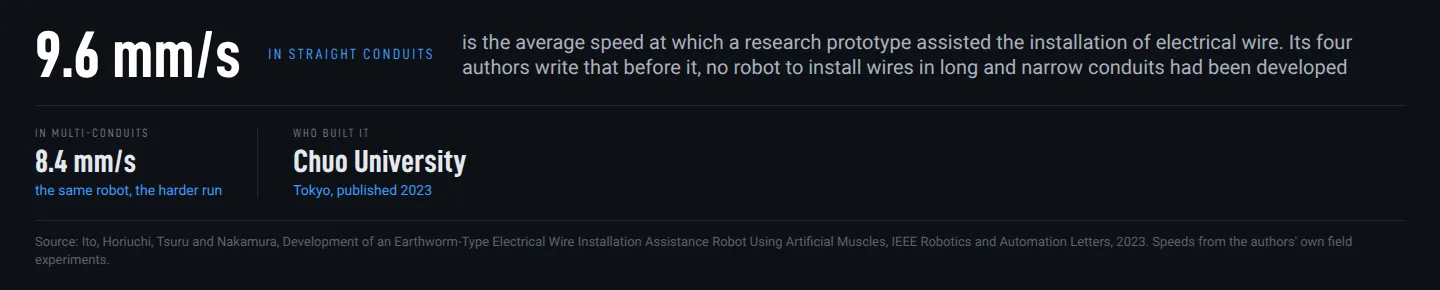
Researchers at Chuo University in Tokyo reported a wire-installation assistance robot driven by pneumatic artificial muscles in IEEE Robotics and Automation Letters in 2023. Their field experiments measured its speed assisting wire installation through conduits.
Prefabrication takes a different route. SES Manufacturing lists factory-built distribution boards and conduit assemblies. Wieland describes PREFAB as moving complex installation work into factory-built components ready for connection.
Your site task changes because part of the assembly arrives complete. Skills England includes plug-and-play components in ST0152 duty 11. Who assembled that board, and how much of that assembly was automated, is a question for the factory.
Replacing electricians in the future needs evidence from a complete job
For a system to take on your complete installation job, independent assessment would have to demonstrate completed work and fault handling under site conditions, including verification of the result. Responsibility would need a lawful certification route.
The sources reviewed for this article on 21 September 2026 document individual tasks, with no independent assessment meeting that condition. Some forums and review sites blocked access, and a cap on the number of searches limited the review’s reach.
The declaration behind an automated signature would still have to be true.

Trade resources for tradespeople, straight to your inbox.
Occasionally we will send you a newsletter. Free, unsubscribe in one click.
Keep reading
Will AI replace plumbers? The headline isn't a forecast for your job
The biggest job-loss headlines count different things. The original papers tell you more about plumbing than the headlines do, but none gives you a reliable forecast for your own job.
Are smart glasses allowed at work? The gap in the privacy regulator's guidance
The privacy regulator's guidance names body cameras, not glasses. Your decisions start before purchase and get harder when an employee brings their own pair.
CCTV in the workplace UK: what you have to do before you switch it on
The maximum fine gets quoted in every article about cameras at work, and it is not going to happen to you. Staff complaints, an order to stop recording and an unpaid ICO fee are the nearer concerns.