
Building regs for boiler replacement: what goes on your Gas Safe notification
You notify the boiler and its controls through Gas Safe. A new chimney liner or electrical circuit takes another route. An unvented cylinder depends on the scope of your registration.
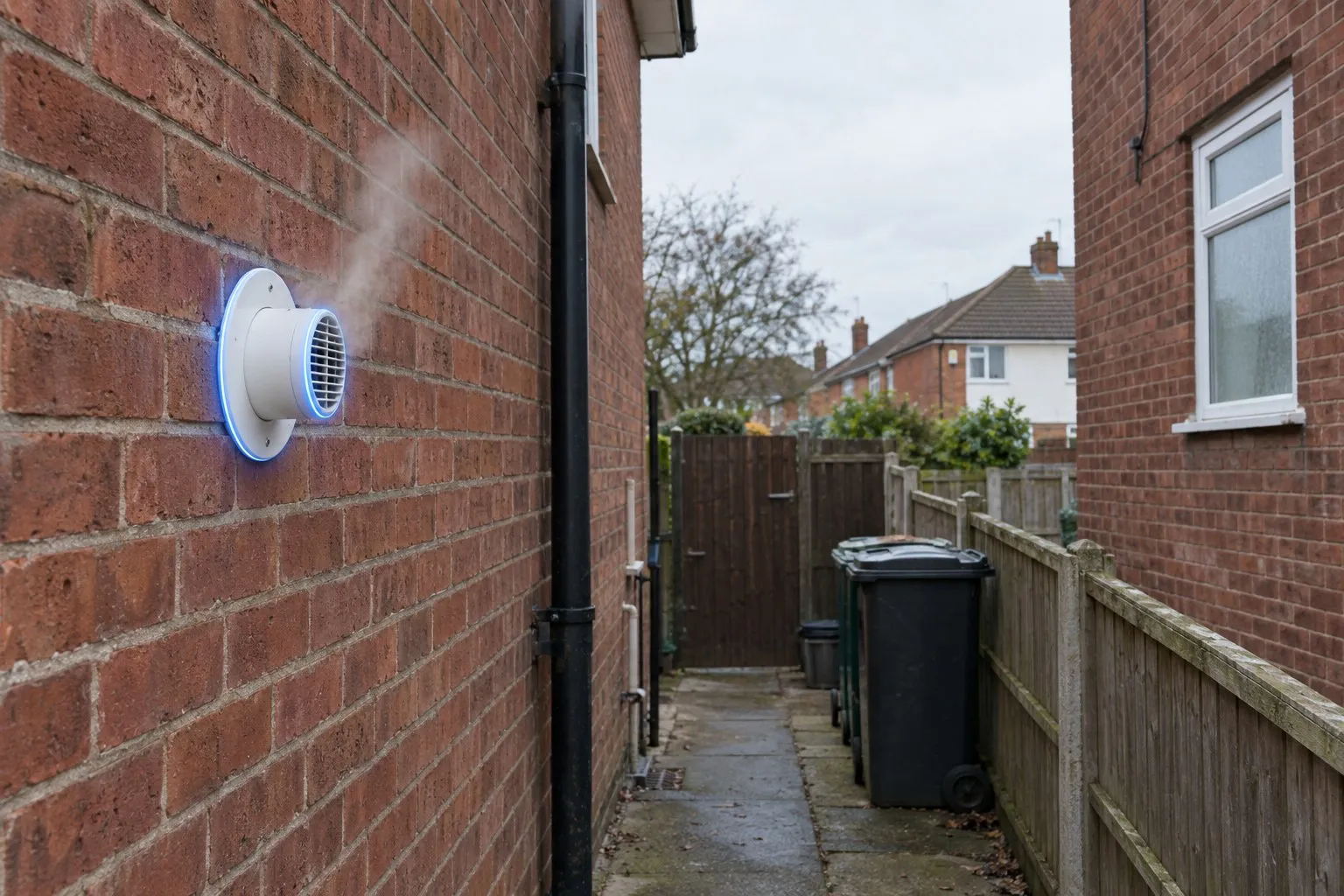
A replacement combi in the same position goes on your Gas Safe notification. The same boiler connected to a new liner in a masonry chimney also needs building control notification for the liner, before work starts.
The scope here is England; Wales, Scotland and Northern Ireland have their own regimes.
Building regs for boiler replacement apply even in the same spot
Building regs apply to every boiler replacement: Approved Document J, the government’s guidance on Part J, says all work on a combustion appliance other than repair or maintenance is notifiable.
You notify the appliance through Gas Safe, with the notification deadline covered in building control for the trades. Schedule 3 of the Building Regulations 2010, which lists who may self-certify what, covers the appliance in row 1 and associated heating or hot-water systems, including controls, in row 4.
Requirement J3 requires carbon monoxide warning provision. Approved Document J 3.43 says a new or replacement gas appliance in a dwelling should have a carbon monoxide alarm in its room, as a way of meeting that duty.
Gas Safe building regulations compliance certificate: who gets it, and a missing one
Your registered business notifies the installation. Gas Safe’s consumer pages, checked on 6 October 2026, and its consumer factsheet, revised April 2016, describe the procedure: the council receives an electronic record and your customer gets the certificate by post.
The certificate belongs to the property. The landlord’s Gas Safety Record, once called CP12, and your Benchmark commissioning checklist are different documents. Gas Safe says the compliance certificate does not represent the appliance’s present condition.
Unnotified work comes back to your installing business: Gas Safe tells the customer to contact you and ask you to notify. If the original business has closed or left the register, Gas Safe’s factsheet calls for another suitably qualified registered business to check and commission the installation. The replacement business then notifies in its own name.
Before your customer appoints that business, they can check the Gas Safe Register.
The owner or solicitor can order a paid duplicate from Gas Safe, online or through its customer services line, subject to its data-retention policy. For a customer with no building regulation certificate for the boiler, a check on Gas Safe’s website establishes whether the installation was notified.
A new flue through the wall or into a chimney
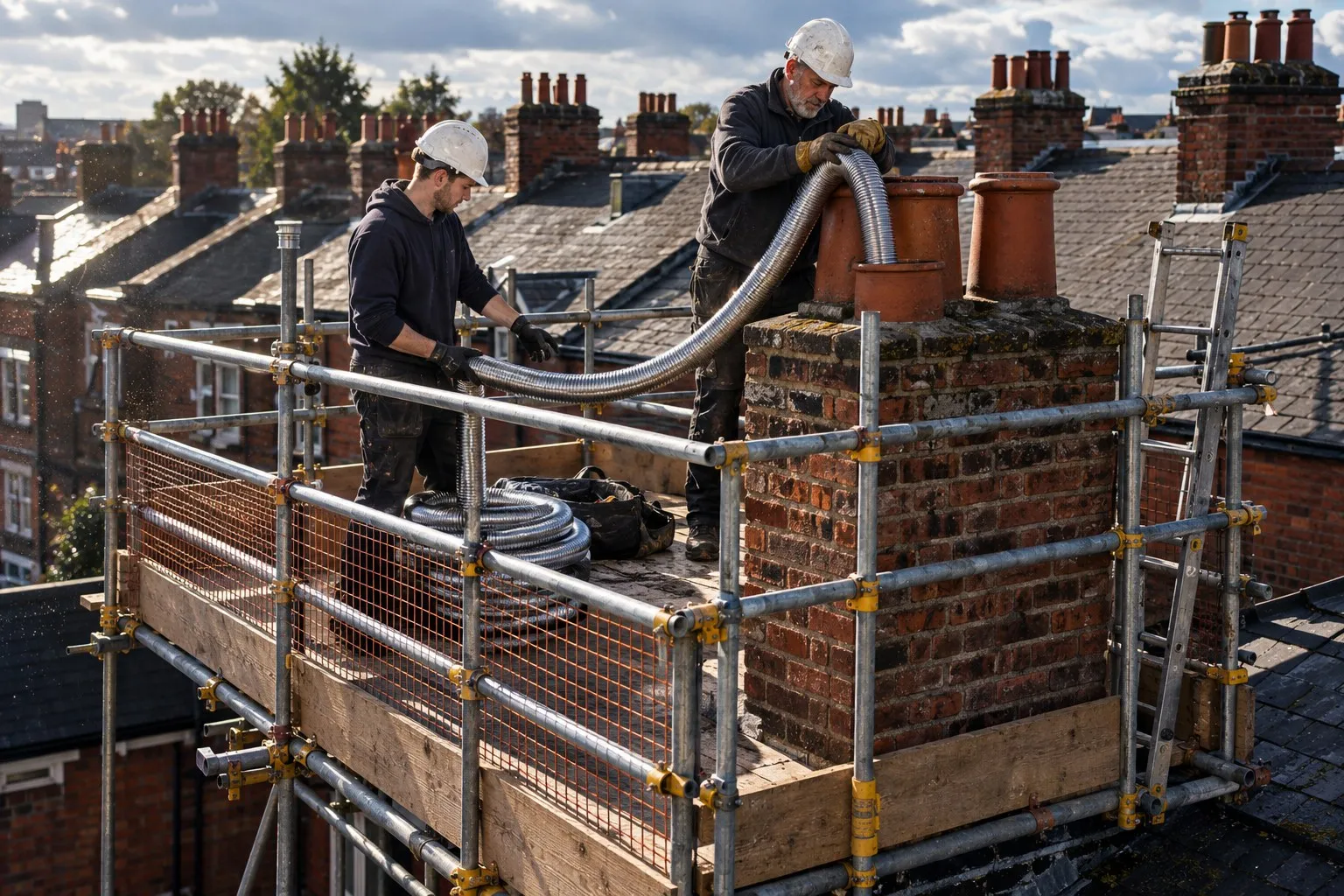
For a new liner in a masonry chimney, Approved Document J 1.35 says the relining is building work that must not start without notifying the local authority. That notice goes to building control, not Gas Safe.
Neither Schedule 3 nor Approved Document J says whether a wall terminal supplied with the boiler is part of the appliance. It stays on your Gas Safe notification only on the reading that it is.
Approved Document J’s Diagram 34 gives 150 mm from a vertical drainpipe and 300 mm from a corner. Two Vaillant ecoTEC plus manuals, for its 46 and 60 kW boilers and a storage combi, give 25 mm and 200 mm, which Vaillant says comply with the building regulations but may need increasing to avoid wall staining and plume nuisance. Neither document says which governs the terminal position.
Either way, J2 requires adequate discharge to outside air, and Approved Document J 3.5(g) summarises the gas duty as a flue “adequate, suitable and effective” for its appliance. Paragraph 1.35 directs notification doubts to building control.
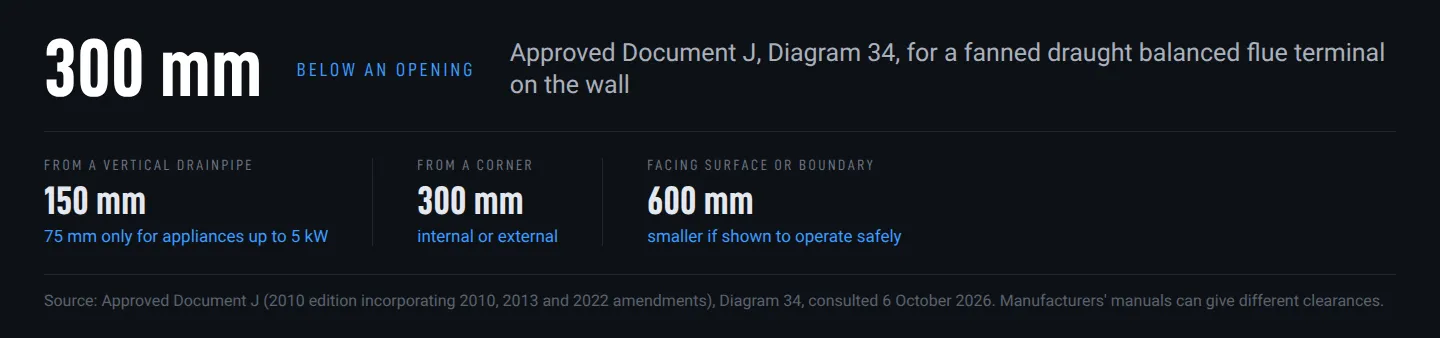
The note to J 3.23 puts plume nuisance outside building regulations and warns of possible statutory nuisance under the Environmental Protection Act. Paragraph 1.52 says flues discharging at low level near a boundary should do so where the building owner will always be able to keep the flue gases dispersing safely. Meeting the diagram’s safety distances can still leave a nuisance for the neighbour.
Moving the boiler into the loft, with new condensate and gas runs
If you move the boiler into the loft, you still notify the appliance through Gas Safe. Schedule 3 row 1 covers the appliance; Approved Document J 1.60 recommends permanent safe access for maintenance and points roof-space gas installations to BS 6798:2009, a paid British Standard.
No Schedule 3 row names condensate, so the table at the end treats the connection as installation work under rows 1 and 4. Approved Document H 1.14 recommends a minimum 22 mm pipe through a 75 mm condensate trap; where a separate trap outside the boiler provides the 75 mm seal, it calls for an air gap between boiler and trap. Receiving pipework should resist pH 6.5 and lower.
Schedule 3 lists appliance and heating-system work without a separate gas-pipework row. New gas pipework is Gas Safe work under gas law: regulation 3(3) of the Gas Safety (Installation and Use) Regulations 1998 limits it to the class of persons the Health and Safety Executive approves, which is Gas Safe registration.

Unvented cylinder or combi conversion: your registration’s scope
A regular or system boiler converted to a combi stays on your Gas Safe notification, appliance and heating system included. Schedule 3 rows 1 and 4 provide those routes.
For a new “wholesome” cold-water supply, row 13 of Schedule 3 lists five schemes (APHC, BESCA, Certsure, HETAS and NAPIT), not Gas Safe. Schedule 4 paragraph 1(k) exempts specified alterations to an existing supply: replacing a part, or adding an output or control device.
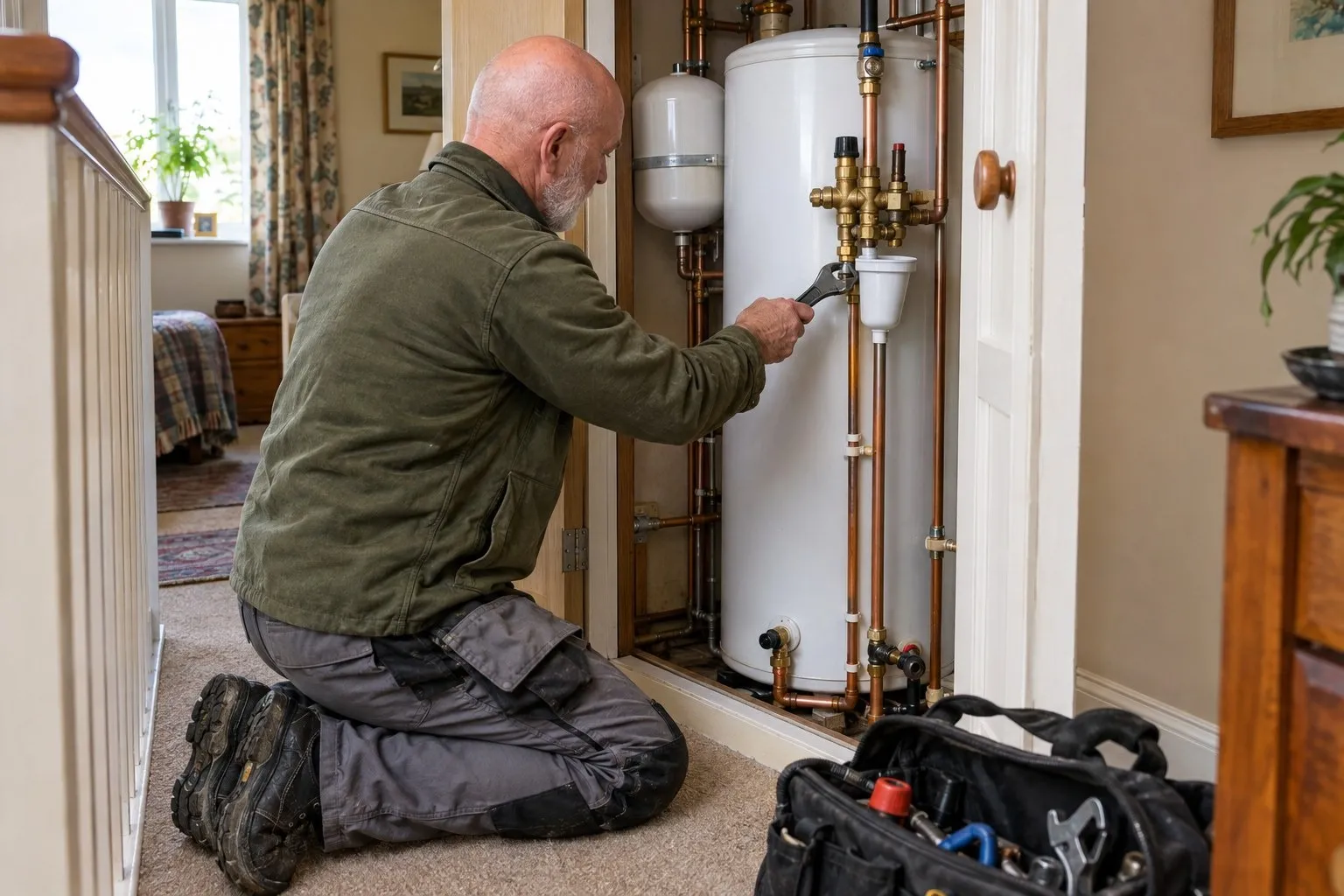
Installing an unvented cylinder is notifiable building work. Approved Document G 3.41 requires notification to building control before work starts. Paragraph 3.42 exempts an installer registered with a competent person scheme for unvented hot-water systems from advance notification.
Schedule 3 row 4 lists Gas Safe for hot-water systems; the 3.42 exemption turns on whether your registration covers unvented systems.
Boiler controls go on the same Gas Safe notification
Fitting controls with the boiler puts them on your Gas Safe notification. Approved Document L 5.27 treats them as part of the installation, covered by Schedule 3 row 4.
The Approved Documents cited were checked on 6 October 2026. Part L here is the 2021 edition with 2023 amendments; the 2026 edition takes effect on 24 March 2027 for work other than higher-risk building work, with transitional arrangements.
L1(b) requires reasonably energy-efficient services with effective controls, commissioned by testing and adjusting. For a boiler that means thermostatic room controls in each room and a boiler interlock (Approved Document L 5.20 and 5.25), or zone control where 5.21 justifies it.
Whenever a gas combi boiler goes into an existing dwelling, paragraph 6.2 says at least one additional measure should be installed: flue-gas heat recovery, weather compensation, load compensation, or a smart thermostat with automation and optimisation.
Adding only a control device to an existing system needs no notification where testing and adjusting it is impossible or would not affect its energy efficiency (Schedule 4 paragraph 1(f)(iii)).
Regulation 44 requires a notice to building control that the system has been commissioned. As a registered installer you may give it yourself (Approved Document L 8.6), and paragraph 8.8 accepts the Benchmark checklist as evidence of satisfactory commissioning.
For a new electrical circuit, another registered installer
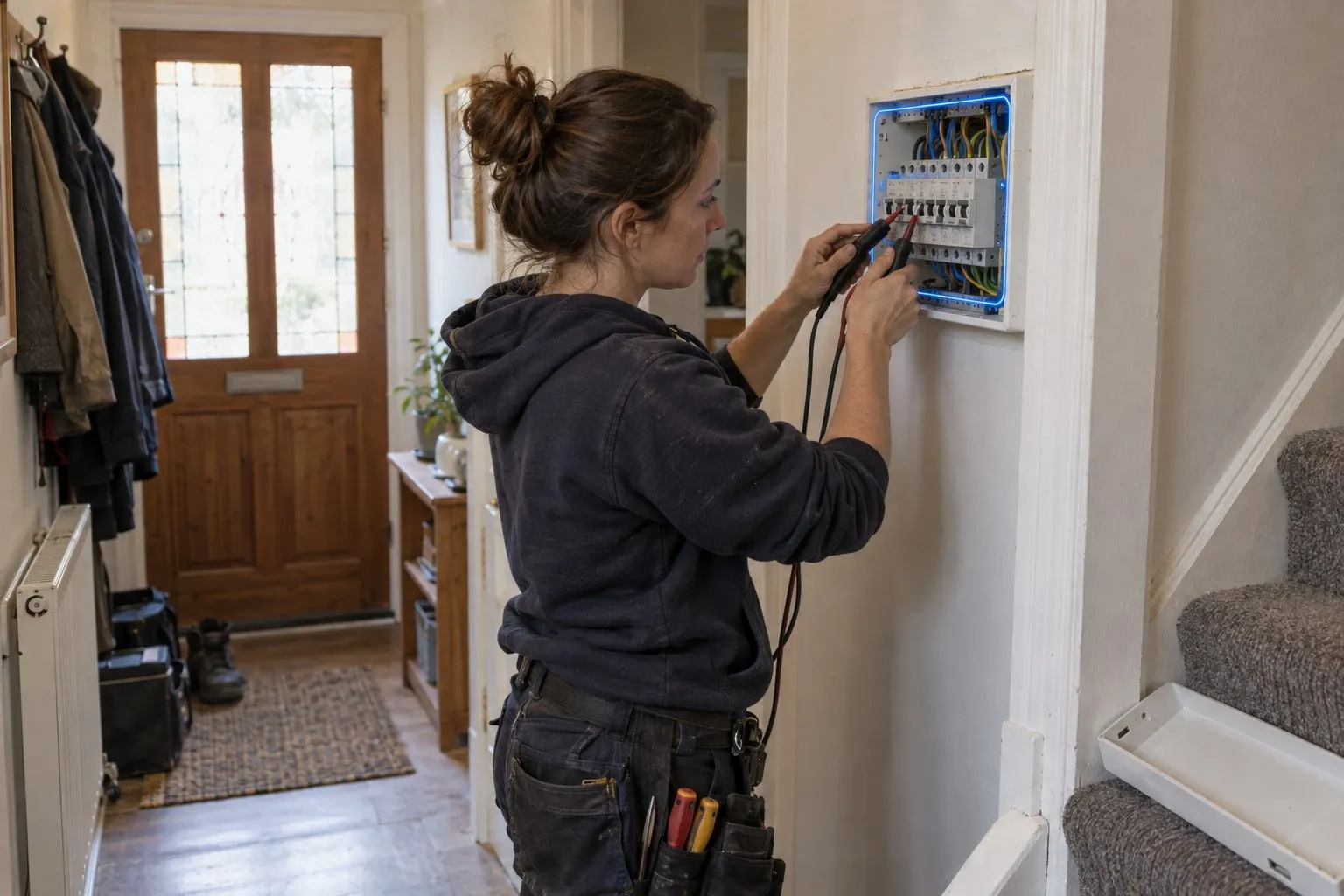
A new circuit for the boiler, notifiable under regulation 12(6A)(a), is certified by an electrically registered installer. Approved Document P 3.1 also permits certification by a registered third-party certifier or building control.
A spur from an existing circuit is not notifiable under Approved Document P 2.7, unless it is in a special location: the space around a bath or shower, or a room with a swimming pool or sauna heater.
With staff spread across jobs, running the business includes naming the certifying electrician on the job sheet before the circuit goes in.
Under the building regulations for boiler replacement, the task decides who notifies or certifies:
| Task | Who notifies or certifies | Where the rule is written |
|---|---|---|
| Same-position boiler replacement | Gas Safe | Schedule 3, rows 1 and 4; Approved Document J 3.43; Approved Document L 6.2 if a combi |
| Moving the boiler | Gas Safe for appliance and heating system | Schedule 3, rows 1 and 4 |
| Regular or system boiler to combi | Gas Safe for appliance and heating system | Schedule 3, rows 1 and 4; Approved Document L 6.2 |
| New flue | Building control for a liner; Gas Safe for a wall terminal, if part of the appliance | Approved Document J 1.35; Schedule 3, row 1 |
| Boiler in the loft | Gas Safe for appliance | Schedule 3, row 1; Approved Document J 1.60 |
| Condensate connection | Gas Safe, as part of the installation | Schedule 3, rows 1 and 4; Approved Document H 1.14 |
| New gas pipework | Gas Safe under gas law | Gas Safety (Installation and Use) Regulations, regulation 3(3) |
| Installing an unvented cylinder | Installer registered for unvented systems; otherwise building control before starting | Approved Document G 3.41 and 3.42; Schedule 3, row 4 |
| Controls | Gas Safe with the boiler; no notification for exempt control-only additions | Schedule 3, row 4; Schedule 4, paragraph 1(f)(iii); Approved Document L 5.27 |
| New electrical circuit | Electrically registered installer, registered third-party certifier or building control | Schedule 3, rows 8 and 9; Approved Document P 3.1 |
You notify the boiler through Gas Safe; an electrician registered with a scheme such as NICEIC or NAPIT takes responsibility for the new circuit’s electrical certification.

Trade resources for tradespeople, straight to your inbox.
Occasionally we will send you a newsletter. Free, unsubscribe in one click.
Keep reading
NICEIC or NAPIT: first-year cost, renewal and per-job charges
NICEIC's £834 covers application and 12 months' certification. NAPIT's £786 covers application and initial assessment, with no published annual fee or confirmation that it is included. Both include VAT. The prices are not like for like.

Building control for the trades
Registered installers can certify their own work. You still have an extension to manage, inspections to arrange and a declaration to sign. These are England's rules.
Is it worth taking on an apprentice? Yes, if they stay past qualifying
An apprentice can repay the investment, but the available British model puts recovery after qualification. What they produce matters, and so does the time your engineer spends teaching them.