
NICEIC or NAPIT: first-year cost, renewal and per-job charges
NICEIC's £834 covers application and 12 months' certification. NAPIT's £786 covers application and initial assessment, with no published annual fee or confirmation that it is included. Both include VAT. The prices are not like for like.
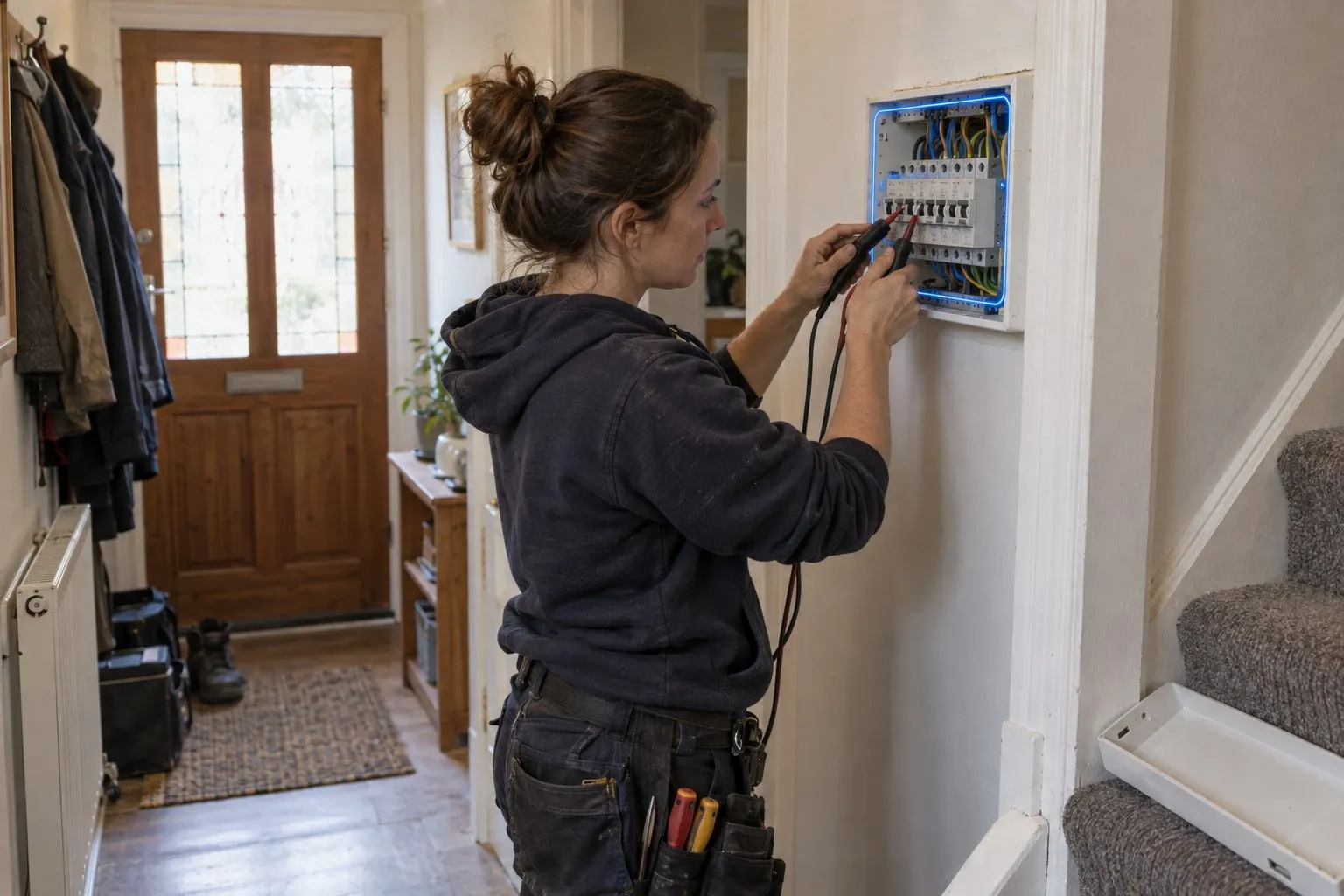
With NICEIC or NAPIT, your fee buys the same Part P right in England: self-certifying your own notifiable work. The scheme notifies building control and sends your customer the Building Regulations Compliance Certificate. Both appear on GOV.UK’s domestic electrical schemes list and assess against the Electrotechnical Assessment Specification (EAS).
NICEIC’s £834 including VAT covers application and 12 months’ certification. NAPIT’s £786 including VAT covers application and initial assessment. The prices are not like for like: NAPIT does not publish its initial annual fee or whether £786 includes it. Those prices were checked on 6 October 2026.
Part P self-certification is England’s; Wales, Scotland and Northern Ireland run their own schemes. Notifiable work still needs a route set out in building control for the trades, whether you pay a subscription or not.
NICEIC and NAPIT registration cost: the joining bill
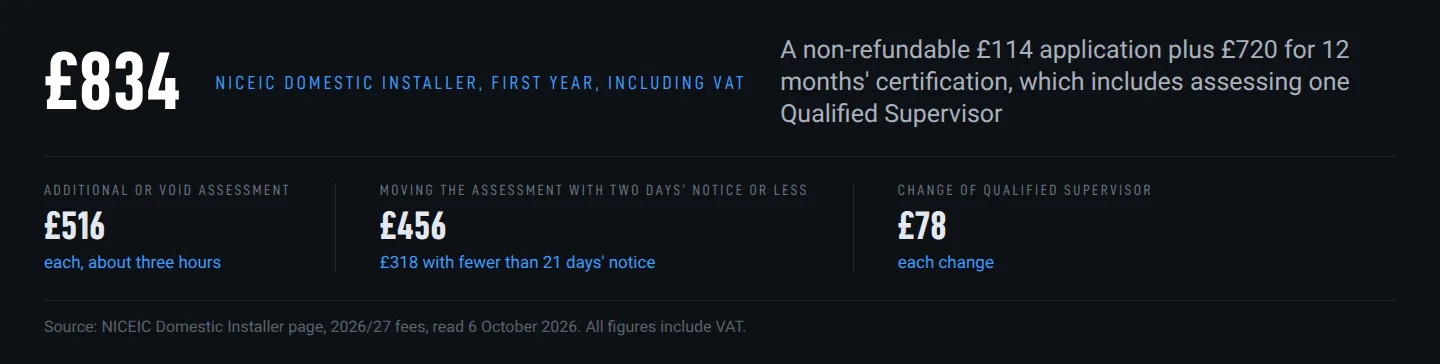
The NICEIC registration cost splits into £114 for the non-refundable application and £720 for 12 months’ certification, both including VAT. Its 2026/27 Domestic Installer fee tables include assessment of one Qualified Supervisor: your nominated competent person responsible for technical standards, with at least two years’ technical responsibility. You pay £114 with the application. Certification can be paid in three interest-free monthly payments, the first before assessment and the rest before certification starts.
An additional assessment costs £516 including VAT under the same fee tables. Insufficient work to assess can trigger that charge. Rescheduling costs £456 with two days’ notice or less, £318 with more than two but under 21 days; changing the Qualified Supervisor costs £78, all including VAT.
The NAPIT registration cost is £655 plus VAT on its joining page, the same £786 including VAT on form APP/FOR/0024 v1.4 (09.26): £156 non-refundable deposit plus £630 balance. It covers application and initial assessment for one or more selected electrical scopes, assuming one visit suffices. Reassessment has no published price. Whether the £786 includes an annual fee is the first point to ask NAPIT about before paying. The form’s version and date need checking too, because prices for grants and schemes for the trades can change during the year.
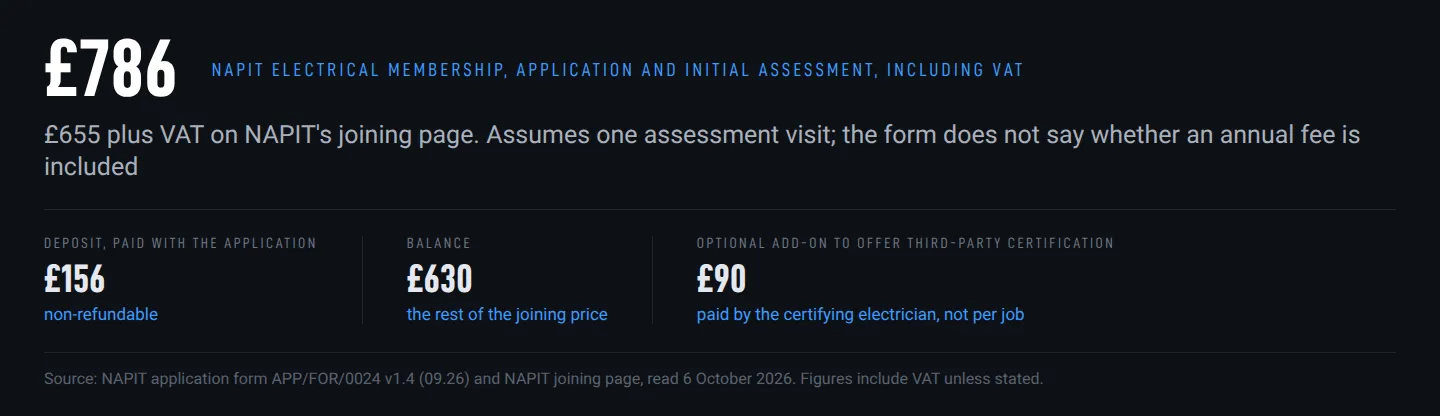
TrustMark is an optional consumer-facing quality mark, unnecessary for Part P. NAPIT’s form prices the add-on at £138 including VAT.
Renewal fees in the second year
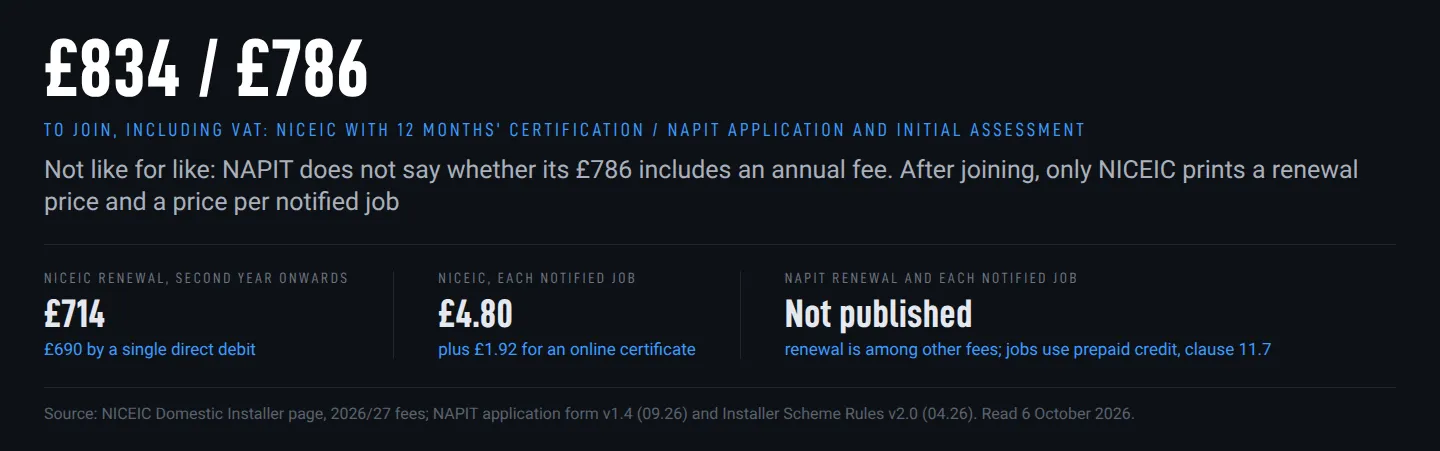
At renewal, NICEIC’s Domestic Installer price is £714 including VAT, or £690 including VAT paid by a single direct debit, according to its fee tables.
NAPIT’s current form lists renewal among additional fees, and its renewal and notification-credit prices are unpublished. Both are figures to obtain before applying.
The Approved Contractor with Domestic Installer bundle matters if you also want commercial and industrial work. NICEIC’s page prices it at £1,542 including VAT on entry, then £738 at renewal, or £714 by single direct debit, both including VAT.
What a NICEIC or NAPIT assessment requires before you pay
Your assessment covers running the business too: the office, instrument records and insurance listed below. Registration itself is not a qualification.
NICEIC’s Domestic Installer Scheme (DIS) rules require the Qualified Supervisor’s full-time availability and a Principal Duty Holder, who may be the same person.
The June 2025 EAS Qualifications Guide requires ongoing professional development. For dwellings-only work it accepts a Level 3 apprenticeship with end-point assessment, including the Domestic Electrician apprenticeship with AM2D. Route 2 covers older apprenticeships or equivalent qualifications. Route 3 is the Experienced Worker Assessment, for at least three years’ full-time work as a domestic electrician. Route 4, the Level 3 Certificate in Installing, Testing and Ensuring Compliance of Electrical Installations in Dwellings, closed to new applicants from 1 January 2026. Earlier holders use Route 2. The guide is where to check your qualification before paying.
NICEIC’s rules require a physical office and BS 7671 with its guides. Virtual offices and PO boxes are unsuitable, as are digital office platforms. Instruments must be held or hired, never borrowed, with accuracy records. You need a certification system and a health and safety policy. Complaints records stay for six years.
Both schemes require £2 million public liability cover. NAPIT’s joining page also requires current calibration certificates and £250,000 professional indemnity cover for inspection and testing.

The assessor examines completed work and work in progress. NICEIC expects enough domestic work to represent the range your business carries out. Its application follows these stages:
- You submit the application with the initial payment.
- You supply the previous 12 months’ domestic work list and work in progress, with customer access arranged.
- The Qualified Supervisor attends throughout. The Principal Duty Holder attends the opening and closing meetings. No part of the assessment may be recorded.
- Independent review leads to certification, a defined scope, deferral or rejection.
- You pay remaining fees before certification takes effect.
Neither scheme publishes a time from application to certification. NICEIC may cancel an application not certified within 12 months of receipt; NAPIT cancels one archived for more than 12 months.
Part P notification fees on every job
For each notifiable job, NICEIC lists separate prices for online notification and installation certificates. Its fee tables price online notification at £4.80 including VAT. Each installation certificate adds £1.92 including VAT online, or £2.28 printed and posted. A notified job with an online certificate therefore costs £6.72 including VAT.
With NAPIT you buy credit in advance and each notification uses it (clause 11.7); its form and rules give no price per credit. If you already hold NAPIT certification for that work under the EAS, adding competent person scheme registration costs no extra fee or assessment (11.2).
Your EIC or MEIWC installation certificate accompanies a separate Building Regulations Compliance Certificate for notifiable work. Your customer can expect that certificate by post within 30 days, according to NAPIT’s household advice, which allows a further week before contacting customer services.
What Part P certification lets you sign off
NICEIC’s January 2026 Electrical Scheme Guide limits Domestic Installer to dwelling work within Approved Document P. Its guide places EICRs under Approved Contractor and does not say Domestic Installer covers them.
NAPIT’s current form offers all-electrical-work and dwellings-only scopes. A defined scope is NAPIT’s third option.
GOV.UK’s list, updated 17 September 2026, also authorises BESCA, Blue Flame Certification and OFTEC for electrical installation work in dwellings.
NICEIC’s undated Platinum Promise terms cover dwelling work completed fewer than six years before a claim. NAPIT’s Work Quality Guarantee terms, v2.0 from May 2018, cover six years, for notified work within your registered scope.
Both cap rectification at £25,000 or the value of the original job, whichever is lower: NICEIC’s terms say the amount paid to the original contractor, NAPIT’s the original contract value. Both protect your customer by funding rectification if you cease trading and cannot put the work right. Both expressly exclude compensation.
Part P without a scheme: paying a third-party certifier
Without membership, you can pay a registered third-party certifier per job. Fees are unpublished; NAPIT’s consumer advice on the Electrical Certifier Scheme says certifiers set their own prices and recommends quotes.
NAPIT’s £90 including VAT add-on is paid by electricians offering third-party certification, not someone buying it for a job.
You must appoint the certifier before work starts. NAPIT’s TPC leaflet requires first-fix and second-fix inspections followed by final testing, with no retrospective certification. Regulation 20A requires you to report completion to the certifier within seven days.
The current Schedule 3A names only NAPIT Registration Limited. Stroma appears only in GOV.UK’s guidance last updated in May 2014.
The council sets its own building control charge for electrical work; the amount needs obtaining from the council.
Switching between NICEIC and NAPIT, or leaving
Switching between installer schemes can remove an entry charge. NICEIC’s Domestic Installer page advertises free transfers subject to its certification criteria.
NAPIT’s current form takes applicants registered elsewhere now or within the previous two years. Section C asks for the previous body, the last assessment date and a Wiring Regulations qualification, and skips the other qualification sections. NAPIT validates previous certification before deciding.
NICEIC’s help hub and NAPIT’s application form specify no notice period for leaving. NICEIC’s rules accept resignation verbally or in writing, and both schemes’ rules keep obligations accrued before cancellation.
Under NAPIT’s Installer Scheme Rules v2.0 (04.26), leaving does not reduce the annual fee already paid (10.8). Work completed but not notified when certification ends needs a call to NAPIT (11.5). You must still fix non-compliant work you were responsible for (11.15).
Before choosing, you need the price for your scope: NICEIC’s Domestic Installer is dwellings-only, with its Approved Contractor bundle for commercial work; NAPIT’s one electrical price applies to all electrical work or dwellings only. Switching remains possible. Ask NAPIT for its unpublished annual fee, renewal price and notification-credit price to put beside NICEIC’s published £834, £714 and £4.80 including VAT.

Trade resources for tradespeople, straight to your inbox.
Occasionally we will send you a newsletter. Free, unsubscribe in one click.
Keep reading
Building regs for boiler replacement: what goes on your Gas Safe notification
You notify the boiler and its controls through Gas Safe. A new chimney liner or electrical circuit takes another route. An unvented cylinder depends on the scope of your registration.

Building control for the trades
Registered installers can certify their own work. You still have an extension to manage, inspections to arrange and a declaration to sign. These are England's rules.

Is it worth taking on an apprentice? Yes, if they stay past qualifying
An apprentice can repay the investment, but the available British model puts recovery after qualification. What they produce matters, and so does the time your engineer spends teaching them.