
CIS explained for UK trades
Paying subcontractors puts the CIS deduction, return and paper trail on your business. That applies to your subcontractor payments even on a job in someone's kitchen, and even when another contractor is making deductions from your own invoices.

Pay a subcontractor for construction work and you take on a tax job as well.
Under the Construction Industry Scheme (CIS), contractors deduct money from qualifying subcontractor payments and pass it to HMRC as an advance towards the subcontractor’s tax and National Insurance. GOV.UK describes a payment on account, rather than an extra tax.
You can be on both sides of CIS
First establish employment status. HMRC’s CIS340 guide, updated on 27 August 2026, says the terms of this engagement decide it. Employees belong under PAYE. Only after deciding that the engagement is self-employed do you ask whether the work falls within CIS. Someone’s previous work as a subcontractor does not settle their status on your job.
HMRC’s Check Employment Status for Tax tool, or CEST, can help you assess that engagement. It asks about the contract, the worker’s responsibilities, who decides how the work is done and how they will be paid. Save your answers and the result. HMRC says it will stand by the result while the information remains accurate and follows its guidance. That gives you a record behind the employment-status declaration you make on your monthly return.
GOV.UK says register before taking on your first subcontractor. CIS340 confirms this includes someone entitled to gross payment. Register through GOV.UK’s “Register as an employer” process; HMRC sends your PAYE reference and instructions.
You can also be a subcontractor when another construction business pays you, then the contractor when you pay someone else. Register for both roles where both apply. The role follows the contract.
The £3 million threshold is for businesses outside construction, GOV.UK says. Your construction business enters CIS through subcontracting covered work.
Same house. Different CIS responsibilities.
GOV.UK includes building work, demolition, alterations, repairs and decorating. CIS340 excludes replacement system parts without other construction operations, such as replacing a boiler within an existing heating system; a complete heating-system installation is covered.
Professional architecture and surveying, materials delivery, offsite manufacture and carpet fitting are excluded. Installing prefabricated components under supply-and-fix arrangements is covered. Carpet fitting is a specific exclusion, rather than an exemption for every kind of flooring.
Under CIS340’s mixed-contract rule, including construction operations brings all payments under that contract into CIS, even on separate invoices. The unit that counts is the contract, not the invoice line. CIS340 also recognises agreements made by word of mouth.
A private householder paying you is outside CIS. But CIS340 says your payments to subcontractors on that same extension can fall inside it. The contract and the payer decide it. The address does not come into it. The building control route for that same extension works the other way round: it follows the work, whoever is paying for it.

HMRC’s answer first. Then payment.
Use HMRC’s free CIS online service or recognised commercial software to verify a new subcontractor before payment. CIS340 says HMRC tells you whether to pay gross or under deduction and supplies a verification reference. The result belongs with your payment records.
CIS340 says you can skip re-verification if the subcontractor appeared on your return in the current or either of the previous two tax years.
GOV.UK’s deduction guidance, checked on 16 September 2026, gives the rates:
- 20% for registered subcontractors paid under deduction.
- 30% for unregistered subcontractors.
- 0% for subcontractors with gross payment status.
CIS340 also requires the higher rate when HMRC cannot identify the subcontractor. HMRC’s answer sets the deduction. What the subcontractor says about their own registration does not.
Gross payment status changes the transfer, not the return
Gross payment status means no CIS deduction. For you as the payer, the instruction comes from HMRC through verification. CIS340 still requires you to include those payments on the monthly return.
The qualification tests belong to the business applying for that status. HMRC checks the business, its turnover and its tax compliance. GOV.UK’s gross-payment guidance requires UK construction work, or the supply of labour for it, and a business run through a bank account.
Excluding VAT and materials, GOV.UK lists £30,000 for sole traders, £30,000 per partner or director or £100,000 for the partnership or company, and £30,000 each for companies with five or fewer controllers. HMRC’s verification result is what you pay on. You do not work the eligibility out yourself.
SI 2016/348 and GOV.UK say £100,000; HMRC’s CISR17290 contradicts them with £200,000.
The compliance test covers the applicant’s tax obligations, including operating CIS correctly when it pays others. HMRC’s reform from 6 April 2024 added VAT filing and payment compliance, with minor VAT failures disregarded.
That last part reaches back into your own cash flow. CIS340 expressly warns that mishandling CIS as a contractor can cost you your own gross payment status when you also work as a subcontractor. Your handling of outgoing payments can change how customers pay your business.
Materials come out. Travel stays in.
Your CIS materials and labour split starts with qualifying costs. GOV.UK says remove VAT, materials paid for directly by the subcontractor, consumables, manufacturing or prefabrication, hired equipment and fuel used for the work before applying the rate.
CIS340 limits plant hire to equipment actually hired from a third party. CIS340 and HMRC’s expenses manual CISR15080 keep travel, accommodation and subsistence in the deduction base, even if you pay the hotel or another supplier directly. That includes travel fuel. Fuel for the machine and fuel for getting to the job receive different treatment.
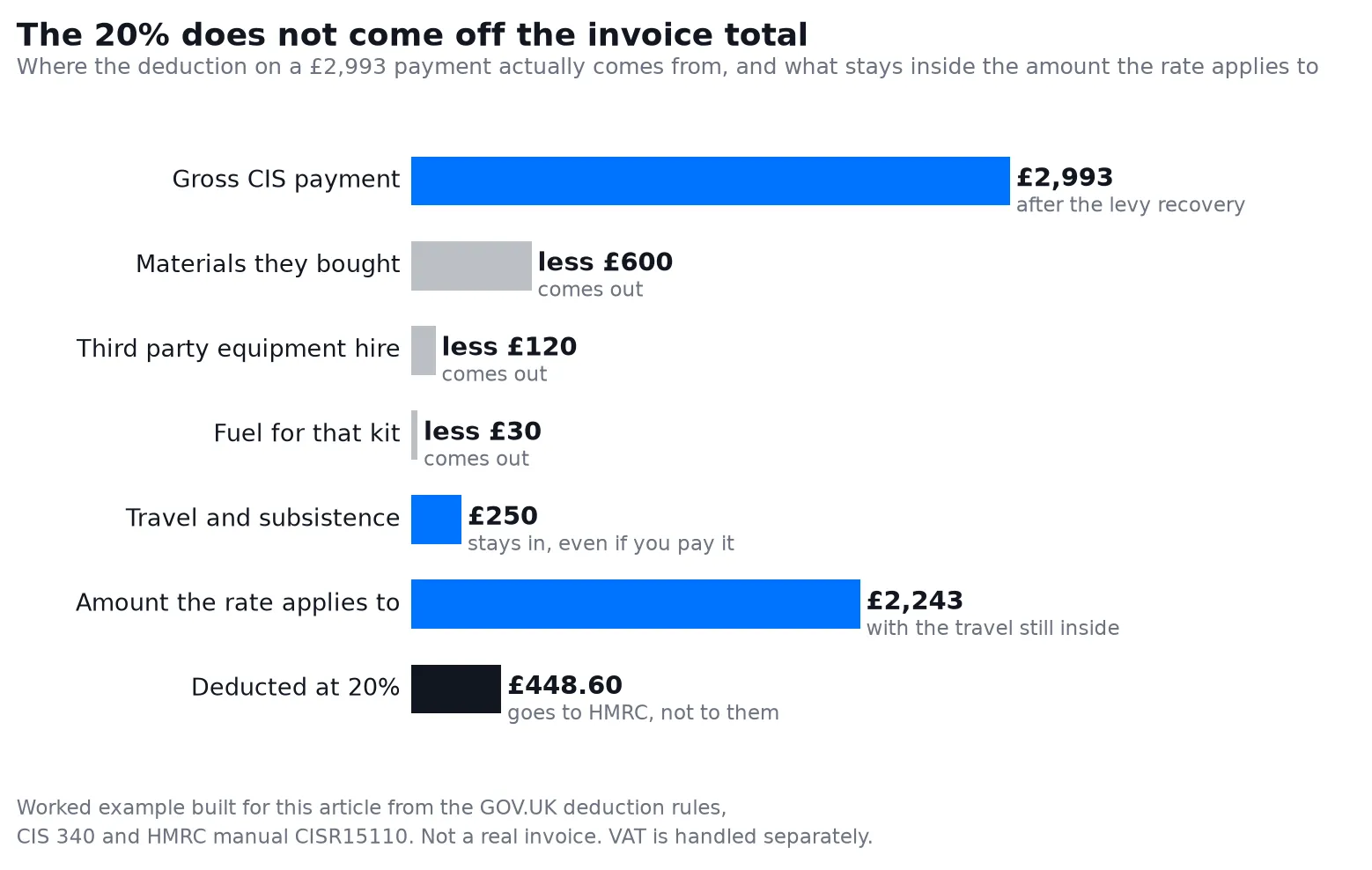
This constructed example uses GOV.UK’s deduction rules and HMRC’s levy treatment in CISR15110. VAT is separate.
| Payment component | Amount |
|---|---|
| Labour | £2,000 |
| Materials bought directly by the subcontractor | £600 |
| Cutting equipment hired from a third party | £120 |
| Fuel for that equipment | £30 |
| Travel and subsistence | £250 |
| Agreed CITB levy recovery withheld | £7 |
After the levy recovery, the gross CIS payment is £2,993. Remove the qualifying materials, hire and machine fuel to leave £2,243. At 20%, you retain £448.60 and transfer the balance. Under HMRC’s domestic reverse charge, where applicable, you account for VAT instead of paying it to your subcontractor.
The travel and subsistence stay in the calculation alongside the labour. Calling the deduction base “labour only” would miss them.
Your CIS deduction statement records what you retained
CIS340 requires a deduction statement showing your name and employer tax reference; the subcontractor’s name and UTR; the tax-month end; gross payments excluding VAT, qualifying materials and deductions; and the verification reference if unmatched. Issue it within 14 days after the tax month ends, meaning the 19th, because the month ends on the 5th.
GOV.UK requires CIS payment records for at least three years after the relevant tax year ends. That is a floor for the CIS records. It is not a date to clear the whole job file.
The 19th is your deadline for returns and statements
CIS340 puts payments, including gross-status payments, in the tax month running from the 6th to the following 5th. The date that counts is the payment date. GOV.UK requires your CIS monthly return by the 19th, and monthly payment to HMRC by the 22nd, or the 19th if paying by post. File through HMRC’s CIS online service or commercial software, declaring subcontractors, payments, deductions, employment-status consideration and required verification.
From 6 April 2026, SI 2026/289 requires mainstream contractors who have previously made payments to file a nil return for a month without payments. The exception is where you notified HMRC in advance that you expected to make no payments; an inactivity notice covers up to six months.
Put that advance-notice requirement in the diary too. It needs attention before the quiet month begins.
Your own deductions can reduce the bill
When you’re getting paid for construction work, your limited company may suffer deductions too. GOV.UK says report the year-to-date total through an Employer Payment Summary, or EPS. HMRC’s payroll guidance sets the deadline for claiming that reduction at the 19th.
CIS340 permits set-off against PAYE, National Insurance, employee student loan repayments and CIS liabilities. The claim goes through the EPS, not the Corporation Tax return. Then you pay what is left.
For a sole trader, GOV.UK gives the annual Self Assessment route instead.

Paying in full can leave you paying again
GOV.UK lists £100 for a return one day late, a further £200 after two months, and the greater of £300 or 5% of the return’s CIS deductions after six months and again after twelve months. You can pay twice: HMRC can claim the deduction you should have made, even though you already paid it to the subcontractor.
Take all contracts, invoices, bank and cash payments, and submitted returns to your accountant or a tax adviser. Ask what to correct, pay and tell HMRC. Keep new payments on the correct CIS footing while the earlier ones are examined.
HMRC claims missed deductions through Regulation 13 determinations. Regulation 9(5) offers possible relief, but the cases below show that reasonable care must be established.
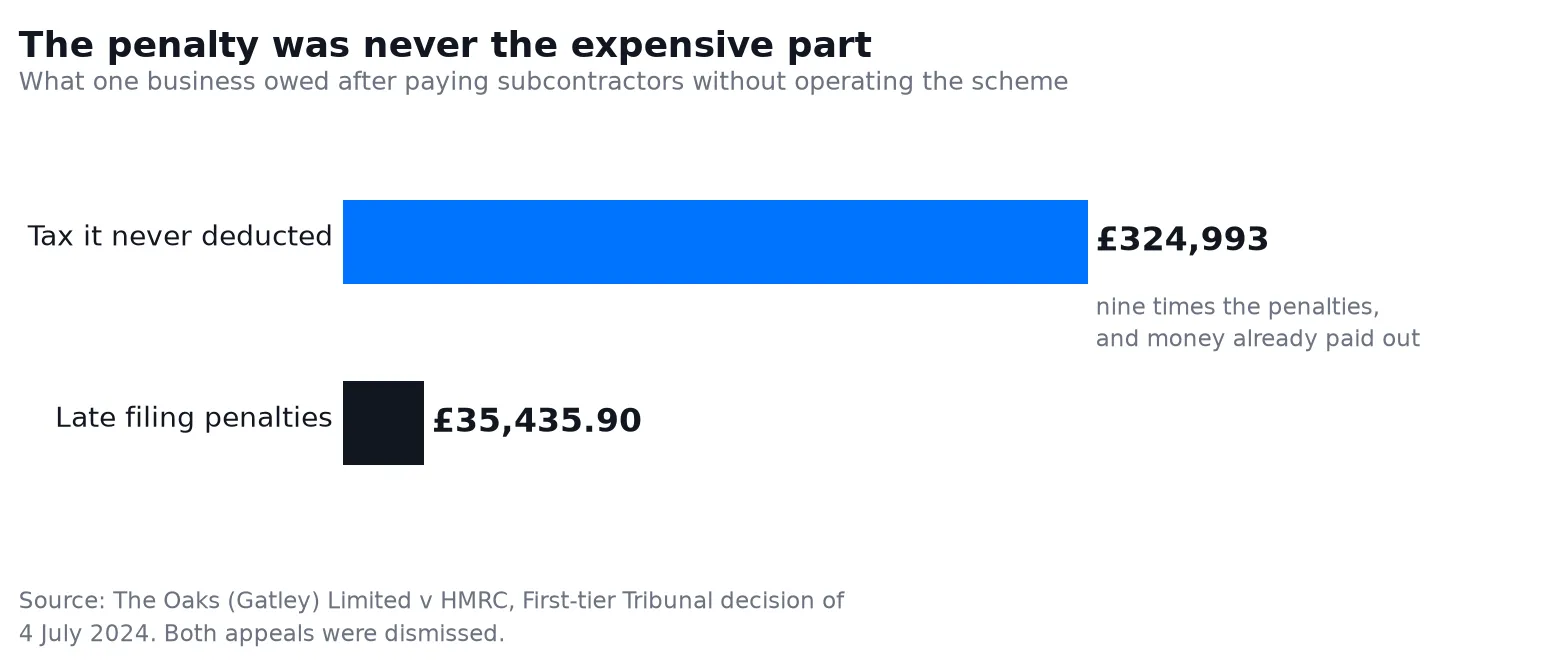
In The Oaks (Gatley) Limited v HMRC, decided in July 2024, the business had made subcontractor payments without deductions. It relied on advice obtained in 2008 that did not fit the actual contract. Its appeals were dismissed. The tax determinations were the larger liability.
In George Star Builders Limited v HMRC, decided in May 2026, the tribunal upheld HMRC’s refusal of Regulation 9(5) relief. The business paid subcontractors in cash without telling its advisers the full facts. It also submitted nil returns despite making payments. Having an accountant did not establish reasonable care when the accountant was missing the information needed to advise.
The decision explained that reasonable care would normally involve seeking appropriate advice, giving advisers a full account of the facts and following that advice.
It also cited PDF Electrical v HMRC, decided in 2012, on the difference between the systems expected of a substantial multinational contractor and those of a small business:
“The compliance systems to be expected of a substantial multi-national contractor with a large and sophisticated accounting department are very different from the systems to be adopted by a small business.”
You do not need a multinational’s accounts department. You do need records of every subcontractor payment. Acting before HMRC asks gives you the opportunity to obtain advice and put the facts forward promptly. It does not automatically remove liability for earlier failures.
Since April 2026, the chain matters too
From 6 April 2026, section 62A of the Finance Act 2004 allows HMRC to claim 20% of the payment if you knew, or should have known, of a connected party’s deliberate CIS or PAYE non-compliance. It applies to the payment, not what you kept back. The CIS penalties that follow such a determination are charged on top of it.
HMRC’s construction labour-fraud guidance, updated in August 2026, asks who pays the workers, and calls for checks on VAT registration, compliance history and suspiciously cheap labour. CIS verification establishes how to pay your subcontractor. Assessing the chain asks a wider question.
Dated checks and the supplier’s answers belong with the contract, including anything they still owe you an explanation for.
Before the next subcontractor payment, check that the rate came from HMRC and not from you, that the materials split only takes out what qualifies, and that the 19th and the 22nd are in the diary.

Trade resources for tradespeople, straight to your inbox.
Occasionally we will send you a newsletter. Free, unsubscribe in one click.
Keep reading
AI for tradesmen: a UK owner's guide, trade by trade
AI can turn a house scan into a heat pump design and help code sewer footage. Further down the trades, the offering gets thin. The price often tells you less than the allowance beside it.

Building control for the trades
Registered installers can certify their own work. You still have an extension to manage, inspections to arrange and a declaration to sign. These are England's rules.

Safety glasses with camera: why your phone usually wins
You can buy glasses with a built-in camera. Whether they can replace your existing PPE is a separate question, and some manufacturers' own pages leave it open.