
CIS materials labour split: what belongs outside the deduction?
Your materials and labour split needs the subcontractor's direct costs behind it. Their markup stays in the CIS base, along with expenses you might never pay into their bank account.

A subcontractor expecting £640 would receive £600 if you included their materials in the CIS deduction. The £40 difference comes from recalculating HMRC’s CIS340 Appendix D3 without its materials allowance. It is an illustration, not a reported payment dispute.
Getting the materials and labour split wrong in the other direction means withholding too little. Your subcontractor has been paid, but your business remains exposed.
CIS340 is HMRC’s contractor guide. CISR numbers identify pages in its internal manual. Your deduction base is the amount you apply the CIS rate to.
CIS materials labour split: materials qualify at direct cost
The materials figure on your subcontractor’s invoice may include a markup. Only their direct purchase cost comes out of the deduction base. Their margin stays in.
Under section 61(1) of the Finance Act 2004, unproven materials costs stay in the deduction base.
HMRC’s CISR15060 ties the allowance to the subcontractor you are paying. If you supplied materials free, their allowance for those materials is nil. If your subcontractor subcontracts again, materials bought by that other business belong to its allowance.
Travel and subsistence remain inside the base even when you pay on the subcontractor’s behalf. CISR15080 includes accommodation too; CIS explained for UK trades covers HMRC’s rate, which may be 30%, not 20%.
VAT changes the materials allowance
A VAT line changes your starting figure before you reach materials. CIS340 paragraph 3.12 tells you to exclude VAT charged by a VAT-registered subcontractor. Whether that VAT should have been charged at all is a separate question, decided by the VAT domestic reverse charge and its own chain of tests on the same invoice.
For the materials allowance, CISR15100 uses VAT-exclusive costs for a registered subcontractor. An unregistered subcontractor can include the VAT they paid on materials.
CIS340’s examples D2 and D3 both use materials costing £240 including VAT. The unregistered subcontractor in D2 gets a £240 allowance. The VAT-registered painter in D3 gets £200.
In D3, the painter’s invoice is £720, including £120 VAT. Removing that VAT leaves £600. Removing the £200 materials cost leaves a £400 deduction base. The example’s 20% deduction is £80, leaving £640 payable.
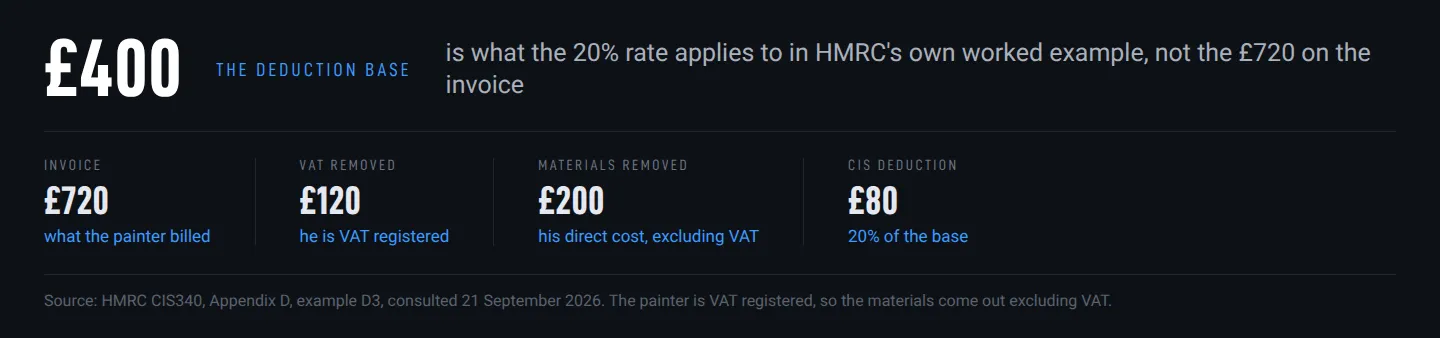
The short GOV.UK guide says VAT the subcontractor “has paid for”; CIS340 says “charged by the subcontractor”. The wordings conflict, but D3 is clear: the calculation removes invoice VAT, then the materials cost.
Plant hire qualifies only when hired from a third party
The digger charge needs an actual hire cost behind it. CIS340 paragraph 3.14 and CISR15090 allow you to exclude the subcontractor’s actual hire cost when the machine comes from a third party.
If the subcontractor owns the machine, their charge for using it stays inside the base. CISR14260 also explicitly excludes hire-purchase payments from the materials allowance: those payments buy equipment by instalments.
An invoice from the hire business can support the actual cost claimed. HMRC requires you to check the arrangement before payment and retain records.
Fuel follows its use. CIS340 paragraph 3.14 allows fuel for running plant to be treated as materials, even when the machine itself is owned. Paragraph 3.11 keeps travelling expenses, “including fuel costs”, inside the base, and CISR15080’s fuel example sits under its heading about travel, subsistence and accommodation. HMRC gives the rule without giving a reason for it. With a single undivided fuel line on the invoice, ask for the split and the evidence behind it: only the part shown to be plant fuel comes out.
Consumables and prefabrication: listed costs, limited definitions
A consumables charge can reduce your deduction base under CIS340 paragraph 3.12. The guide, updated on 27 August 2026 and checked on 21 September 2026, lists materials, consumable stores, fuel “except fuel for travelling”, plant hire and manufacture or prefabrication costs.
Paragraph 2.17 lists only materials and VAT; paragraph 3.12 gives the longer calculation list. Your duty under 3.13 is still to check the claimed costs and keep records against overstatement.
The short GOV.UK guide describes consumable stores as “equipment which is now unusable”. CIS340 gives no definition or item-by-item classification. You need evidence of what was bought and its cost, with a record supporting any allowance.
For prefabrication, CIS340 lists the cost without explaining how to quantify the subcontractor’s own workshop labour. You still need checked costs and a recorded basis, without assuming all workshop labour qualifies.
Charges you recover can change the payment reported
If you recover your CITB construction training levy from a subcontractor, CISR15110 says it reduces the gross payment reported to HMRC. Its example starts with £1,000 excluding VAT. A £7 levy deduction gives £993 to report.
CITB opposes passing on the levy. Its guidance says construction employers have “no statutory power or authority” to make that deduction under the Industrial Training Act 1982. Where both parties agree, CITB says the practice is lawful and that it has no power to intervene. HMRC’s calculation guidance covers the tax treatment, not your authority to take the money.
You are recovering your own levy obligation. HMRC describes the tax treatment of that recovery. CITB addresses your authority to take the money, so the calculation guidance is not permission to impose the charge.
Insurance and administration charges present a separate conflict within HMRC’s manual:
- CISR15030 defines a contra as a charge for goods or services supplied to the subcontractor. It keeps the payment used for CIS unchanged. Its worked example covers surplus materials, so goods only.
- CISR15120 reduces the payment used for CIS by deductions for public liability insurance and administrative charges.
A service charge can fit both descriptions, and HMRC gives no boundary between them. For the public liability insurance you recover, CISR15120 is the page that names it, so that is the treatment to follow and to write down with the payment. For anything else you recover, CIS340 paragraph 6.2 lets either side ask HMRC for a ruling, and paragraph 3.13 still asks you for checked costs and records either way.
With no materials figure, you may need to estimate
Your first move is to request receipts or other direct-cost evidence, as CIS340 paragraph 3.13 allows. If the subcontractor will not provide satisfactory information, CISR15060 permits a reasonable estimate. Your record explains the cost information used and how you arrived at the allowance.
A supply-and-fix invoice saying installation is “free” still needs a materials cost. CISR15060 says you must estimate it when the equipment cost is unspecified. CIS340 paragraph 3.14 requires the plant-hire check before payment. Where no cost can be supported, section 61 leaves that amount subject to deduction.
HMRC publishes no universal checklist of documents proving third-party hire. Your check and retained cost evidence must support the allowance without overstating it.
Under regulation 51 of the CIS Regulations 2005, you keep invoices, hire evidence, receipts and calculation workings for at least three years after the relevant tax year ends.

During a materials dispute, the deduction still goes to HMRC
The disputed payment still needs the appropriate CIS deduction. Under CIS340 paragraph 6.2, either you or the subcontractor can seek an HMRC ruling.
You must make the appropriate deduction and pay it to HMRC while the dispute continues. If some or all proves unnecessary, HMRC says it will repay the excess to the subcontractor.
An overstated allowance puts the shortfall on you
An inflated materials figure can turn a settled invoice into a problem with getting paid for the work yourself. CIS340 paragraph 3.13 says HMRC may recover an under-deduction from you where the materials element is excessive.
If your CIS materials labour split is just the labour line, a charge for your subcontractor’s own machine can pass through without deduction. The subcontractor already has that money. CIS340 paragraph 3.14 names who may have to fund the shortfall: “Failure to do so may leave the contractor responsible for any under deduction.”

Trade resources for tradespeople, straight to your inbox.
Occasionally we will send you a newsletter. Free, unsubscribe in one click.
Keep reading

CIS VAT reverse charge flowchart: should VAT be on your invoice?
Being inside CIS does not automatically mean reverse charging VAT. The flowchart follows HMRC's five tests, with written customer notification controlling the final one.

Contractor or subcontractor under CIS? The registration you may be missing
Being paid under CIS does not register you to pay your own subcontractors. Your role follows each contract. If you already employ staff, adding the contractor side changes your existing PAYE scheme.

Missing building regs certificate: where to look and who applies
Your former client's buyer wants the certificate. A paid archive search can end empty. The owner applies for regularisation, with a fee to pay and a separate question over who ultimately bears the cost.