
CIS VAT reverse charge flowchart: should VAT be on your invoice?
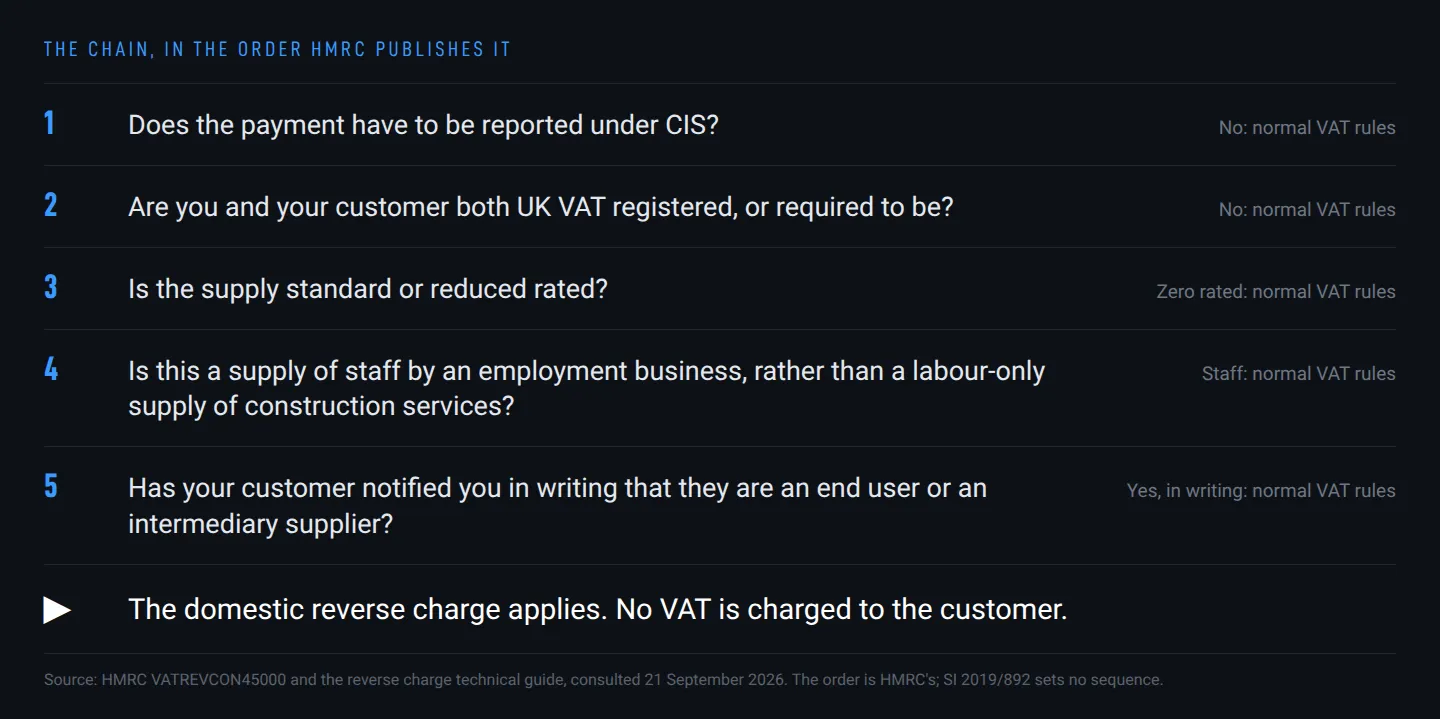
Being inside CIS does not automatically mean reverse charging VAT. The flowchart follows HMRC's five tests, with written customer notification controlling the final one.

The invoice went out with VAT added when the reverse charge should have applied. Your customer paid it to you. HMRC’s VATREVCON44000 says they must recover that VAT from you while accounting for the reverse charge themselves. If you already declared it, the manual points to normal error correction procedures.
The reverse charge is a VAT rule, separate from CIS. The deduction covered in CIS explained for UK trades is a separate calculation on the same invoice, worked out from a CIS materials labour split that has nothing to do with the VAT decision.
The CIS VAT reverse charge flowchart gives you the VAT treatment
Your chain starts with CIS reporting, then both businesses’ VAT status and the VAT rate. The staff-supply test follows, with written end user or intermediary notification last. The first test you fail decides it: you stop at that normal-rules exit.
More than one CIS VAT reverse charge flowchart exists, and each asks a different set of questions. This sequence comes from HMRC’s internal manual, VATREVCON45000; the downloadable suppliers flowchart asks whether your customer is CIS registered, where this one asks whether the payment has to be reported, and the buyers version runs four tests. Normal VAT rules include zero-rating where appropriate. VATREVCON21000 separately excludes supplies within the same VAT group.
The legislation and HMRC guidance cited were consulted on 21 September 2026.
No CIS reporting means no reverse charge
The payment must be one your customer is required to report under CIS. Otherwise, you take the normal VAT route. VATREVCON21000 makes reportability the test.
Your customer may be a CIS contractor yet fail to appear in the online CIS check. HMRC’s supplier guidance covers that situation: unless the customer identifies itself as an end user or intermediary, you need its confirmation that it reports under CIS before applying the reverse charge.
Your own gross or net CIS payment status is irrelevant to this VAT test, according to VATREVCON32100.
Materials follow the service’s reverse charge treatment
Materials ride with the service. They get no test of their own. Materials supplied with your construction service can form part of a single supply for VAT. Where that supply is reverse charged, the treatment covers the full value, including those materials. VATREVCON23000 expressly prohibits artificial separation to avoid reverse charging them. Where a contract mixes reverse-charge work with work outside it, HMRC lets you disregard the reverse-charge element when it comes to 5% or less of the contract’s value, agreed by both parties from the start rather than invoice by invoice. That 5% appears in HMRC’s guidance, not in SI 2019/892.
Materials supplied on their own take the normal VAT route.
HMRC’s technical guide also says a single supply-and-fix order keeps its reverse-charge treatment when you issue separate invoices for the supply and installation. The VAT decision follows the supply across those invoices.
Both businesses: VAT registered or required to be
You and your customer must each be UK VAT registered or required to register. If either business is neither registered nor required to be, normal VAT rules apply.

VATREVCON22000 expressly includes businesses obliged to register, including those still without a VAT number. HMRC’s supplier guidance calls for your customer’s valid UK VAT number as part of your checks.
HMRC’s registration guidance sets the threshold at taxable turnover exceeding £90,000 over the previous 12 months, or expected to exceed £90,000 in the next 30 days.
Zero-rated work stops here. Reduced-rate work carries on.
A zero-rated construction supply takes the normal-rules exit. There is no VAT to reverse charge. VATREVCON27000 confirms that ordinary zero-rated invoicing applies, without special reverse-charge wording.
Standard and reduced-rated services continue through the remaining tests.
The rate belongs to your particular supply. HMRC’s technical guide includes standard-rated services supplied for new-build housing, so the address alone leaves the rate open. The supplier guidance directs VAT-rate questions to Buildings and construction, VAT Notice 708.

Employment business staff are excluded. Labour-only work can qualify.
At this test, are you an employment business supplying staff? If so, normal VAT rules apply, including where the payment falls within CIS. HMRC’s technical guide places those supplies outside the construction reverse charge.
Labour-only construction work is not a supply of staff. If you are responsible for the work and correcting defects, HMRC’s distinction points to labour-only subcontracting.
Labour-only construction means ‘no’ to the staff question. A labour-only construction supply continues to the customer-notification test when the preceding conditions are satisfied.
End user notification: written confirmation stops the reverse charge
A valid written end user or intermediary notification ordinarily takes the supply out of reverse charging.
An end user is VAT registered and obliged to process payments to subcontractors through CIS. It does not make onward supplies of the construction services received. Those are the criteria in VATREVCON33100.
A qualifying intermediary resupplies the services without material alteration or further processing to a linked end user. VATREVCON33300 recognises links through a corporate group or a relevant interest in the same land. It excludes temporary site access rights from that interest.
HMRC’s downloadable suppliers flowchart mentions only end users. The technical guide and VATREVCON45000 include intermediary suppliers too.
Without written notification, the reverse charge applies when the earlier tests have been passed. VATREVCON33100 says:
“If a supplier believes their customer is an end user but the customer has not provided a written end user notification, they should still apply the reverse charge rather than charge VAT under normal rules. This is because the obligation to notify end user status lies with the customer.”
An email can provide notification. An end user clause accepted by your customer in writing counts; you, the supplier, must keep a copy. Article 8(1A) of SI 2019/892 requires written confirmation no later than when the supply is made, or coverage through a written agreement.
A contract-specific notice covers that contract. VATREVCON33400 also recognises notices covering future dealings until changed, and expects both businesses to retain a copy. VATREVCON43000 places liability for an incorrect end user declaration on the customer.
One qualification remains: the technical guide permits both parties to agree continued reverse charging for further construction supplies on the same site after an earlier reverse-charge supply between them.
Reverse charge invoice wording puts the VAT with your customer
If you reach the reverse-charge endpoint, your invoice still needs the information required on a VAT invoice. HMRC’s technical guide requires you to show the reverse-charge VAT amount while excluding it from the amount charged to your customer.
If your system cannot show that amount, you must state the VAT rate. You must also add wording identifying the customer’s responsibility to account to HMRC and make the reverse-charge items identifiable. Any of HMRC’s three examples does the job; the exact wording to copy is at the end.

For your VAT Return, VATREVCON31000 puts the net sale in box 6, with no output VAT from that sale in your box 1. Your customer accounts for the output VAT and may recover input VAT under the normal rules.
Your getting paid and cash-flow planning must allow for receipts without VAT, an effect HMRC’s technical guide flags explicitly.
Regulation 14(1)(o) of the VAT Regulations 1995 requires the reference “reverse charge”. VATREVCON37100 says the precise wording is not prescribed in law and offers three examples that meet the requirement. One is:
“reverse charge: Customer to pay the VAT to HMRC.”

Trade resources for tradespeople, straight to your inbox.
Occasionally we will send you a newsletter. Free, unsubscribe in one click.
Keep reading

CIS materials labour split: what belongs outside the deduction?
Your materials and labour split needs the subcontractor's direct costs behind it. Their markup stays in the CIS base, along with expenses you might never pay into their bank account.

Contractor or subcontractor under CIS? The registration you may be missing
Being paid under CIS does not register you to pay your own subcontractors. Your role follows each contract. If you already employ staff, adding the contractor side changes your existing PAYE scheme.

Missing building regs certificate: where to look and who applies
Your former client's buyer wants the certificate. A paid archive search can end empty. The owner applies for regularisation, with a fee to pay and a separate question over who ultimately bears the cost.