
CIS monthly return deadline: paid on time, but filed late?
Paying HMRC on time can still leave your return late. An empty month also needs reporting unless an exemption applies. Once a return is overdue, its penalty clock keeps running even as the next month comes round.

If you wait until the electronic payment deadline to file, your return can be late even when the money arrives on time.
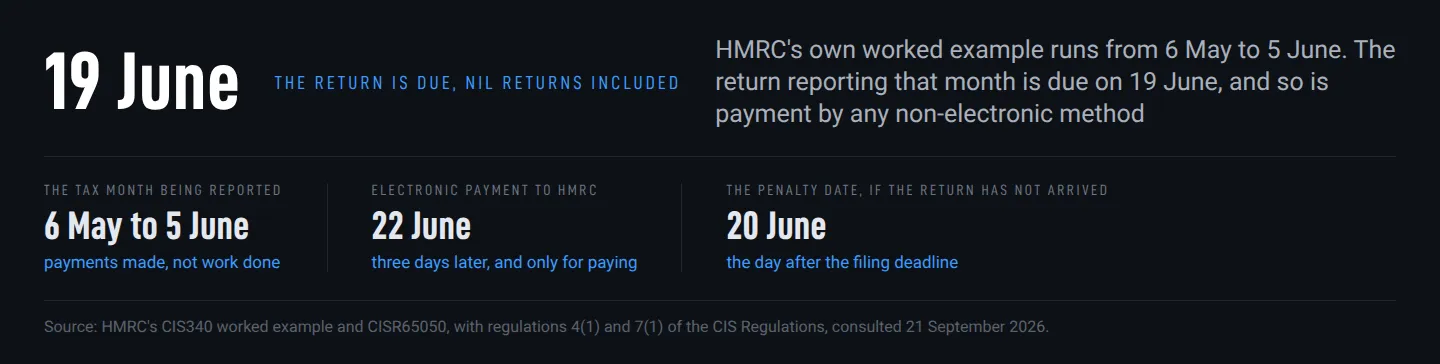
The CIS monthly return deadline is the 19th. Your return covers a tax month, the scheme’s month from the 6th of one month to the 5th of the next. Regulation 4(1) of the CIS Regulations sets the return at not later than 14 days after the end of every tax month, which lands on the 19th.
The 22nd is for electronic payment to HMRC. Regulation 7(1) gives 17 days after the end of the tax period only where payment is made by an approved method of electronic communications, and 14 days in any other case. A cheque sent by post must arrive by the 19th, says CIS340, HMRC’s official guide to the scheme.
The CIS monthly return deadline is the 19th, even if you pay later
The initial filing penalty is £100 under Finance Act 2009, Schedule 55. The penalty clock starts on the 20th, the “penalty date” HMRC identifies in CISR65050 and uses to calculate the further late-filing charges.
CIS340’s example covers 6 May to 5 June, reported by 19 June.
HMRC’s filing guidance gives no extra day when the 19th falls on a weekend or bank holiday. CISR65020 specifies no extension: the manual requires receipt by the 19th and treats later returns as late.
These penalties concern filing. Paying your deductions late has separate consequences.
Pressing send is not enough. Under regulation 39 of the CIS Regulations, HMRC’s system has to accept your return before it counts as delivered.
Keep your submission receipt. CISR65710 tells HMRC staff to establish whether you received one when you say you filed but its records show nothing, and then to check whether you selected the wrong month.
You can file through HMRC’s free CIS online service or recognised commercial software. CIS340 warns that using both simultaneously may overwrite returns.
Your return reports subcontractor payments to HMRC. The separate CIS deduction statement, your subcontractor’s record of the deduction, is covered in CIS explained for UK trades. CIS340 gives both reporting obligations the 19th deadline.
An empty month still needs a nil return
A nil return is your monthly return showing no subcontractor payments. HMRC’s CISR65050 expressly covers late returns and late nil returns, so the same initial £100 late-filing charge applies to both.
SI 2015/429 removed that duty from 6 April 2015. After eleven years without it, SI 2026/289 restored it from 6 April 2026 for construction businesses that had previously made relevant subcontractor payments. You must now report empty months too, unless you give HMRC advance notice that you will make no payments. Older advice may still describe the previous regime.
Those rules, and the HMRC guidance used here, were checked on 21 September 2026.
For an isolated empty month, you can file the nil return as usual. GOV.UK’s filing guidance gives the routes as the HMRC CIS online service or suitable commercial CIS software. The deadline remains the 19th.
The test concerns subcontractors getting paid, not whether anybody was on site. CIS340 requires the monthly return to reflect what you actually paid and deducted during that month.

You can tell HMRC about a longer pause
For a longer pause, an inactivity request tells HMRC you have stopped using subcontractors and expect no payments in the foreseeable future. An inactivity request lasts up to six months and can be renewed, according to GOV.UK’s Tell HMRC about changes.
You can request it while filing a nil return through the CIS online service. HMRC also accepts requests by phone or post if you cannot use that service.
There is a deadline conflict: CIS340 describes inactivity notification by the 19th after the empty month, while regulation 4(9B), inserted by SI 2026/289, requires notification at least 14 days before that tax month starts. A nil return by the 19th reports the empty month. To rely on notification for future empty months, the regulation requires notice at least 14 days before each tax month starts.
CISR67630 says inactivity cannot be backdated to before the current month. Every earlier missing return still needs filing, with its own deadline and penalty clock.
If you resume payments, you must file a monthly return showing them. GOV.UK says this ends the inactivity period.
If you stop using subcontractors completely, the same guidance requires you to tell HMRC and stop filing monthly CIS reports. CIS340 also covers completing the final return and paying outstanding deductions.
After the first £100, each missing return keeps ageing
Missing successive months starts a separate penalty clock for each return. The earlier return continues ageing while the next becomes overdue.
Under Finance Act 2009, Schedule 55, the charges are added at these stages:
- On the 20th, the penalty date: £100 under paragraph 8.
- After two months: a further £200 under paragraph 9.
- After six months: the greater of £300 or 5% of the CIS deductions that should have been reported, under paragraph 10.
- After twelve months, for non-deliberate failure: the greater of £300 or 5% again, under paragraph 11(5).
Each interval runs from the penalty date, and Schedule 55 allows penalties under different paragraphs to accumulate. Deliberately withholding information attracts higher penalties at twelve months.
If you have filed a CIS monthly return before, the ordinary minimum penalties still apply to later nil returns. Those minimums stay in place even when there were no deductions to report.

If you have never filed a CIS monthly return, a separate rule applies. Schedule 55, paragraph 13 caps the combined fixed penalties under paragraphs 8 and 9, the £100 and the further £200 taken together, at £3,000. Its scope covers your first return and returns with filing dates earlier than the date you first submitted a return.
For returns covered by that first-time-filer rule, the ordinary £300 minimums are removed. Percentage penalties remain outside the cap.
HMRC’s CISR65080 describes that protection as a period of capping, open until you file your first monthly return: returns falling due after that filing carry the ordinary penalties. Your outstanding returns still need filing under the monthly reporting duty, and any penalty challenge still has its own deadline.
An amended CIS return belongs to the original tax month
A correction can go unmatched if you enter the wrong period or the wrong Accounts Office reference. In HMRC’s worked example in CISR66020, the contractor makes both errors while trying to repair an earlier return.
GOV.UK directs you to the HMRC CIS online service for corrections. CIS340 identifies “Amend return” in the Returns menu. Commercial software may support amendments too, although the guide warns that some packages lack that function.
CISR66010, HMRC’s operational manual, permits corrections for the current tax year and the previous six tax years.
Your correction belongs to the same tax month as the original return. Under CIS340, it must reflect the payments and deductions actually made during that month.
Telephone correction requests go through the CIS Helpline, according to CISR66620. The published number is 0300 200 3210.
You can correct the figures and still face a late-filing penalty. Any challenge to that charge goes through the separate appeal route, where HMRC considers the facts of your case.

A CIS penalty appeal has its own deadline: 30 days from the notice
You have 30 days from the date on the penalty notice to appeal, according to GOV.UK’s filing guidance.
You can challenge whether the penalty is payable or its amount under Schedule 55, paragraph 20. HMRC accepts appeals online or by letter, not by phone. A letter needs your Unique Taxpayer Reference (UTR), your tax identification number, and the payment reference on the notice, together with your grounds. A late appeal also needs a reason for missing the window.
HMRC calls something that prevented compliance despite reasonable care a “reasonable excuse”. Confusing the 22nd with the filing deadline would need to be assessed against your circumstances; CH160600 says HMRC assesses whether a misunderstanding of an obligation was objectively reasonable, so acceptance depends on that assessment. Pressure of work is normally rejected, according to CH160800.
Reliance on an accountant has conditions. Under Schedule 55, paragraph 23, you must have taken reasonable care to avoid the failure, and CH160700 looks at what you required the other person to do and how you followed progress. Once a reasonable excuse ends, you must file without unreasonable delay.
GOV.UK says you need not pay an appealed penalty until the appeal is resolved, but the penalty remains payable if your appeal fails. CISR65110 says HMRC suspends collection once it records the appeal on its system.
HMRC decides each appeal on its facts. If it rejects yours, CISR65120 provides 30 days to request an internal review, then a further 30 days after the review conclusion to take the appeal to the tribunal.
If your return is still missing, file it now. The appeal challenges the penalty; the return itself still has to be filed.

Trade resources for tradespeople, straight to your inbox.
Occasionally we will send you a newsletter. Free, unsubscribe in one click.
Keep reading

CIS verify subcontractor online: can you trust their word?
Your subcontractor says you should pay without deductions. HMRC's payment instruction decides. If they've worked for you before, your old monthly returns establish whether you need to verify them again.

CIS deduction statement template: what goes in every box
The reference at the top is yours. The UTR is theirs. The statement needs to show what you paid and withheld, with the optional boxes kept separate from the required details.

CIS explained for UK trades
Paying subcontractors puts the CIS deduction, return and paper trail on your business. That applies to your subcontractor payments even on a job in someone's kitchen, and even when another contractor is making deductions from your own invoices.