
CIS sole trader: what comes back, how to claim it and how long you wait
Your deductions count towards the year's tax bill. Two worked examples show why you might get a refund or owe more, including a payment towards next year.

Every CIS deduction on your payment and deduction statements for the tax year just ended is tax you have already paid. HMRC sets it against your income tax first, then against your Class 4 National Insurance, and pays back whatever is left over.
As a CIS sole trader you claim it on your Self Assessment return: the short pages (SA103S) below £90,000 turnover, the full ones (SA103F) from £90,000, with deductions in box 38 or box 81. A refund usually arrives within two weeks of filing online, plus up to 12 more weeks if security measures apply. A shortfall is due by 31 January 2027. Figures were checked on GOV.UK on 6 October 2026.
The contractor’s side of the scheme is in CIS explained for UK trades.
Income and expenses as a CIS sole trader
Your pay goes in before CIS deductions, invoiced materials included: box 9 of SA103S, or box 15 of SA103F. Expenses come off it. GOV.UK allows materials, protective clothing, insurance and business phone costs, but not everyday clothing, fines or the cost of preparing your own tax return. On the cash basis, where money counts when it moves, equipment is an expense when you pay for it.
A van’s flat rate for 2025 to 2026 is 45p a mile for the first 10,000 business miles and 25p after; the 55p from 6 April 2026 belongs to next year’s return. Once you use flat rates for a van you stay on them, and they are closed to a van already in capital allowances or expensed when bought.
If you use the £1,000 trading allowance, you cannot claim expenses as well; both examples below have far more. Receipts stay with you in case HMRC asks.
How to claim CIS tax back on the tax return
- Registration. With no UTR yet, choosing “working as a subcontractor” registers you for Self Assessment and CIS together. The deadline for 2025 to 2026 was 5 October 2026; late registrants get three months from HMRC’s letter or email to file, still pay by 31 January 2027, and may face a penalty.
- Statements. Each contractor must give you a payment and deduction statement within 14 days of the end of each tax month: the evidence each claim rests on. If one is late or lost, ask the contractor for it. If you still cannot get them, say because the contractor has gone out of business, write to PT Operations, HM Revenue and Customs, BX9 1BX, with your name, address and UTR, the contractor’s name and address, the payment dates and why you have no statements. Since 1 December 2022 HMRC has dealt with one statement request per customer, and considers more only if you show you asked the contractor first, so keep a copy of every request.
- Return. Any refund already received during the year through form CIS40 goes in box 1 on page TR 6. HMRC usually pays the refund into the account on your return, and only into a UK bank account, so the section “If you have paid too much tax” needs completing. If you have paid HMRC by card, it will always try to refund to that card first.
- Deadline. Paper returns must reach HMRC by 31 October 2026; online, the deadline is 23:59 on 31 January 2027.

The same deduction rate can leave a bill
The 20% comes off the labour you invoice: contractors take out materials you paid for directly first, under GOV.UK’s contractor guidance. So the deduction can run ahead of your tax or fall short of it.
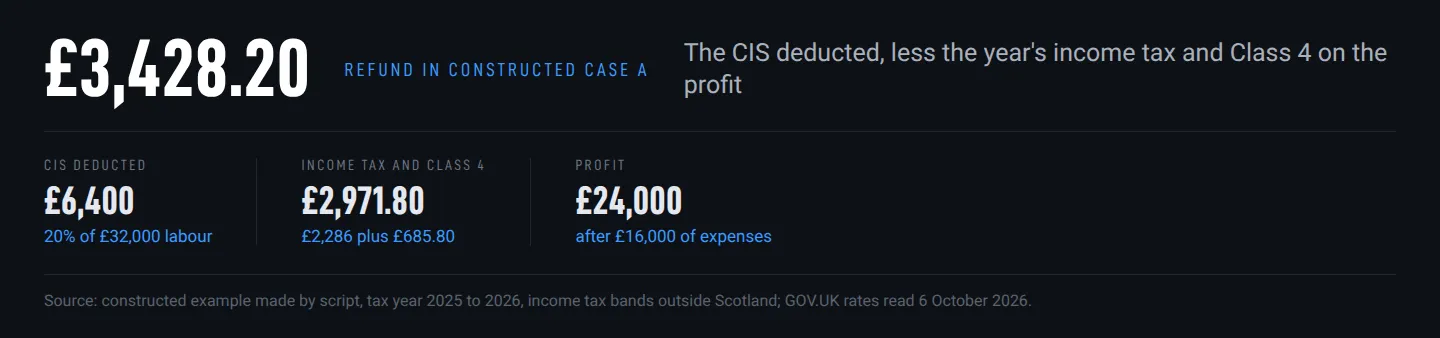
The two worked examples below use round figures for 2025 to 2026, cash basis, no VAT, other income or student loan. They show how the sum works, not what you will get back. The accounts use GOV.UK’s bands, which apply outside Scotland, where income tax bands differ.
| A. Buys and invoices materials | B. Labour only | |
|---|---|---|
| Labour invoiced | £32,000 | £88,000 |
| Materials invoiced | £8,000 | £0 |
| Turnover before the CIS deduction (box 9) | £40,000 | £88,000 |
| CIS deducted, 20% of the labour (box 38) | £6,400 | £17,600 |
| Materials bought | £8,000 | £0 |
| Van, 12,000 business miles (10,000 at 45p, 2,000 at 25p) | £5,000 | £5,000 |
| Tools, workwear, insurance and phone | £3,000 | £2,500 |
| Total expenses | £16,000 | £7,500 |
| Profit | £24,000 | £80,500 |
| Income tax | £2,286 | £19,632 |
| Class 4 National Insurance | £685.80 | £2,866.60 |
| Tax and Class 4 for the year | £2,971.80 | £22,498.60 |
| Result | Refund of £3,428.20 | £4,898.60 to pay |
For 2025 to 2026, GOV.UK gives a £12,570 Personal Allowance; income tax is 20% up to £50,270 and then 40%, and its “Rates and allowances: National Insurance contributions” table puts Class 4 at 6% between £12,570 and £50,270, then 2%. In case A, £24,000 of profit less £12,570 leaves £11,430: 20% of it is £2,286 of income tax and 6% is £685.80 of Class 4. Above £6,845 of profit, Class 2 is treated as paid, so nothing is due for it. Your own sum works the same way: profit, less £12,570, at those rates, less your deductions.
Payments on account in January
A return that leaves tax to pay can also bring payments towards next year’s bill, Class 4 included.
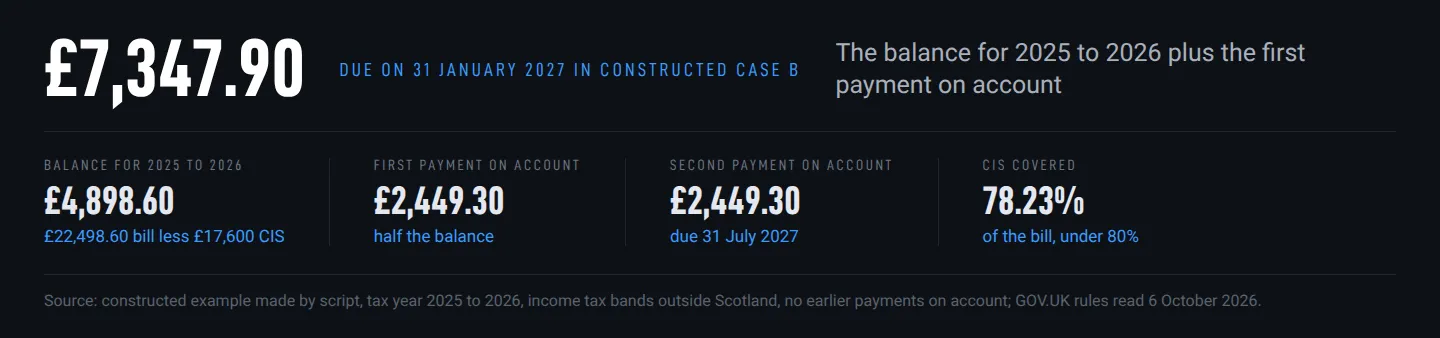
Whether they apply. They do unless the bill left after deductions is under £1,000, or more than 80% of the year’s tax and Class 4 was paid at source; HMRC’s manual treats CIS deductions as deducted at source here. Case A owes nothing, so none. In case B, £17,600 covered 78.23% of the £22,498.60 bill and left £4,898.60, so they apply.
How much. Each is half of the bill left from the year just filed: £2,449.30 in case B.
When. With no earlier payments on account, case B pays £7,347.90 on 31 January 2027, the £4,898.60 balance plus the first £2,449.30, and the second £2,449.30 on 31 July 2027, both towards 2026 to 2027.
If next year looks lower. Deductions from the current tax year cannot be used against any year’s payments on account or balancing charges, under CISR75010. You can still ask online or with form SA303 to cut both payments by the same amount; cut too far and GOV.UK charges interest.
How long a CIS tax refund takes
While HMRC processes it, the refund may still show as available credit in your account. If you got a submission reference, do not request it again: that can delay it. After 14 weeks in total with nothing paid, contact HMRC.
On 6 October 2026, HMRC’s reply-date tool estimated a reply by 7 March 2027 for a claim posted on 1 October 2026, and by 15 October 2026 for the same claim sent online. Its dates update weekly.
Until it lands, the refund sits in your cash flow like an unpaid invoice, which our guides on getting paid for your work deal with.
On 6 October 2026, seven firms’ CIS refund pages advertised from as little as two weeks to eight to twelve weeks or more, against HMRC’s usual two weeks online. GOV.UK’s “How to choose a tax agent” says you can claim yourself and remain responsible for your return.
When HMRC’s figures differ from yours
If you think a statement’s figures are incorrect, GOV.UK says to speak to your contractor. HMRC compares the deductions on your return with what each contractor reported, and where a statement disagrees with its records, it can refuse the claim. Credit is given only for deductions actually made.
HMRC does not publish how big a difference it tolerates; the manual page on matching is withheld under freedom-of-information exemptions. So box 38 has to be the total of your statements, and each has to agree with what the contractor reported.
A wrong figure can be corrected within 12 months of the filing deadline. After that, older mistakes go to overpayment relief, and HMRC’s SACM12040 excludes CIS deduction errors from it: the 12 months are your window.

If your business becomes a limited company, it recovers deductions during the year through the limited company route through the EPS, using an Employer Payment Summary to offset them.

Trade resources for tradespeople, straight to your inbox.
Occasionally we will send you a newsletter. Free, unsubscribe in one click.
Keep reading

Contractor or subcontractor under CIS? The registration you may be missing
Being paid under CIS does not register you to pay your own subcontractors. Your role follows each contract. If you already employ staff, adding the contractor side changes your existing PAYE scheme.
The CCTV evidence disciplinary procedure: the clip is only the start
You already have the footage. Whether you can rely on it turns on how it was obtained, what you investigated and whether your employee had a fair chance to answer.

Principal contractor building regulations: the role your client never assigned
The same builder can hold two principal contractor roles on one domestic job. Part 2A covers Building Regulations compliance; CDM covers health and safety. Each brings its own duties.