
Principal contractor building regulations: the role your client never assigned
The same builder can hold two principal contractor roles on one domestic job. Part 2A covers Building Regulations compliance; CDM covers health and safety. Each brings its own duties.
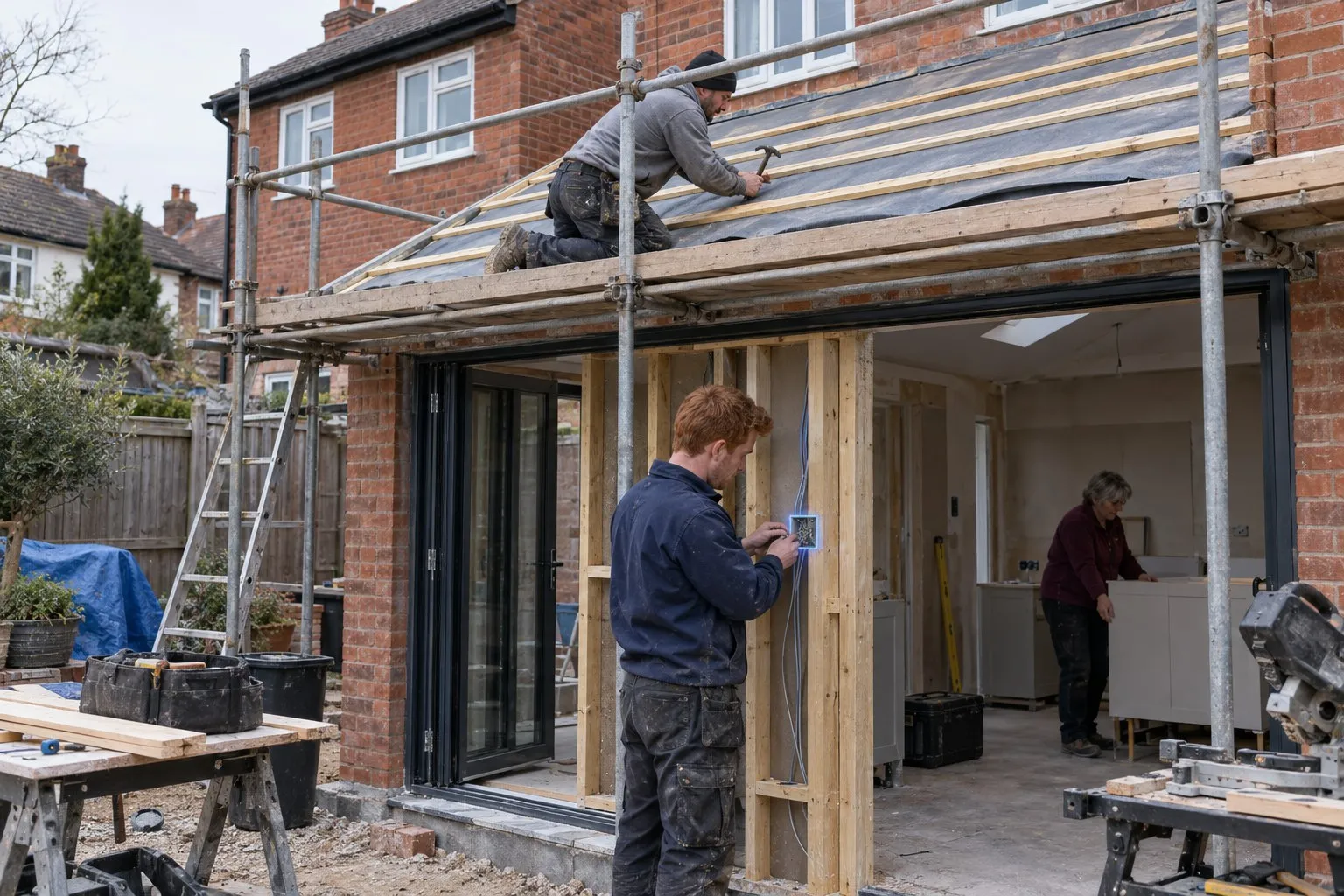
No written appointment from the domestic client, and several contractors on the job: if you control the construction phase, regulation 11C(2)(b) of Part 2A of the Building Regulations 2010 in England makes you principal contractor. CDM 2015, the health and safety rules for construction work, has an identical default in its regulation 7(2)(b). The same control can give you both roles, with different duties: Part 2A is about the work complying with the Building Regulations, CDM about nobody getting hurt.
Part 2A has applied since 1 October 2023, under SI 2023/911. It applies in England only: Wales has its own Part 2B, and Scotland and Northern Ireland have their own building regulations. A domestic client is one whose project is outside the course or furtherance of their business, such as work on their own home (regulation 2).
Your obligations under building control for the trades include duties when you are the only contractor, and making sure the client is aware of their responsibilities.
Principal contractor building regulations duties are about compliance
The principal contractor under Part 2A is the contractor who plans and manages the building work during the construction phase, and monitors it so that it complies with the Building Regulations.
The National Federation of Roofing Contractors (NFRC) warns in its February 2025 guidance note GN70 that matching role names do not mean the roles are the same.
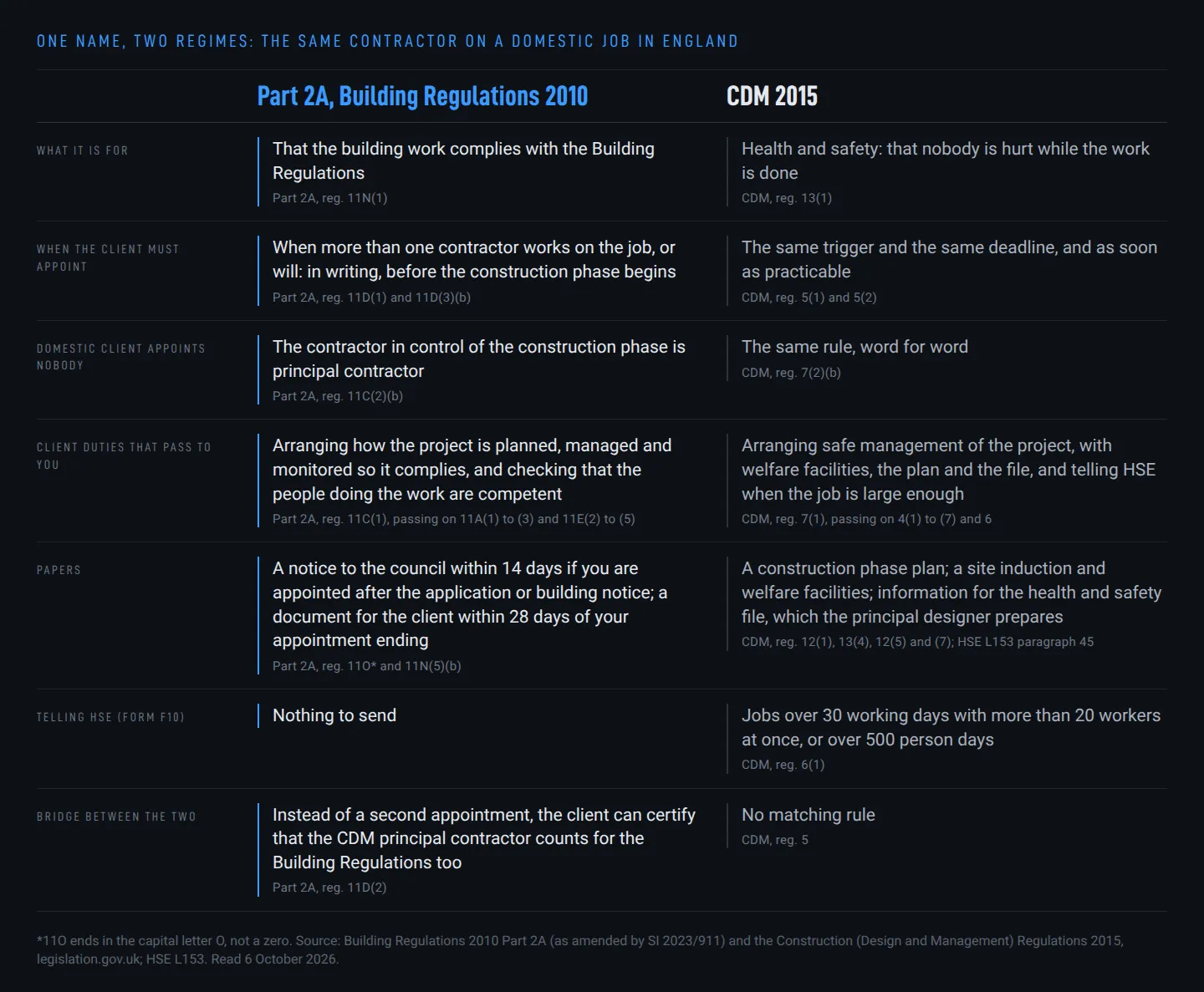
Under CDM regulation 6(1), HSE must be notified on form F10 of work lasting over 30 working days with more than 20 workers at once, or over 500 person days. Part 2A has no equivalent.
HSE’s two-page leaflet CIS80 (April 2015), unrelated to the Construction Industry Scheme, includes a one-page construction phase plan template for small jobs. CDM regulation 12(1) requires you to have the plan drawn up before setting up the site. CDM also requires a site induction and welfare facilities (13(4)), and information for the health and safety file, which the principal designer prepares (12(5) and (7)).
Appointing a principal contractor for a domestic client
Under 11D(1), your client must appoint in writing a contractor with control over the building work as principal contractor, and a designer with control over the design work as principal designer, whenever more than one contractor is involved or reasonably foreseeable. Both regimes use that trigger and require the appointments before the construction phase begins; CDM adds “as soon as is practicable” (11D(3)(b); CDM 5(1) and (2)).
Part 2A does not define “in control”: regulation 2 defines contractor, domestic client and sole contractor, and control appears only as a test inside 11C and 11D. None of the council and trade guides reviewed gives a rule for separately hired trades. If the client hires an electrician and a plumber separately, the answer depends on who controls the work in fact. Ask the client to make the written appointment under 11D(1) before work starts, which settles the question without relying on the default.

Instead of making a second appointment, your client can certify in writing that the CDM principal contractor is treated as appointed for Building Regulations purposes (11D(2)). CDM has no matching rule.
Under 11C(1), you take on the domestic client’s arrangements for how the project is planned and managed, and monitored so it complies, and for checking that the people doing the work are competent. CDM 7(1) passes on the client’s duties for managing the project safely and notifying HSE. In either regime those client duties can go to the principal designer instead, by written agreement.
The domestic client does not have to fulfil an unappointed principal contractor’s duties themselves (11C(3)).
The council application and the 14-day notice
Dutyholders are the people Part 2A gives duties to: the client, the designers and the contractors, including the principal designer and principal contractor. Submitting an application can include a confirmation that their duties have been met: Babergh and Mid Suffolk’s supplementary information form carries one for the relevant Part 2A requirements.
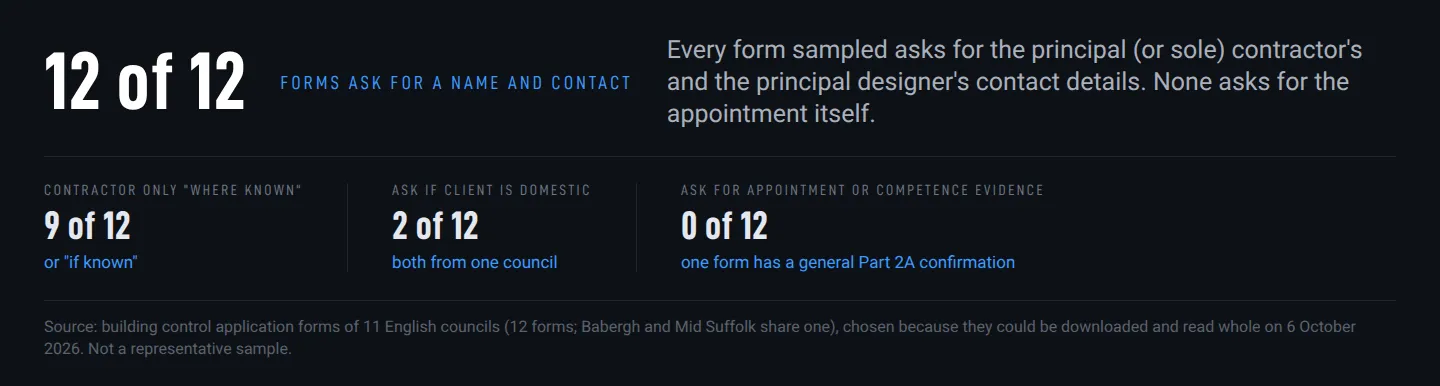
Milton Keynes’ “Understanding Dutyholders Responsibilities” page says applications “cannot progress without correctly appointed Dutyholders”, while 9 of the 12 forms ask for contractor details only “where known” or “if known”. Regulation 11D(3)(b) still requires the appointment before the construction phase begins, whatever the application form asks.
You have 14 calendar days from your appointment to notify the council if you are appointed for a domestic client after the application or building notice (11O(5) and (7)). The notice gives the location of the work, your details and the date of your appointment, and states that it is given on the domestic client’s behalf.
An outgoing contractor gives their details to the client within 5 calendar days of their appointment ending.
Planning and monitoring the building work
Under 11N(1), you plan and manage “the building work during the construction phase”, monitor it so that it complies, and coordinate matters for compliance. Regulation 11N(2) requires all reasonable steps to secure cooperation and coordinated work, and to make sure the contractors comply with their duties.
You must share relevant information with the principal designer and take their compliance comments into account under 11N(3) and (4). Each contractor must also plan and manage their own work, with monitoring for compliance, under 11J(1).

None of fifteen Local Government and Social Care Ombudsman building control decisions read on 6 October 2026 mentions Part 2A, a principal contractor or a dutyholder. That does not show no cases exist, and the duties in 11N and 11E apply from your appointment either way; the papers that record them are the 11O notice and the 11N(5)(b) document.
Bracknell Forest’s enforcement policy, dated 23 April 2026, considers the principal contractor’s role when deciding whether to prosecute.
The government’s circular letter from DLUHC, first issued on 31 October 2023 and updated on 1 February 2024, says it does not expect proactive inspections of dutyholders and competence outside higher-risk building work. If work fails to comply, building control can “track back” through those responsible.
Competence required before you accept the role
Part 2A names no card, qualification, scheme or registration as proof of competence. Regulations 11F and 11H require relevant skills, knowledge, experience and behaviours, or organisational capability where the contractor is an organisation: management policies, systems and resources that make sure staff are competent and trainees supervised (11Q(3)).
An organisation must designate a capable individual under its control to manage its principal contractor functions (11H(2) and (3)).
Looking up an electrician’s registration with their scheme is one reasonable step you might take; regulations 11E(2) and (5) require “all reasonable steps”, without naming a particular check.
You must meet the relevant competence requirements before accepting work or acting as principal contractor (11E(6) and (7)). The behaviours required include refusing work that does not comply or that is beyond your skills, knowledge or experience (11Q(4)).
Trainees need adequate supervision under 11F(3) and (4). Regulation 11F(5) bars appointing someone training for the principal contractor role to that role. If you cease to meet the requirements as principal contractor, 11I(1) requires you to notify the client.
When the principal contractor role ends
The role ends with the construction phase, which regulation 2(1) closes “when that project is completed”, or earlier if your appointment ends first; the regulations give no further definition of completed. If your appointment ends early, 11D(4) requires the client to appoint a replacement “as soon as reasonably practicable”, and 11N(6) requires that replacement to review your arrangements.
Within 28 days of your appointment ending, you must give the client a document explaining the arrangements you put in place for your planning, coordination and information sharing with the principal designer (11N(5)(b)). You can keep a copy with the paperwork you use for running the business.

Trade resources for tradespeople, straight to your inbox.
Occasionally we will send you a newsletter. Free, unsubscribe in one click.
Keep reading
The CCTV evidence disciplinary procedure: the clip is only the start
You already have the footage. Whether you can rely on it turns on how it was obtained, what you investigated and whether your employee had a fair chance to answer.

CIS sole trader: what comes back, how to claim it and how long you wait
Your deductions count towards the year's tax bill. Two worked examples show why you might get a refund or owe more, including a payment towards next year.
Missing building regs certificate: where to look and who applies
Your former client's buyer wants the certificate. A paid archive search can end empty. The owner applies for regularisation, with a fee to pay and a separate question over who ultimately bears the cost.