
Will AI replace electrical estimators? The supplier's small print has a say
AI takeoff tools are reaching UK estimating desks. Their product pages promise speed; their terms keep qualified review in the job. Counting, measuring, pricing and exclusions each come out differently.
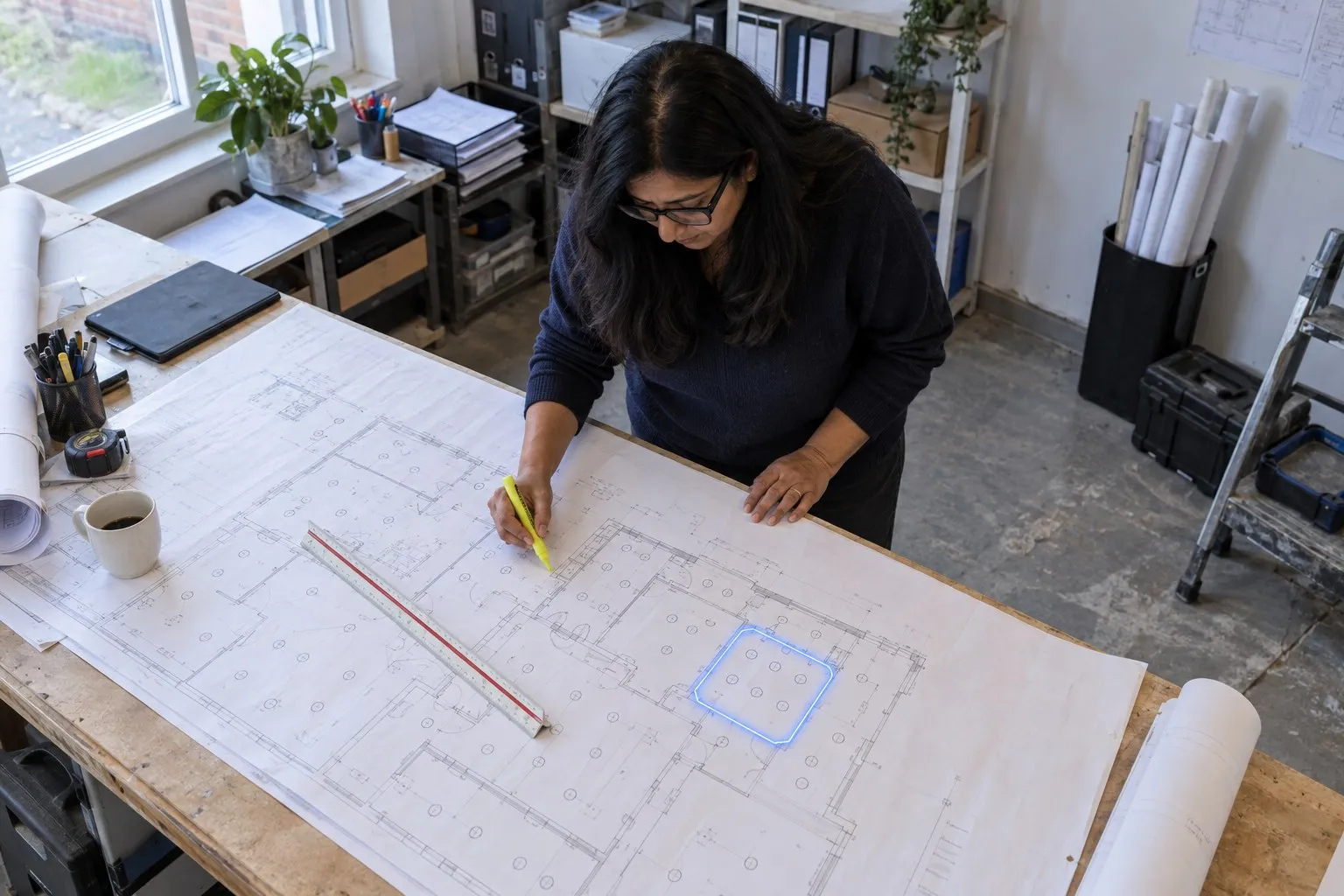
On 6 October 2026, recruitment agency Andy File Associates advertised on Reed for a senior electrical estimator at a hard facilities management provider in Sheffield, offering up to £55,000 depending on experience. Duties included “Preparing accurate and competitive electrical estimates from first principles” and “Presenting findings and recommendations during tender adjudication meetings”.
Countfire, Trimble and Kreo offer automated counting and parts of measurement on their UK pages as at 6 October 2026. Countfire’s terms say its output should be verified by qualified people before commercial decisions, so checking the count stays with whoever prices the job. Pricing from first principles, negotiating supplier quotes, deciding exclusions and presenting at adjudication are duties in the advert, and the product pages describe counting and measuring. If you price your own tenders, that is the split: the tools take time out of counting and measuring, and the checking and every decision after it stay at your desk.
Most of the AI for tradesmen on sale handles office work, and in an electrical contractor’s office these products sit at the estimating desk. Everything below is about pricing the job; installing the work and signing its certificate fall to the electrician on site, the subject of will AI replace electricians.
Will AI replace electrical estimators on the symbol count?
Counting fittings starts with distinguishing the symbols on your lighting layout. Automated counting offers an alternative to your highlighter or manual Bluebeam count marks.
Countfire’s website says it counts thousands of symbols in seconds across a project. The UK service works on PDFs in a desktop browser and exports to Excel. Its trial page names “AI Smart Select”. Its product page also describes adding symbols and managing false positives when drawings are incomplete.
US supplier Trimble’s announcement of 30 June 2026 reports more than three million symbols detected automatically, with manual recognition time reduced by more than 50%. The same release leaves false-positive checks with estimators, a few lines below the saving.
The nearest independent test is academic. Dosi and colleagues’ SkeySpot preprint, submitted in August 2025, tested researchers’ own models on 45 scanned electrical drawings from UK housing developers. Those models struggled with visually similar symbols, including USB double sockets, grid switches and hob switches. No commercial product was in the test, but it shows where an automated count is most likely to slip.
Countfire’s terms dated 9 April 2026, clause 16.2, say the output should be independently reviewed and verified by “suitably qualified personnel” before pricing. Countfire offers a free seven-day trial, and a drawing you have already counted by hand gives you a known total to set its marks against. On any drawing, the review starts with the symbols that look alike, each marked fitting type compared with the lighting schedule.

Measuring routes and changes of level
On a containment layout, each route has to be followed through its rises and drops. The alternative most desks already have is measuring on screen: Bluebeam’s UK pricing page, checked on 6 October 2026, lists counts and advanced measurements from Core, at £330 per user annually including tax.
Routing is the newer promise in AI electrical takeoff software. Trimble’s June announcement says its new auto-routing calculates conduit lengths including vertical rises and drops. The release announces UK availability across its MEP estimating solutions.
US vendor Togal publishes a University of Kansas study led by Victoria Marulanda, conducted in March 2025, claiming time savings of up to 76% against On-Screen Takeoff.
A single researcher was new to both programmes. The study assumed the quantities produced through manual measurement in On-Screen Takeoff were accurate. Both main cases used architectural floor plans; in the hotel, the quantities compared were footprint, internal area, wall centrelines, toilets and single-swing doors. Only the control drawing included lighting fixtures.
The 76% saving came from the fire station example. The longer version gives the two-building average as approximately 71% in its discussion and approximately 70% in its abstract. In the reflected-ceiling control drawing, the tool failed to distinguish the specified ceiling materials and elements. The saving fell to about 22%. The authors advise against relying solely on the automated results.
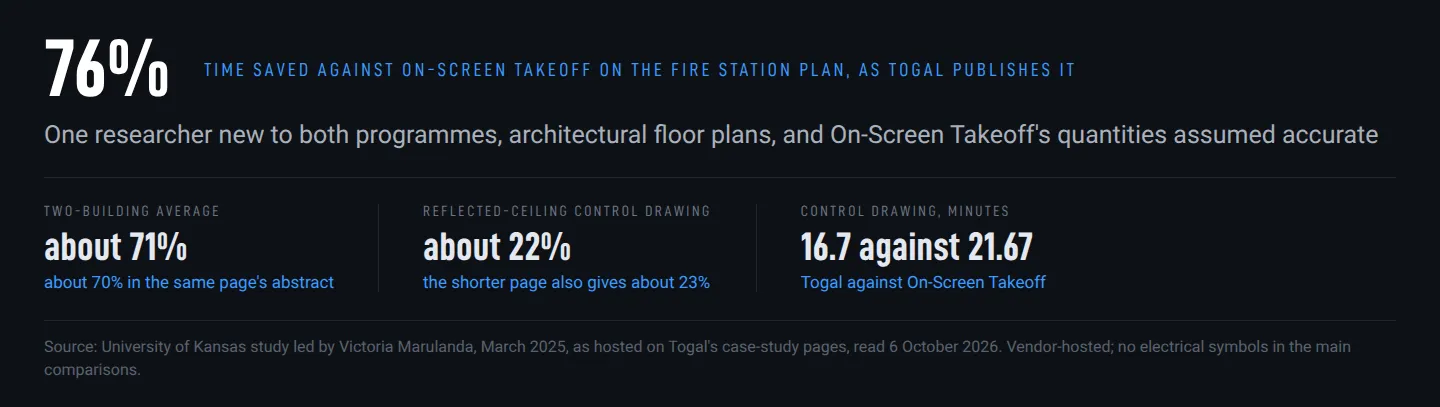
Two answers are worth having in writing before paying: which routing features the UK version includes, and what kind of drawing any quoted saving came from. In this study, the one ceiling layout saved about 22%.
Your rates inside the automated estimate
The quantities need your rates before they become a price. Countfire’s FAQ says that to build estimates from your counts you will need to “upload your price list and create kits first”. The price list and kits you already keep are what turns a trial count into a figure you can compare with a past tender.
If you price with Luckins data or Amtech software, the AI may come from the same supplier as the rest of the tools and technology on your desk. Amtech and Luckins belong to Trimble, which acquired Amtech, Luckins included, in 2014. Its Estimation MEP page lists AI-powered graphical takeoff alongside managed material pricing and labour for UK customers, and Trimble launched the product in July 2024 for smaller UK M&E contractors. The first quote for AI takeoff can come from the supplier you already pay.
The Sheffield advert also lists analysing and negotiating supplier and subcontractor quotations.
Ownership of the AI output matters before your data goes in. Under clause 7.1 of Kreo’s terms, dated 26 August 2026, rights in each AI-generated output, such as a quantity takeoff or cost estimate, belong to Kreo, excluding your embedded intellectual property. The customer receives a licence for internal business use during the contract. That clause is worth reading before your past takeoffs live only inside the tool.
Exclusions, RFIs and tender risk
Your exclusions start with the tender documents and the risk your business accepts. Purely Recruitment’s Swindon advert, published on Reed on 22 September 2026, asks for tender-stage requests for information and identification of long-lead items. Sheffield’s advert adds risk assessment and value-engineering opportunities.
An extracted quantity leaves those decisions open. A query about an unresolved specification still goes out as an RFI during the tender stage, written by whoever prices the job.
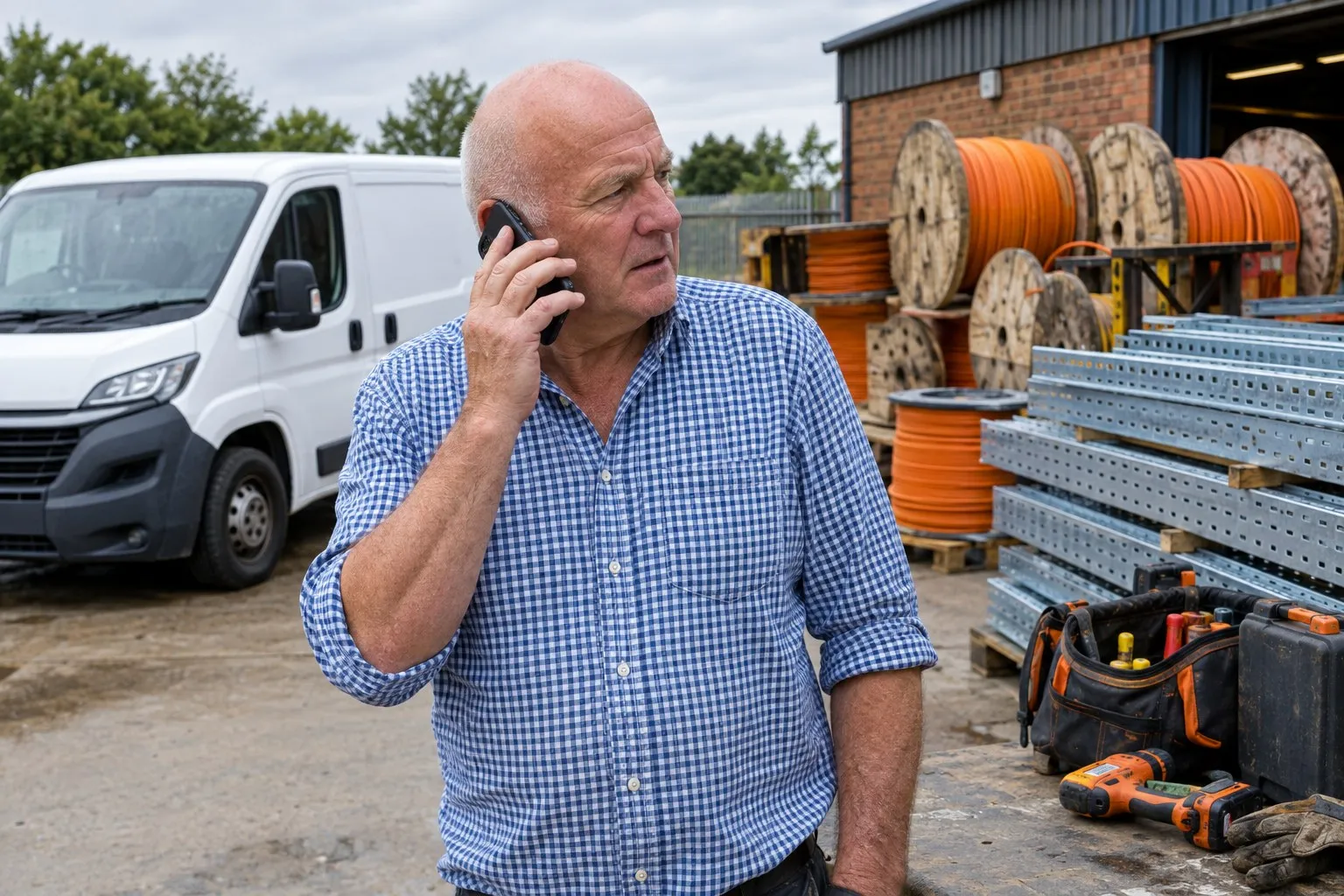
Across the six agency adverts read on Reed on 6 October 2026, four ask for estimating software or Microsoft Office. None mentions AI or automatic takeoff. The sample is too small for a national claim, but its written duties extend well beyond measuring drawings.
Kreo’s terms call AI a productivity aid supporting professional judgement and make the customer responsible for qualified verification of every output before bidding or pricing. Trimble’s public Offering Terms likewise put verification and ultimate use of AI content with the customer. Every quantity in the tender is the bidder’s to stand behind, whichever tool produced it.
The terms also cover the drawings you upload. Togal’s terms dated 20 February 2025, governed by Florida law, grant it a licence to use, modify and distribute customer content to provide and improve the service. For a drawing set received under a tender, that clause is worth reading before the upload, alongside whatever the tender says about confidentiality.
What an estimator costs and what the licence costs
If you employ an estimator, the Reed agency adverts span £35,000 for Guildford’s junior role to £70,000 for Derby’s senior role. If you price the work yourself, the cost is your own hours.

Countfire’s homepage assumes £300 per estimator-day and five days saved a month, and its FAQ puts the saving at £1,500 per estimator per month.
The pricing pages on 6 October 2026 list Kreo Pro at £125 per user monthly, billed annually, and ZeroCount at £55 per licence monthly excluding VAT.
The sum that matters replaces Countfire’s averages with your own: the hours spent counting and measuring each month, against the licence price a supplier gives you in writing, with the checking time the terms put on you added back.
Whoever signs the tender decides whether to buy, and what the purchase changes is how many of their hours go into counting and measuring before they sign.

Trade resources for tradespeople, straight to your inbox.
Occasionally we will send you a newsletter. Free, unsubscribe in one click.
Keep reading
Recording in a customer's home: who answers for each camera
Your technician can record a job and be recorded on the same visit. The business's camera is never covered by the household exemption for purely personal use; the customer's camera often is, but not always.

Dashcam in work van: what changes when you start watching the driver
A camera fitted for collision evidence can become a way to watch staff. Each setting needs a reason, especially when the van spends the night outside your technician's house.
Are smart glasses allowed at work? The gap in the privacy regulator's guidance
The privacy regulator's guidance names body cameras, not glasses. Your decisions start before purchase and get harder when an employee brings their own pair.