
Smart glasses for construction workers: what UK sites allow, what the kit does and where it lets you down
When your people work on someone else's site, the principal contractor gets a say before the supplier does. The useful jobs are specific, and permission comes before the kit.
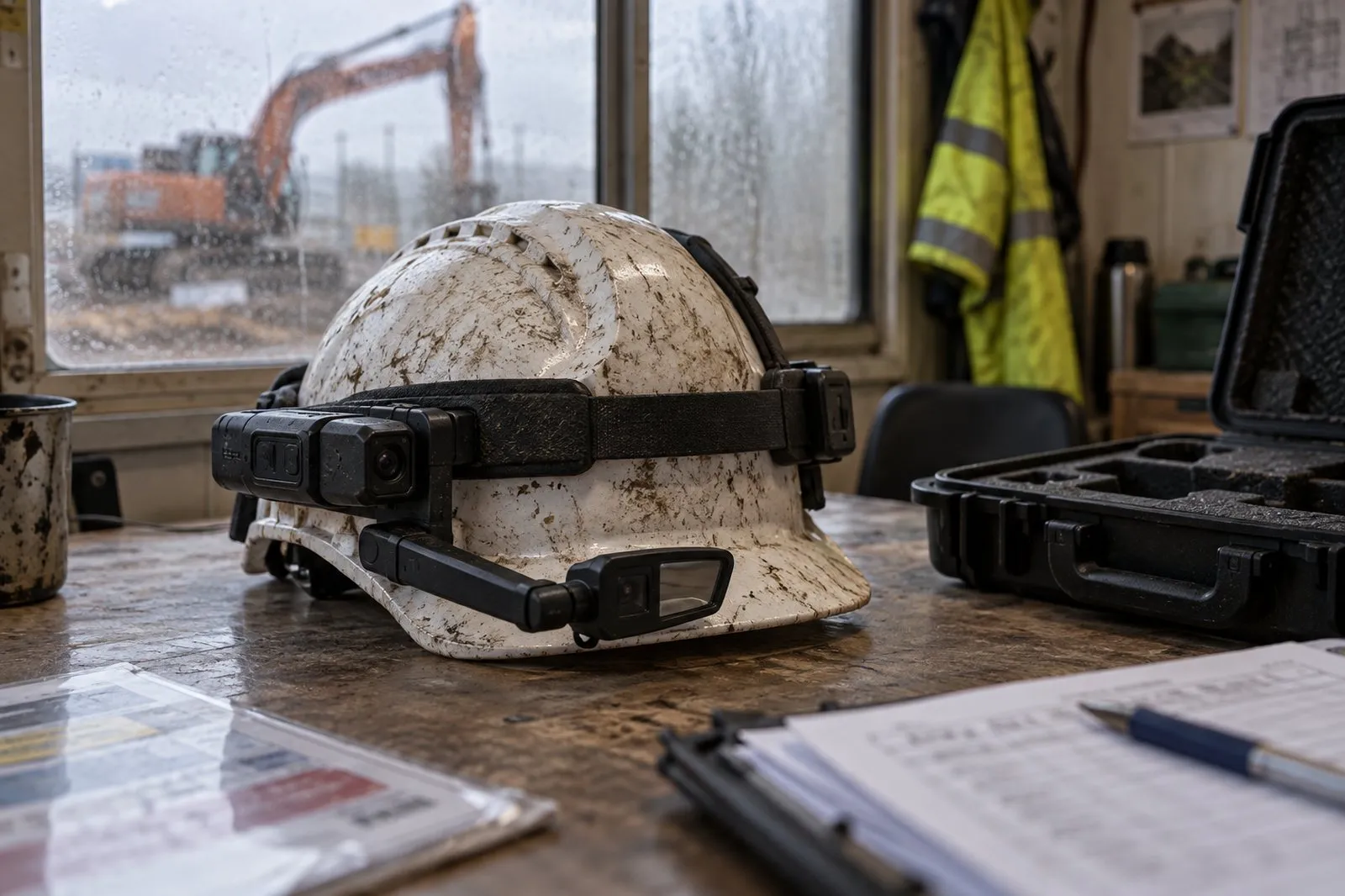
Your engineer is in the cabin, signing the induction sheet. The smart glasses you want them to use are still in their case.
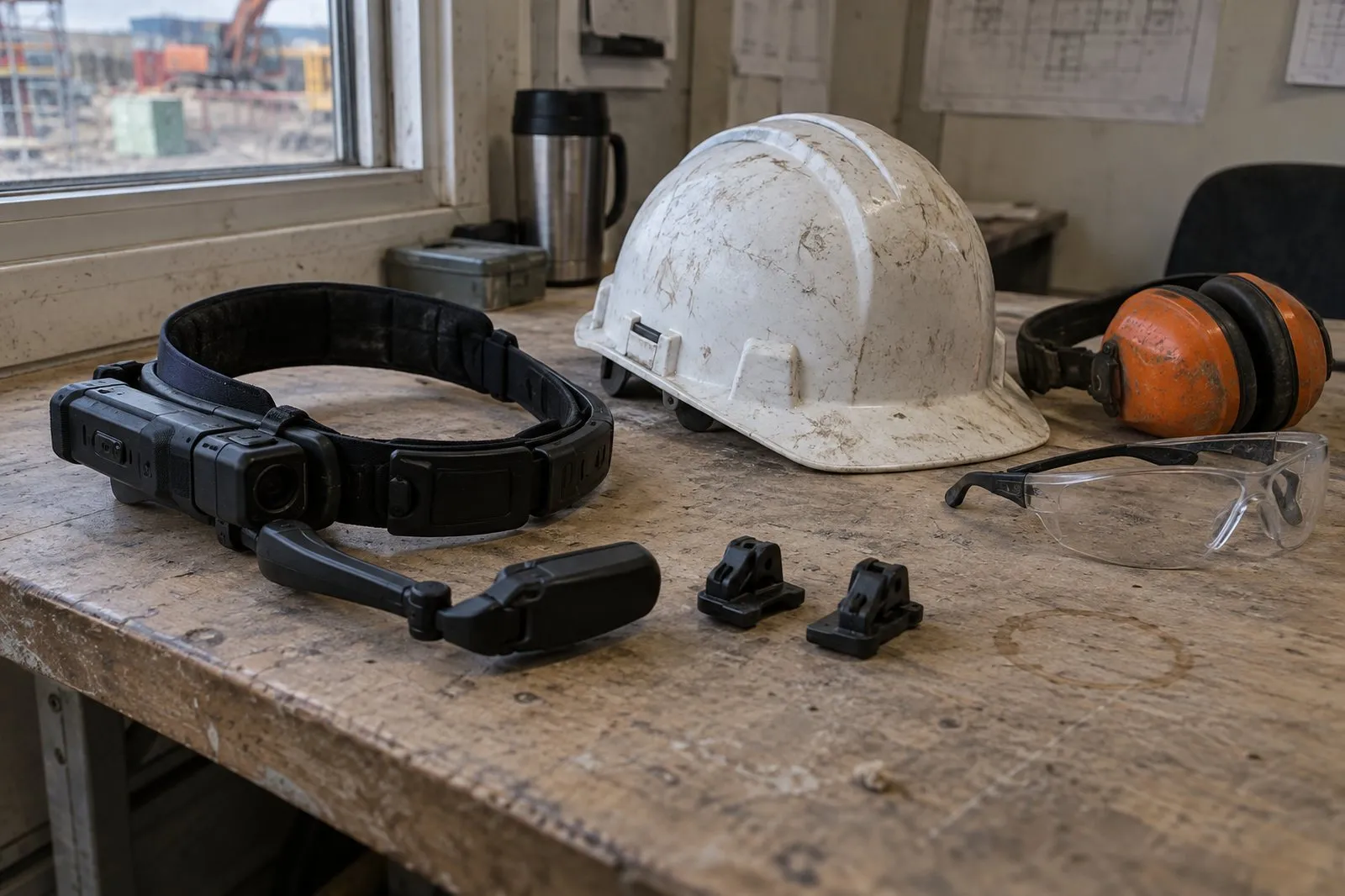
Smart glasses for construction workers get sold on the display and the camera. On a UK site the kit that actually gets used is the industrial kind: a monocular headset such as the RealWear Navigator 520 or the Vuzix M400, clipped to a hard hat, with a camera for a remote call and a small screen for a drawing or a checklist. If you want the design itself laid over the room, that is HoloLens 2 territory, the sort of thing tried at Hinkley Point C rather than on a three-van business’s jobs.
What follows is what the site will ask you before that headset comes out of its case, and where it earns its place once it does.
The site gets the first say
HSE expects site rules to cover mobile phones and PPE. On a project with other contractors, CDM 2015, regulation 15 requires you to follow the principal contractor’s directions and the relevant construction phase plan.
In an HSE prosecution reported in August 2026, a telehandler driver had used his phone against site rules he had signed. A lift supervisor was killed when the telehandler reversed into him in Ince, Ellesmere Port. The case involved a phone, not smart glasses, but it shows why that induction sheet matters.
VolkerWessels UK’s mobile-device policy includes “any other personal electronic equipment”. It allows designated work where the person in charge approves the device and its use is documented in the risk assessment and method statement, or work package plan.
It also prohibits use while walking, working at height and operating plant. The plant restriction expressly includes hands-free devices. Those restrictions still apply to approved work.
Take a defined task to site management: where your engineer will stand, what they will view or record, and when the smart glasses switch off. Then put the agreed controls into your RAMS. Permission to use the kit leaves what CCTV in the workplace asks to deal with separately.
Your usual gloves and working conditions decide whether the controls work
RealWear claims accurate Navigator 520 voice recognition in noise up to 100 dBA. That remains a manufacturer’s claim; the research found no independent construction-site test at a stated noise level.
For the Vuzix M400, headset reseller VR Expert reports that the touchpad is difficult to operate with working gloves. Whether they work with your gloves on is a separate question from what smart glasses cost to buy and run, and it is the one this section is about.
Outside in winter, you also need a clear operating limit. RealWear’s documents disagree:
- Its 520 datasheet gives -20°C to +50°C.
- Its 520 shop page gives -20°C to +45°C.
- Its Navigator-series support page, which does not single out the 520, gives -15°C to +50°C.
The paperwork could do with talking to itself.
Get the applicable limit confirmed. RealWear’s own battery guidance adds that the cell should be kept between -10°C and +50°C, that a cold battery may not work temporarily even when fully charged, and that performance is particularly limited well below freezing. A January start on an exposed site is part of the test, not an exception to it.
Before live work, arrange a safe controls test with the gloves and ear defenders your people actually wear, against the relevant background noise.
The hard hat, the clip and the headset get checked as one
RealWear offers clips for named hard hat models. Vuzix says its M-Series mounts fit most standard US and EU safety helmets. Neither says anything about authorisation from the hard hat’s maker.
The mounting arrangement matters. RealWear’s Hard Hat Band excludes full-brim helmets and helmet-mounted earmuffs, despite broader claims that its headset works with PPE.
Under EN 397:2025, the British Safety Industry Federation explains, specified tests are carried out with attachments fitted where they may affect helmet conformity. The trade body names cameras as an example.
HSE’s own guidance on head protection, in its L25 booklet, tells you not to customise a helmet and to always check with the manufacturer. A clip in the accessory slot is closer to that line than most people assume.
Safety glasses with a camera built in, in the sense of a certified pair of specs that records, are a separate product and a separate question. The industrial headsets here go on the hard hat and over your ordinary eye protection. They do not replace it.
You need documentation covering your helmet, mount and headset combination, with the rest of your engineer’s PPE. The guidance does not say every unapproved attachment automatically cancels certification. Equally, a clip fitting the slot settles only the physical fit.
A remote pair of eyes has a specific job
Does your supervisor need to see a detail while the person on the tools keeps their hands available? A stationary call about unfinished pipework gives you something specific to test.
In 2020, Balfour Beatty’s Texas team reported quicker responses to requests for information using Vuzix glasses. Construction Dive published no measured saving and identified keeping a strong connection as a challenge. Useful contractor experience, but it gives you no UK payback figure.
At least the awkward bits survived the write-up.
Test the signal where the work actually is. Count questions resolved, calls abandoned and visits still needed. Your comparison is with the phone call or photographs you would otherwise have used.
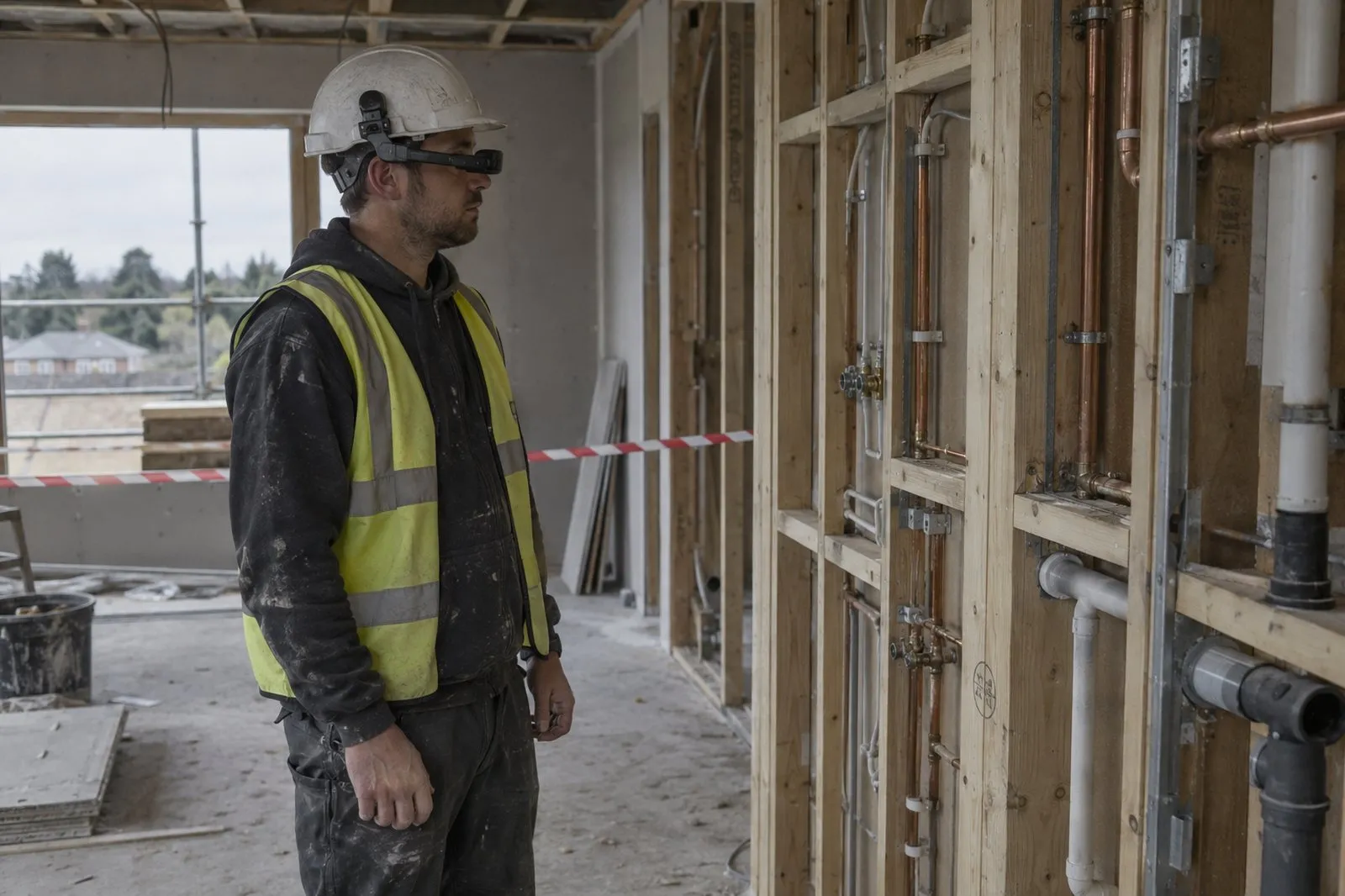
An overlay can direct your engineer to something worth checking
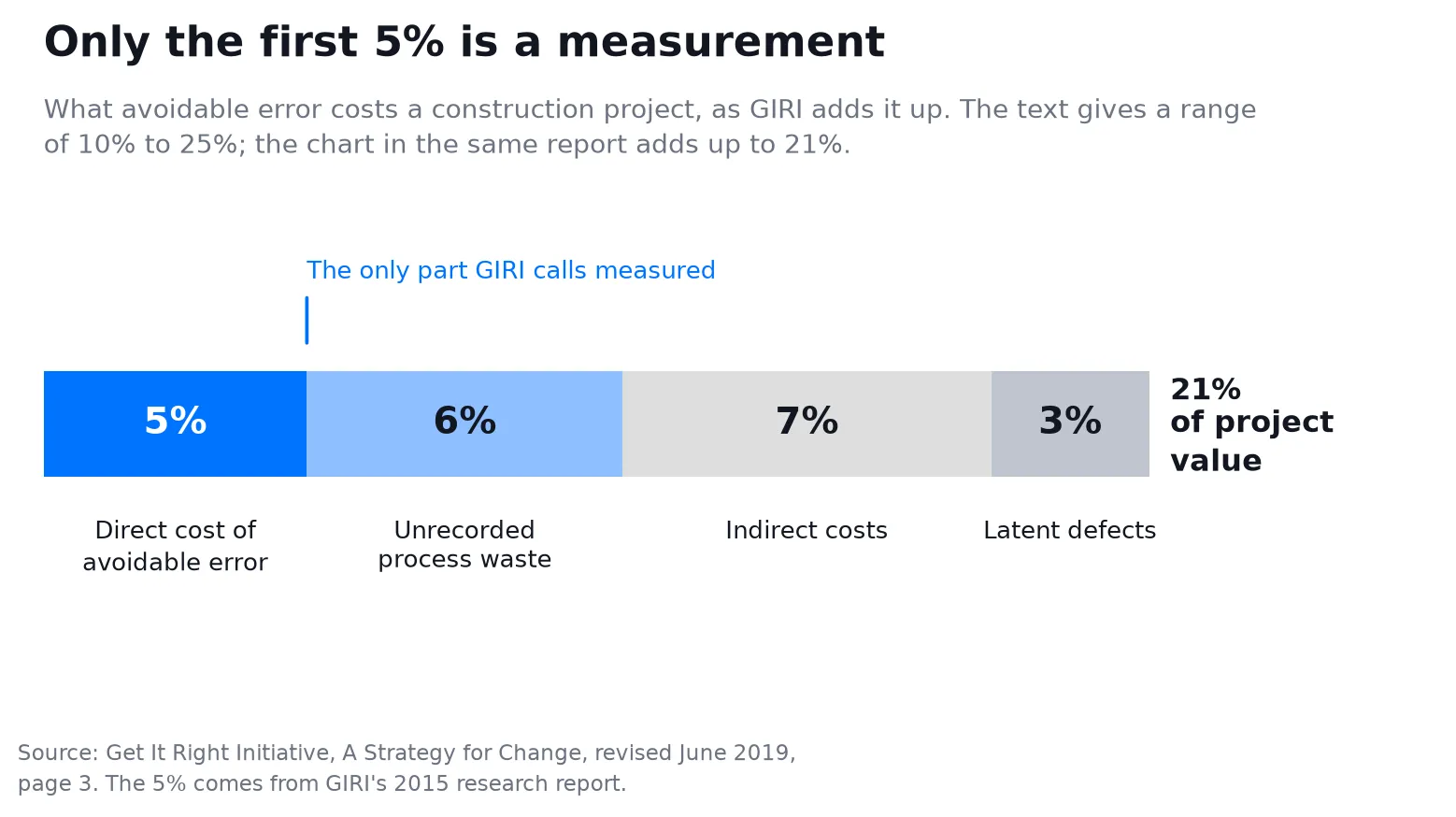
The Get It Right Initiative, GIRI, cites international studies putting direct avoidable-error costs at about 5% of project value. Its wider cost chart adds up to 21%, while the text gives a range of 10% to 25% including unmeasured and indirect costs.
Your question is narrower: which particular mistake might seeing the design here help your engineer catch?
In a Construction Management interview about Laing O’Rourke’s Hinkley Point C trials, Dr James Potter described how HoloLens 2 made discrepancies easy to spot but could overwhelm users with information. Switching layers on and off kept inspection focused.
That gives your engineer a reason to investigate a mismatch. Acceptance still needs a check against the specified tolerance.
Smart glasses leave supervision with you
With a learner, decide who is answering questions and checking the work before deciding what goes on their head.
An ASCE-reported laboratory study with six experienced nail-gun users found simple monocular diagrams gave the best balance between performance and situational awareness in larger timber-wall tasks. Registered overlays reduced some errors in smaller tasks, but increased mental workload and restricted movement.
Our research did not locate a controlled on-site trial with trade apprentices wearing smart glasses.
An older government apprenticeship study, published in 2012 using 2011 data, shows how the supervisor’s time commitment changed as apprentices learnt.
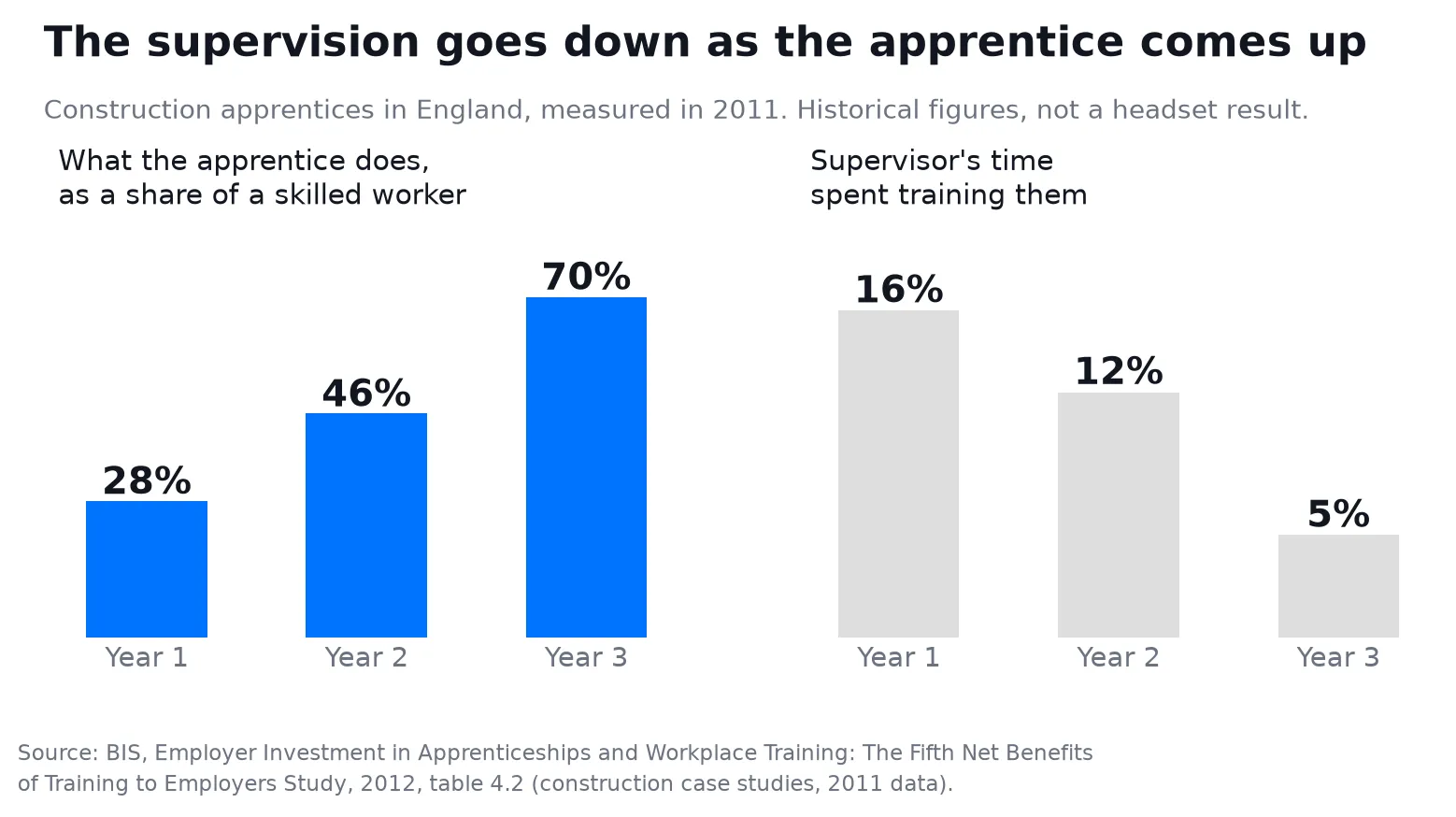
Those proportions are historical context, not current staffing benchmarks or evidence that glasses let you cut supervision. What that supervision costs you in hours is the other half of the sum.
Your inspector decides which records are enough
For a payment record, clear, identifiable images are the output you need. The Royal Institution of Chartered Surveyors’ payment guidance lists photographs as optional. Where appropriate, they should be annotated, dated and timed, with copies kept in the valuation folder.
Agree what needs recording before work is covered up. A headset trial should produce records you can retrieve against the job, rather than a long video someone has to search.
For inspections, Building Control Solutions may accept photographs and short clips case by case, alongside a written description. This local service requires physical visits for foundations and completion.
Ask your inspector what they will accept before you plan around a remote inspection.
Your attention still belongs to the site
On simulated elevated steelwork, a study of 40 people found reduced vigilance during demanding measuring tasks. Yet a seated laboratory study with minimal virtual content found no loss of awareness of the surroundings.
An inspection-scenario study rated HoloLens highest of four options for perceived safety. That measured people’s impressions; the steelwork research measured vigilance. The results cannot be treated as a single safety verdict.
Keep moving plant, access routes and work at height out of your initial trial.
Smart glasses on a construction site: the advantages and the disadvantages
What they do well, when the job is defined: a stationary remote call where the supervisor sees the detail and the engineer keeps both hands; a design overlay that points to a mismatch worth checking; a dated, retrievable image for the valuation folder.
What works against them: the touchpad with working gloves; the battery and the operating range on a January morning; the mount that excludes full-brim hats and helmet-mounted earmuffs; the extra information that overloads the wearer; the drop in vigilance on demanding tasks; and the supervision they do not take off your hands.
None of that decides it for you. It tells you what to put in the trial, which is the question every piece of tools and technology for a trades business has to answer before it earns its place in the van.
Give the person wearing it room to say when the kit gets in the way. You need an honest answer from your engineer more than you need a successful demonstration.

Trade resources for tradespeople, straight to your inbox.
Occasionally we will send you a newsletter. Free, unsubscribe in one click.
Keep reading
Smart glasses at work: the real cost
Everyone selling smart glasses shows you the catalogue. Nobody shows you the bill. What a pair actually costs a business with vans on the road, what they fix on the tools, and what they leave exactly as it was.
AI for tradesmen: a UK owner's guide, trade by trade
AI can turn a house scan into a heat pump design and help code sewer footage. Further down the trades, the offering gets thin. The price often tells you less than the allowance beside it.
Safety glasses with camera: why your phone usually wins
You can buy glasses with a built-in camera. Whether they can replace your existing PPE is a separate question, and some manufacturers' own pages leave it open.