
Smart glasses at work: the real cost
Everyone selling smart glasses shows you the catalogue. Nobody shows you the bill. What a pair actually costs a business with vans on the road, what they fix on the tools, and what they leave exactly as it was.
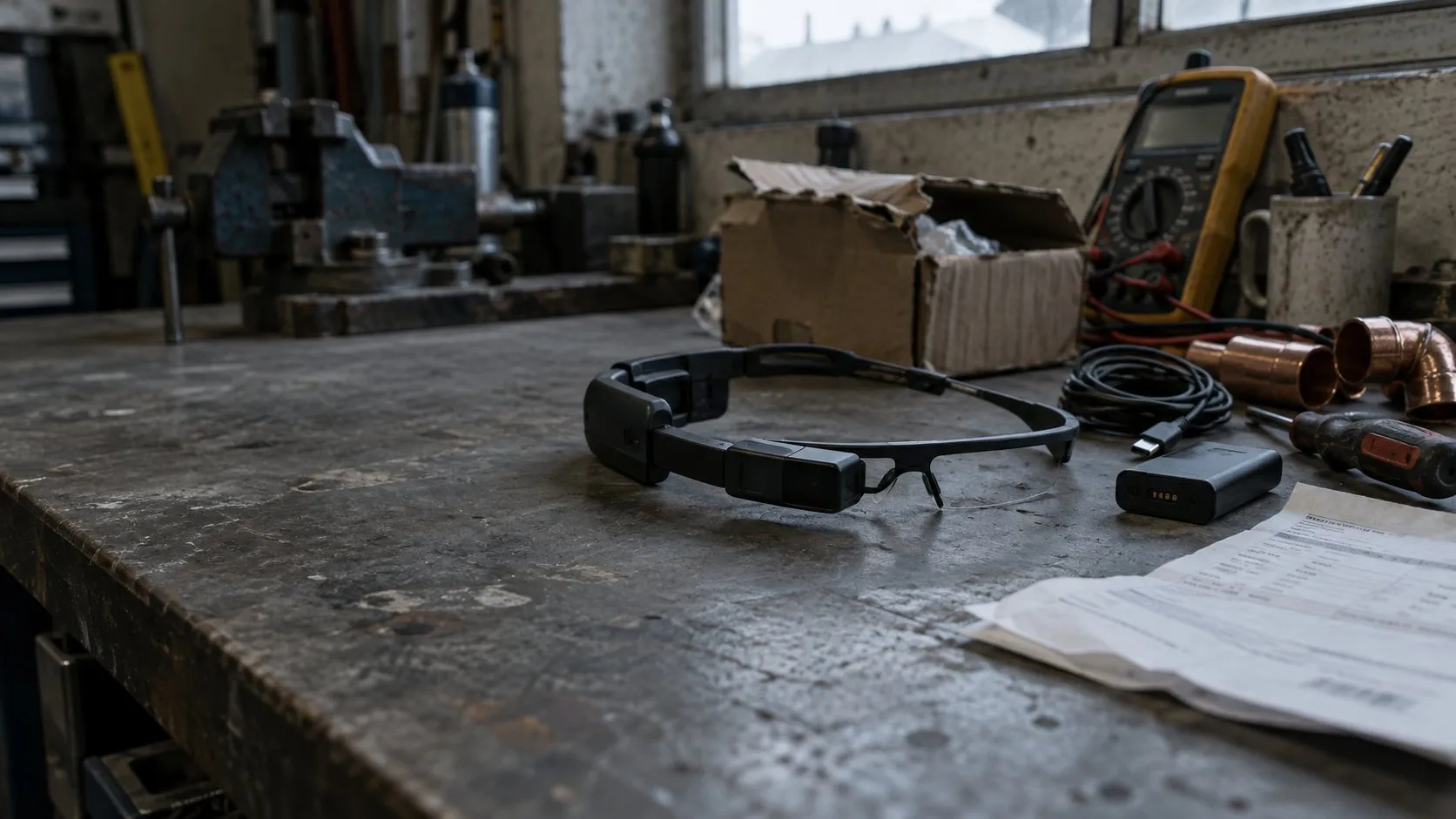
Search for smart glasses for work and you get a catalogue. Page after page of weight, resolution and field of view, most of it written by the people who make the things. Not one of them tells you what happens on the Tuesday after they arrive.
Every figure below has a source. Where the number does not exist, we say so rather than making one up, because a made-up number is how this category got its reputation in the first place.
What the kit actually costs
Start with a problem you hit before you even get to price. No manufacturer publishes a pound price for most current industrial models. RealWear, Vuzix and Iristick all quote in dollars or euros. Every pound figure you will find comes from a UK reseller, which means the number moves with the exchange rate and with whoever is quoting.
The list prices, as published by the makers:

Two of those deserve a second look. The RealWear Arc 3 is sold into industry at $2,950, and it is rated IP54 and one metre drop resistant, against IP66 and MIL-STD-810H on RealWear’s own Navigator 520 and Z1. Splash resistance, in other words, from the same catalogue that sells you site resistance one page earlier.
And the Epson Moverio BT-45C is the only device in the category with an official UK price on the maker’s own site: £1,380 including VAT. Although Epson’s US site lists the same product as discontinued, and a UK reseller marks it end of life, which is its own comment on the category.
Then there is the part that never appears in the comparison table. RealWear’s cloud platform is licensed per device, around $60 per device per year at the one reseller price we could find, because RealWear publishes no pricing of its own. No RealWear spec sheet lists a cellular modem either, so mobile data is a $250 accessory. Vuzix does not publish platform pricing at all. And the consumer devices people quote at you as the cheap option, the XREAL One at £349 for instance, and that is a sale price against £449, have no battery of their own. They are a screen. They need a phone or a laptop to show you anything.
They are not safety glasses
This is the part the catalogue leaves out, and RealWear says it out loud in its own support documentation. RealWear claims no eye protection certification for any current model, and tells users to carry on wearing their own: if you wear eye protection for your work, keep wearing it while using the device. The Arc 3 spec sheet lists prescription and safety glasses under “compatible with”, which is a manufacturer positioning its product next to your protective equipment rather than as your protective equipment.
Vuzix is a quieter case. On the M400, M4000, Z100 and LX1 there is no eye protection certification that we could find, and the company’s own compliance pages list radio and electrical standards and nothing about eyes. For the Blade 2 Vuzix does claim ANSI Z87.1, though its own spec sheet files that under “targeted certifications”, which is an intention rather than a certificate, and the Blade 2 no longer has a live product page. Iristick is the exception that proves it can be done: the eye protection is built into the frame. What is on sale today as safety glasses with a camera, and what the markings on your own pair are claiming, is its own question.
So if a job needs eye protection, unmarked glasses do not provide it, however industrial they look. You wear both.
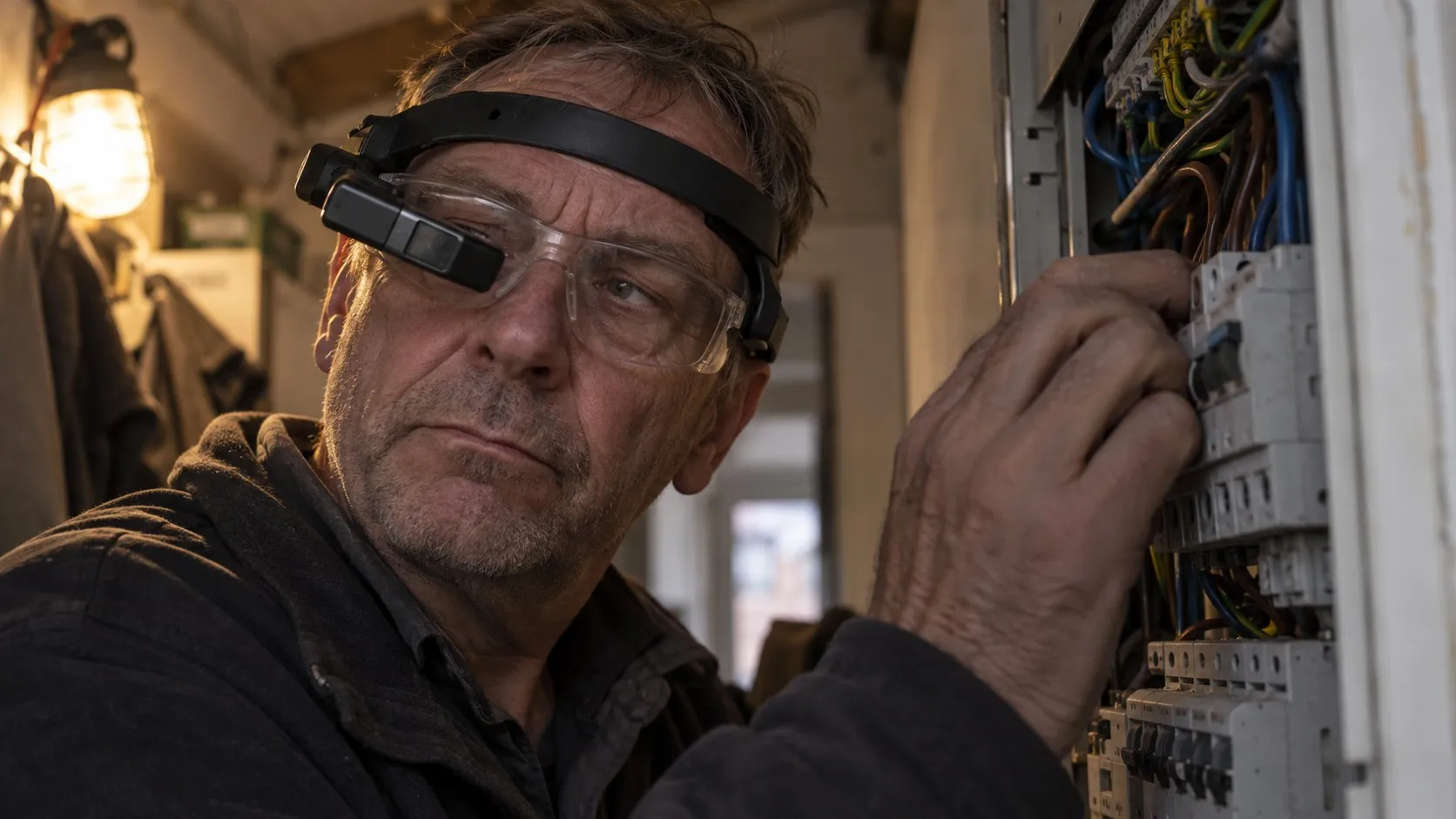
The standard moved recently, too. Since 11 November 2025, EN 166:2001 has been withdrawn from the UK designated standards list and EN ISO 16321-1 is the one that gives presumption of conformity for new certification. Certification bodies say kit already certified can be sold until its certificate expires, up to five years. If you are buying now, check which standard the certificate actually names.
“Full shift” is not a number
Almost nobody in this category publishes battery life in hours. They publish milliamp hours and the phrase “full shift”.
Take the Vuzix M400, which is the one people ask about most. Vuzix publishes no runtime for it at all. The power section of the official product sheet lists a 3,200 mAh external power bank and a 135 mAh on-board cell whose stated job is to bridge a battery swap. The two to three hours you will see quoted comes from resellers, not from Vuzix. Which is a fair engineering answer to a long shift, as long as you know that buying the glasses means buying the packs, and that somebody has to remember to charge them every night.
The real cost is the person doing the teaching
In UK construction, 26% of employer training spend is the wages of the people doing the training. That is the highest proportion of any sector, and it stands against 18% across the UK as a whole. It comes from the Employer Skills Survey 2024, fieldwork from June 2024 to January 2025, 22,712 interviews of which 5,935 completed the investment in training module.
Not the course fees, not the materials. The wages of the person who stopped earning in order to show somebody else.
That is the cost smart glasses are sold against. The pitch, stripped of the demo, is that a senior engineer can help from somewhere else instead of driving over, or that a recording made once saves the explanation they currently give over and over.
Which is a real problem worth solving. But notice what it means for your sums. If the value is in the senior’s time, the payback depends entirely on how much of that time you are currently spending, and almost nobody measures it. There is no published UK figure for the expert-to-apprentice ratio. Nobody has measured how many hours a senior loses to interruptions either, or how long a new starter takes to become productive on a given task. We looked. They do not exist.
So if a vendor shows you a payback calculation, ask which of those three numbers they used, and where they got it.
The device can die before the payback does
Google Glass Enterprise Edition 2 stopped selling on 15 March 2023 and lost support on 15 September 2023. No successor. RealWear’s HMT-1 is declared end of life and end of support by RealWear itself, reported in the trade press as September 2022, though RealWear’s own notice carries no date. PTC retired Vuforia Chalk, one of the better known remote assistance tools, on 31 October 2025.
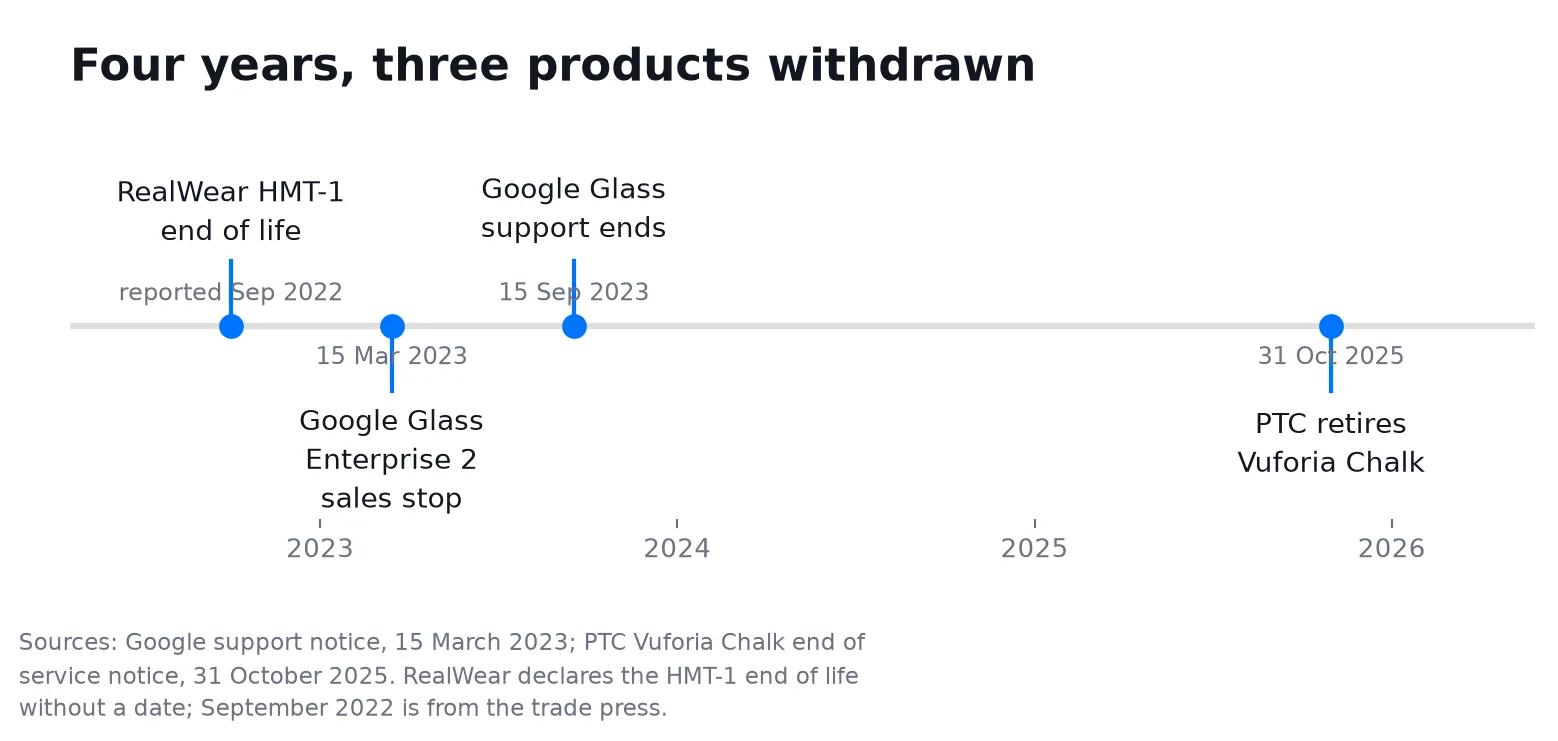
RealWear now says its current line is supported until at least 2029, and ships a new operating system generation roughly every three years. Vuzix has put out one or two new models a year since 2022. That is a healthy pace for a product category and an awkward one for a business buying eight units on a three year view.
None of that means the technology is going away. It means the specific box you buy might, and that belongs in the cost, next to the hardware and the licence.
What the evidence actually says
It works in some places, and yours is not obviously one of them.
The strongest independent result we found is a 2023 study of ten experienced metalworkers doing a turbine blade repair, which found 21% less time and 26% less perceived workload using AR against paper instructions. Ten people. A controlled task.
Set against that, a 2020 study of AR remote support, meaning a human expert guiding a newcomer through the headset, found it faster and with fewer errors on complex tasks, and found that paper instructions were still more efficient on simple ones. Worth holding onto, because that study supports a person helping remotely, not a device replacing the person.
And a 2023 study comparing AR, VR and video training found no difference in completion time or errors between AR and video. Video. The thing you already have on the phone in your pocket.
The published enterprise case studies are weaker than any of that, because they are not independent. AGCO’s own figures run from “over 30% less inspection time” to training “300% faster”, with no methodology published for any of them. Boeing has been reported three different ways depending on which article you read: 25%, 30%, and zero errors. The first-call-resolution numbers that circulate in field service come with no sample size, no definition and no publication behind them.
In construction specifically, a 2020 UK study whose authors also surveyed the sector put perceived AR adoption at 1.5 out of 5. The same paper states plainly that there is no hard evidence of these benefits in the construction industry, and that the success stories the sector quotes come from elsewhere.
There is no independent trial measuring first time fix with AR in UK plumbing, electrical or domestic heating work. None. It is a genuine hole in the literature, and anyone telling you otherwise is selling something.
Filming your own people has rules
If the glasses have a camera, and the industrial ones do, you are now recording your staff and your customers’ homes. The ICO has published guidance on exactly this and it is more specific than most people expect.
- Consent is usually the wrong basis. The ICO says consent is unlikely to be appropriate between employer and worker because of the power imbalance. Legitimate interests is the usual route, and it comes with conditions.
- A data protection impact assessment is required. The ICO says so directly on its body worn video page: the use of body worn video requires you to undertake one.
- Everyone caught by it has to know, including your customer and anyone else in the house. The ICO extends this to visitors and customers, not just staff.
- Audio is treated more strictly than video. The ICO’s guidance is that any capability to record audio should be switched off by default and used only in exceptional circumstances, and that continuous audio and video recording is unlikely to be justifiable in most circumstances.
None of that makes it impossible. It makes it paperwork, and the paperwork is a cost, and it lands on whoever in your business does the paperwork. The same duties reach the cameras screwed to your own walls, where the CCTV in the workplace rules add an annual fee and a sign to the list.
Eyes, and who actually does this work
A 2024 study followed 43 employees at two German companies over six months, in goods logistics and order picking, with eye examinations before and after shifts. Overall visual acuity differences were small and not significant. But workers over 40 had markedly higher odds of near vision deterioration, an odds ratio of 16, on a handful of affected individuals and with a very wide confidence interval. Treat it as a signal, not as a measurement. The common complaints were eye strain, stinging and rubbing.
Now put that next to who does this work. 24% of the UK construction workforce was over 55 in 2023, up from 13% in 2000.
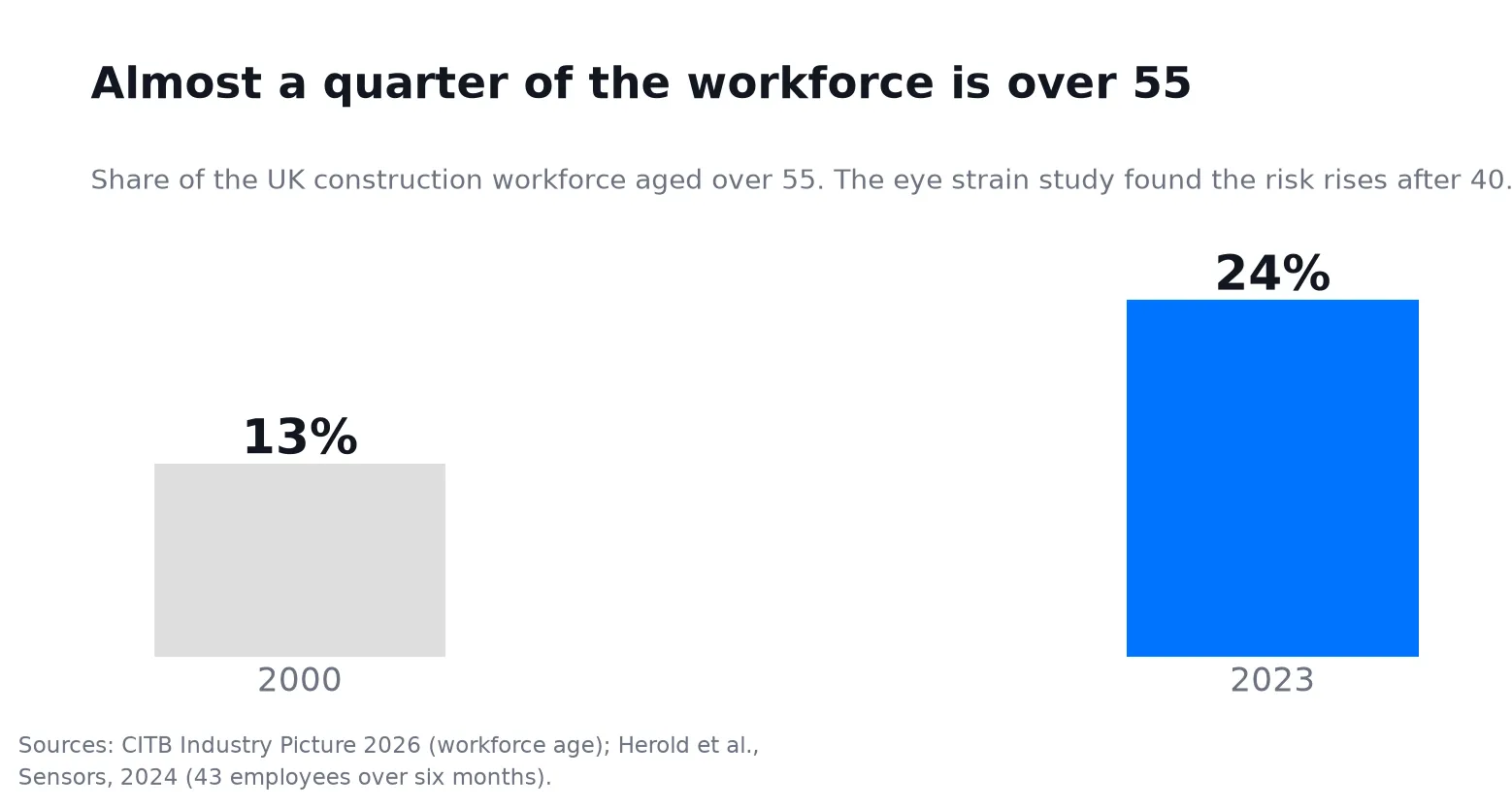
Nobody has run that study on a British site, over a full day, in plumbing or electrical work. The eye strain research that exists is from warehouses and utilities. So this is not a reason not to try it. It is a reason to ask your two most experienced people how their eyes feel after a week.
If you want to try it anyway, try it like this
You probably should try it, at some point. Resellers will quote you for a fleet. Start with one.
- Pick one job type, not the whole business. Something you do often, that goes wrong in the same way, and where the fix depends on somebody senior being there. If that job is on somebody else’s site, the principal contractor gets a say before you do: smart glasses for construction workers covers what the site will and will not let you do.
- Measure it first, for a month. How many second visits. How many phone calls to the senior. How many hours they lost to them. If you cannot measure it before, you cannot prove the glasses changed it after.
- Try the phone first. A video call and a decent torch costs nothing, and the study above found no measurable difference between AR and video for training. If the phone does not help, the glasses probably will not either, and you have saved a couple of grand finding out. The phone may also already do the job you are being sold the glasses for: what AI does in your trade goes through the ten, one by one.
- Buy one, not a fleet. Rent if you can. Ask the reseller about the return window and about what happens to the software licence when the model is discontinued.
- Ask the eye protection question in writing before you buy, and check the certificate number rather than the marketing page.
- Write the recording policy before the first shift, not after the first complaint.
That hour of the person who knows how to do the job costs the same whether they are standing next to the apprentice or watching through a camera on their face. Work out what it is worth to you first. Then go and look at the catalogue.

Trade resources for tradespeople, straight to your inbox.
Occasionally we will send you a newsletter. Free, unsubscribe in one click.
Keep reading
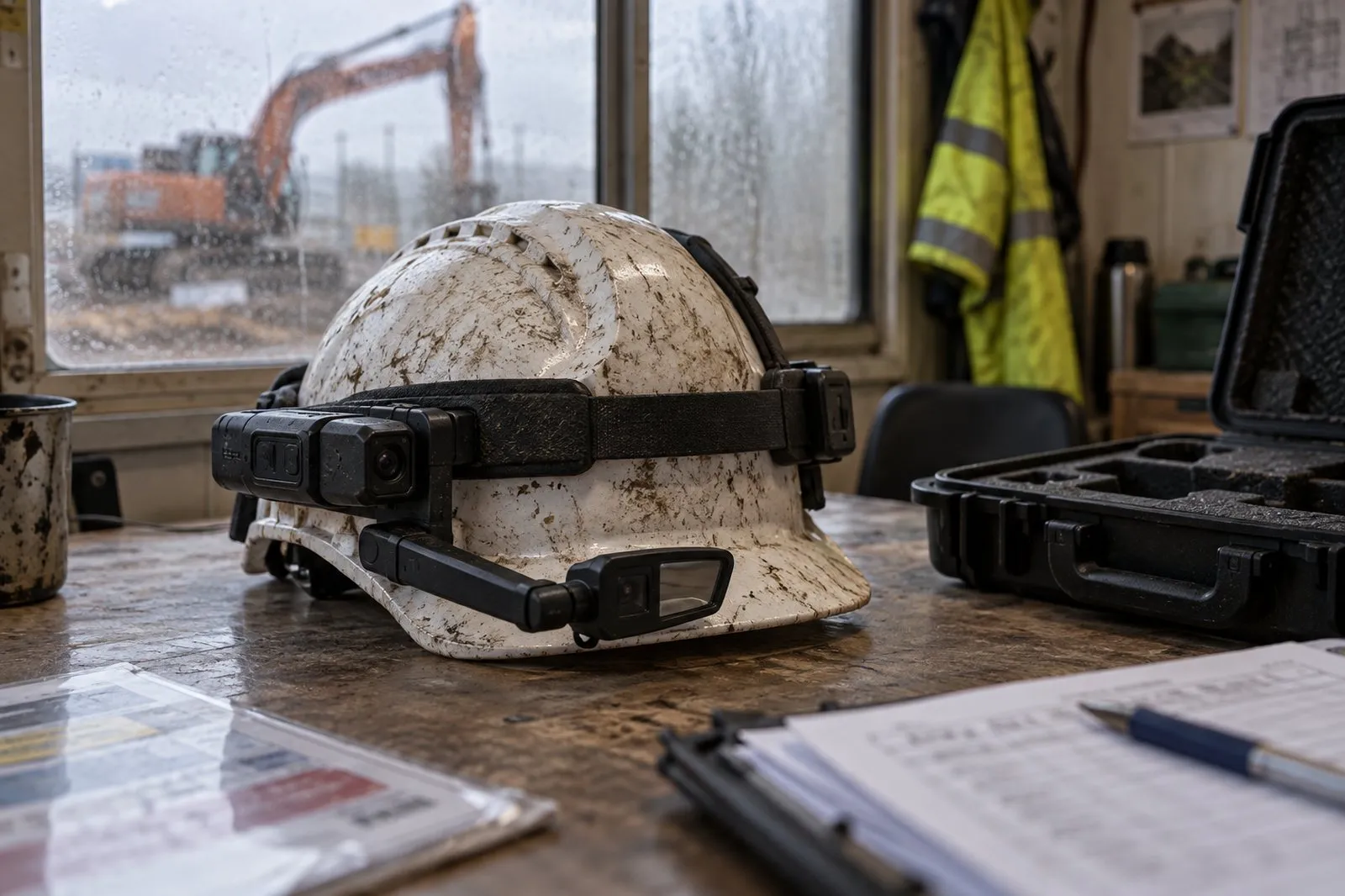
Smart glasses for construction workers: what UK sites allow, what the kit does and where it lets you down
When your people work on someone else's site, the principal contractor gets a say before the supplier does. The useful jobs are specific, and permission comes before the kit.
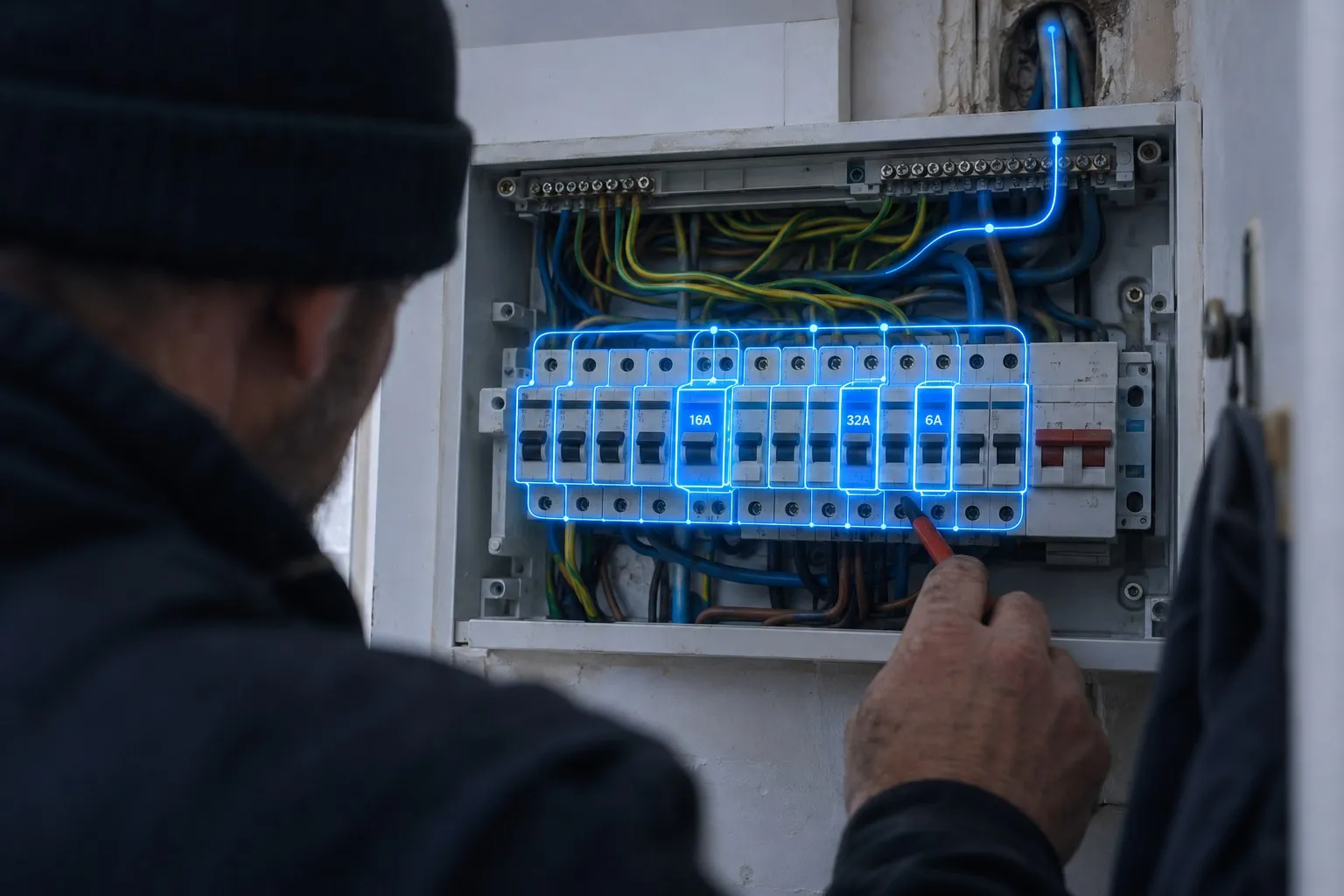
AI for tradesmen: a UK owner's guide, trade by trade
AI can turn a house scan into a heat pump design and help code sewer footage. Further down the trades, the offering gets thin. The price often tells you less than the allowance beside it.
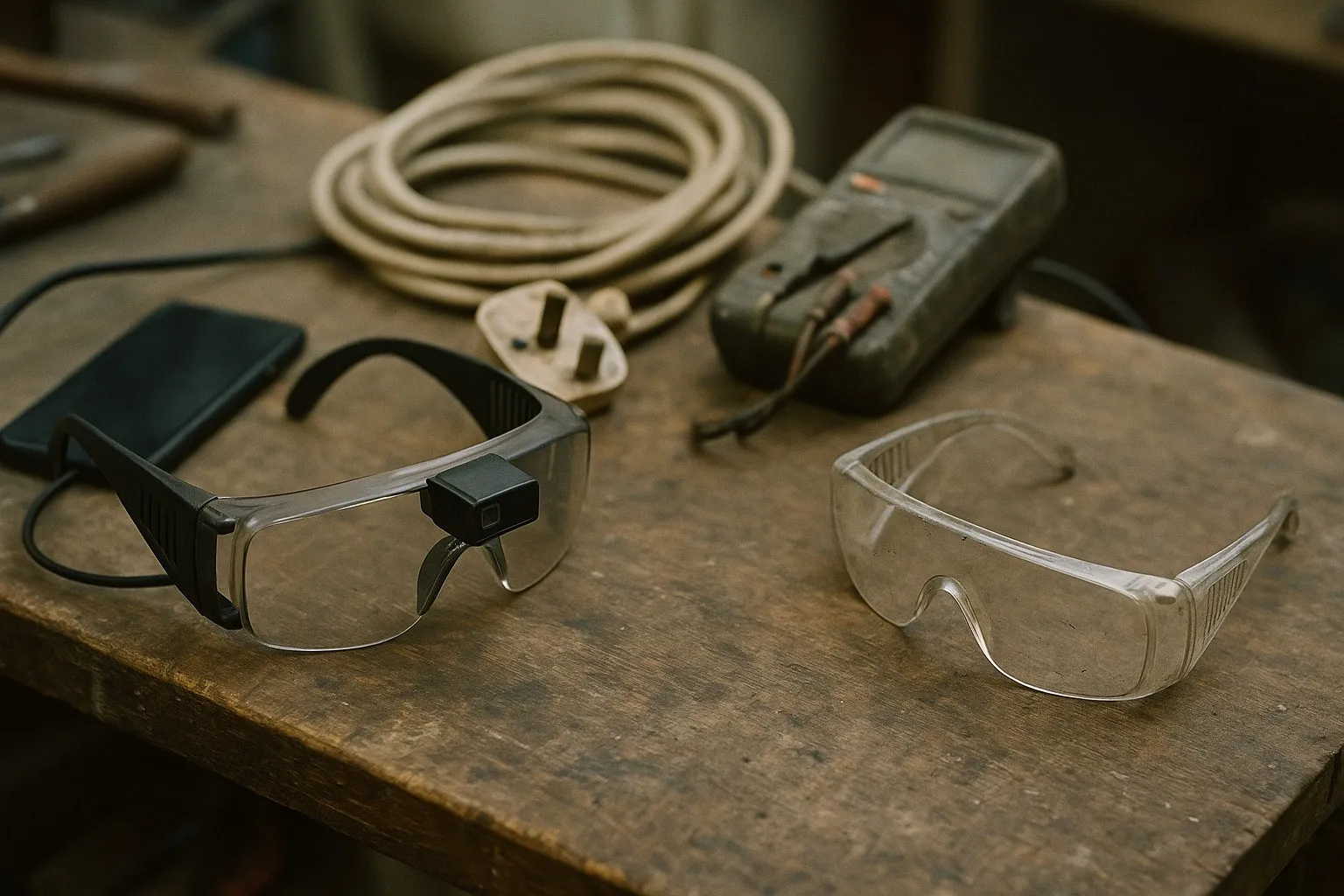
Safety glasses with camera: why your phone usually wins
You can buy glasses with a built-in camera. Whether they can replace your existing PPE is a separate question, and some manufacturers' own pages leave it open.